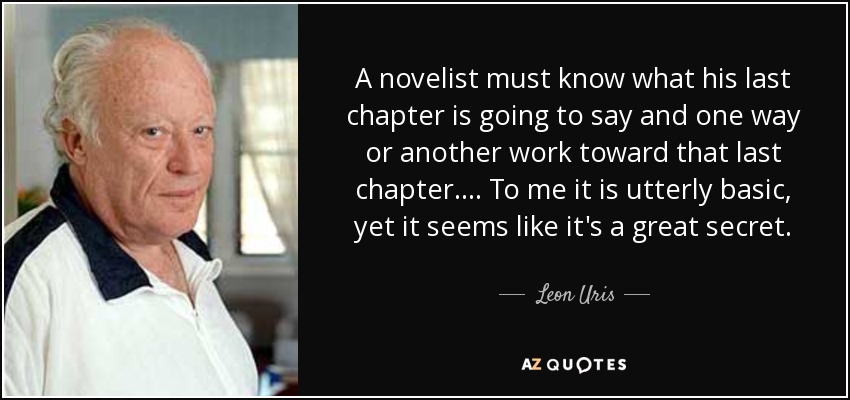
A novelist must know what his last chapter is going to say and one way or another work toward that last chapter. ... To me it is utterly basic, yet it seems like it's a great secret.
Some Pulitzer winners - novelists - have confided to me that getting the prize screwed them up. It messed with their heads. That hasn't been my experience.
The novelist has more and more to say to readers who have less and less time to read: where to find the energy to engage a culture in crisis when the crisis consists in the impossibility of engaging with the culture?
A movie will do in one second, with one image, what it will take a novelist at least a page to describe.
Writing a novel is a very hard thing to do because it covers so long a space of time, and if you get discouraged it is not a bad sign, but a good one. If you think you are not doing it well, you are thinking the way real novelists do. I never knew one who did not feel greatly discouraged at times, and some get desperate, and I have always found that to be a good symptom.
Two things a novelist can do with a hat: Talk through it or pull a rabbit from it.
We tend to overestimate what we can do in a short period, and underestimate what we can do over a long period, provided we work slowly and consistently. Anthony Trollope, the nineteenth-century writer who managed to be a prolific novelist while also revolutionizing the British postal system, observed, “A small daily task, if it be really daily, will beat the labours of a spasmodic Hercules.” Over the long run, the unglamorous habit of frequency fosters both productivity and creativity.
With a novelist's sense of drama and a historian's understanding of the social forces that shape our lives, Tom Gjelten has captured vividly -- through the chronicle of a powerful family's fortunes -- one of the great political dramas of our time.
Whether he be an original or a plagiarist, man is the novelist of himself.
But I have seen my obstacles: trivialities, learning and poetry. This last needs explaining: the old artist's readiness to dissolve characters into a haze. Characters cannot come alive and fight and guide the world unless the novelist wants them to remain characters.
The preoccupation of the novelist: how to capture the living moments, was answered by the diary. You write while you are alive. You do not preserve them in alcohol until the moment you are ready to write about them.
Sometimes I think some of my fellow novelists who have not worked in television and film are very naive about this process. They get an offer and there's the dump truck full of money and they sign it, they cash the check and then they're not involved in the series. They may get invited to the premiere and they come out of the premiere looking like all of their children had just been gassed, with a stunned look on their face because everything has been changed.
I'm a novelist who read a lot as a kid. When you grow up on books and then grow up to write books, famous authors are a lot more meaningful to you than TV and movie stars.
When it [truth] emerges it often bears out the saying that 'truth is stranger than fiction.' A novelist has to appear plausible, and would hesitate to make use of such astounding contradictions as occur in history through some extraordinary accident or twist of psychology .
There is a part of me in every character, naturally. That's why novelists rarely write good autobiographies. You start one and it becomes another novel.
The only excuse for a novelist, aside from the entertainment and vicarious living his books give the people who read them, is as a sort of second-class historian of the age he lives in. The "reality" he missed by writing about imaginary people, he gains by being able to build a reality more nearly out of his own factual experience than a plain historian or biographer can.
The business of a novelist is, in my opinion, to create characters first and foremost, and then to set them in the snarl of the human currents of his time, so that there results an accurate permanent record of a phase of history.
It may happen in the next hundred years that the English novelists of the present day will come to be valued as we now value the artists and craftsmen of the late eighteenth century.
I'm more influenced by novelists than I am by filmmakers.
Great novelists are philosopher novelists - that is, the contrary of thesis-writers.
I think novelists perform many useful tasks for their fellow citizens, but one of the most valuable is this: to enable us to see ourselves as others see us.
Age could not wither nor custom stale her infinite monotony: in fact, neither Age nor Custom could do anything (as they said, their voices rising) with the American novelist Gertrude Johnson.
How can we expect novelists to be moral, when their trade forces them to treat every end they meet as no more than an imperfect means to a novel?
Novelists are people who have discovered that they can dampen their neuroses by writing make-believe. We will keep on doing that no matter what, while offering loftier explanations.
Novelists should never allow themselves to weary of the study of real life.
Follow AzQuotes on Facebook, Twitter and Google+. Every day we present the best quotes! Improve yourself, find your inspiration, share with friends
or simply: