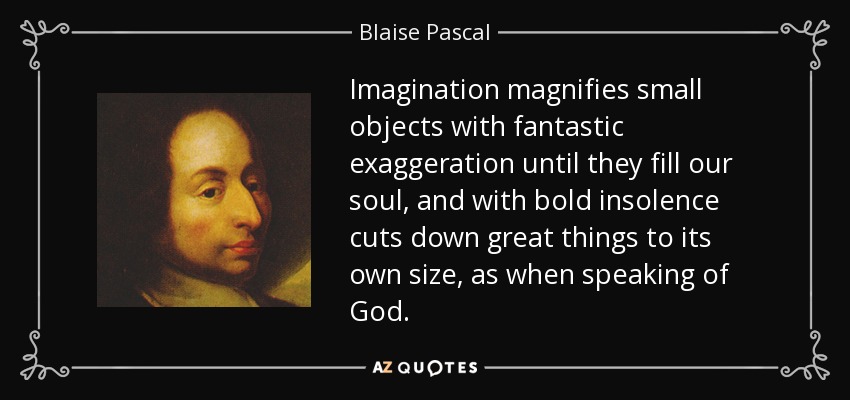
Imagination magnifies small objects with fantastic exaggeration until they fill our soul, and with bold insolence cuts down great things to its own size, as when speaking of God.
It isn't a matter of how long, or even how much you know. It's a way of looking at things, how much you see and how you think. I suppose it's, well, perspective. . . When you start seein' five sides to a four-sided object, that's when you get the gray robe.
In Tereza’s eyes, books were the emblems of a secret brotherhood. For she had but a single weapon against the world of crudity surrounding her: the novels. She had read any number of them, from Fielding to Thomas Mann. They not only offered the possibility of an imaginary escape from a life she found unsatisfying; they also had a meaning for her as physical objects: she loved to walk down the street with a book under her arm. It had the same significance for her as an elegant cane from the dandy a century ago. It differentiated her from others.
To be shown love is to feel ourselves the object of concern: our presence is noted, our name is registered, our views are listened to, our failings are treated with indulgence and our needs are ministered to. And under such care, we flourish.
Summer is a Latvian chicken. We make foolish choices. We think we’re young again. We run with outstretched arms toward an object of love and it pecks us and pecks us until we’re standing there snot-nosed and teary in the middle of Astor Place and the sun sets fire to our Penguin shirts and all that is left to do is go to our air-conditioned homes and ponder the cruelty of our finest season.
Where do vanished objects go?" "Into nonbeing, which is to say, everything," replied Professor McGonagall. "Nicely phrased," replied the eagle door knocker, and the door swung open.
It was a blessing and also a curse of handwritten letters that unlike email you couldn’t obsessively reread what you’d written after you’d sent it. You couldn’t attempt to un-send it. Once you’d sent it it was gone. It was an object that no longer belonged to you but belonged to your recipient to do with what he would. You tended to remember the feeling of what you’d said more than the words. You gave to object away and left yourself with the memory. That was what it was to give.
Grover started to sniffle and I figured if I didn't cheer him up he'd either start bawling or chewing up my mattress. He tends to eat household objects whenever he gets upset.
I think I am beginning to understand why grief feels like suspense. It comes from the frustration of so many impulses that had become habitual. Thought after thought feeling after feeling action after action had H. for their object. Now their target is gone. I keep on through habit fitting an harrow to the string then I remember and have to lay the bow down. So many roads lead through to H. I set out on one of them. But now there's an impassable frontier-post across it. So many roads once now so many culs de sac.
They did not submit to the obvious alternative, which was simply to close the eyes and fall. So easy, really. Go limp and tumble to the ground and let the muscles unwind and not speak and not budge until your buddies picked you up and lifted you into the chopper that would roar and dip its nose and carry you off to the world. A mere matter of falling, yet no one ever fell. It was not courage, exactly; the object was not valor. Rather, they were too frightened to be cowards.
At least we know we tend to be afraid. If you object to my plural noun, I'll retract it.
So many objects, so many memories. Each was being labelled and packed away in bags just as it was in her mind. To be stored in an area that would sometime be called upon to teach and help in future life.
Acquaintance: "A person whom we know well enough to borrow from, but not well enough to lend to. A degree of friendship called slight when its object is poor or obscure, and intimate when he is rich or famous.
For this quiet, unprepossessing, passive man who has no garden in front of his subsidised flat, books are like flowers. He loves to line them up on the shelf in multicoloured rows: he watches over each of them with an old-fashioned gardener's delight, holds them like fragile objects in his thin, bloodless hands.
Once someone appears to us primarily as an object, kindness has no place to root.
I wonder sometimes what the memory of God looks like. Is it a palace of infinite rooms, a chest of many jeweled objects, a long, lonely landscape where each tree recalls an eon, each pebble the life of a man? Where do I live, in the memory of God?
Sonnet XXV Before I loved you, love, nothing was my own: I wavered through the streets, among Objects: Nothing mattered or had a name: The world was made of air, which waited. I knew rooms full of ashes, Tunnels where the moon lived, Rough warehouses that growled 'get lost', Questions that insisted in the sand. Everything was empty, dead, mute, Fallen abandoned, and decayed: Inconceivably alien, it all Belonged to someone else - to no one: Till your beauty and your poverty Filled the autumn plentiful with gifts.
For pain words are lacking. There should be cries, cracks, fissures, whiteness passing over chintz covers, interference with the sense of time, of space ; the sense also of extreme fixity in passing objects ; and sounds very remote and then very close ; flesh being gashed and blood sparting, a joint suddenly twisted - beneath all of which appears something very important, yet remote, to be just held in solitude.” — Virginia Woolf, The Waves
The mind is a metaphor of the world of objects.
One must do violence to the object of one's desire; when it surrenders, the pleasure is greater.
She was incapable of love for any object not of her own choice and she resented anyone's demand for it.
The problem of reconciling human suffering with the existence of a God who loves, is only insoluble so long as we attach a trivial meaning to the word "love", and look on things as if man were the centre of them. Man is not the centre. God does not exist for the sake of man. Man does not exist for his own sake. "Thou hast created all things, and for thy pleasure they are and were created." We were made not primarily that we may love God (though we were made for that too) but that God may love us, that we may become objects in which the divine love may rest "well pleased".
God has no needs. Human love, as Plato teaches us, is the child of Poverty – of want or lack; it is caused by a real or supposed goal in its beloved which the lover needs and desires. But God's love, far from being caused by goodness in the object, causes all the goodness which the object has, loving it first into existence, and then into real, though derivative, lovability. God is Goodness. He can give good, but cannot need or get it. In that sense , His love is, as it were, bottomlessly selfless by very definition; it has everything to give, and nothing to receive.
We are afraid that Heaven is a bribe, and that if we make it our goal we shall no longer be disinterested. It is not so. Heaven offers nothing that the mercenary soul can desire. It is safe to tell the pure in heart that they shall see God, for only the pure in heart want to. There are rewards that do not sully motives. A man's love for a woman is not mercenary because he wants to marry her, nor his love for poetry mercenary because he wants to read it, nor his love of exercise less disinterested because he wants to run and leap and walk. Love, by definition, seeks to enjoy its object.
What distinguishes - in both senses of that word - contemplation is rather this: it is a knowing which is inspired by love. "Without love there would be no contemplation." Contemplation is a loving attainment of awareness. It is intuition of the beloved object.
Follow AzQuotes on Facebook, Twitter and Google+. Every day we present the best quotes! Improve yourself, find your inspiration, share with friends
or simply: