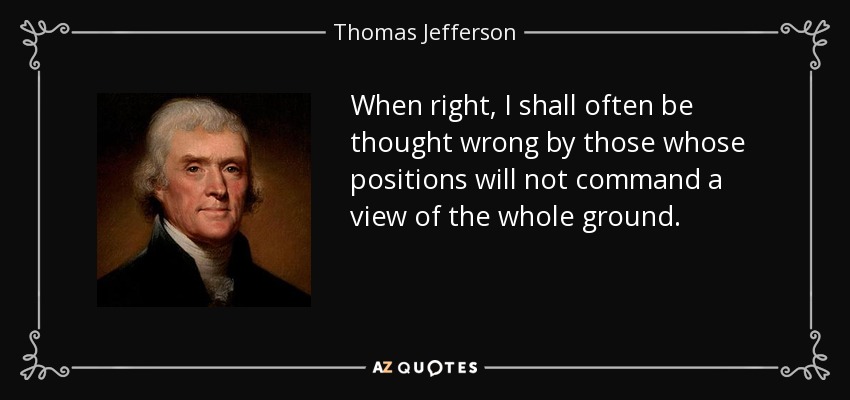
When right, I shall often be thought wrong by those whose positions will not command a view of the whole ground.
How often is immense sadness mistaken for courage?
I reject karma and rebirth not only because I find them unintelligible, but because I believe they obscure and distort what the Buddha was trying to say. Rather than offering the balm of consolation, the Buddha encouraged us to peer deep and unflinchingly into the heart of the bewildering and painful experience that life can so often be.
We all press buttons in relationships, in our dealings with people, without thinking what it really means. We all knock along without questioning what kind of situation we're in. We may often be in a very good one, but we don't even appreciate the good situations. We're lazy. Or we're scared. Or we just don't notice.
When your house contains such a complex of piping, flues, ducts, wires, lights, inlets, outlets, ovens, sinks, refuse disposers, hi-fi re-verberators, antennae, conduits, freezers, heaters -when it contains so many services that the hardware could stand up by itself without any assistance from the house, why have a house hold it up. When the cost of all this tackle is half of the total outlay (or more, as it often is) what is the house doing except concealing your mechanical pudenda from the stares of folks on the sidewalk?
Much of what we call evil is due entirely to the way men take the phenomenon. It can so often be converted into a bracing and tonic good by a simple change of the sufferer's inner attitude from one of fear to one of fight; its string can so often depart and turn into a relish when, after vainly seeking to shun it, we agree to face about and bear it.
We all know how important love is, yet how often is it really emoted or exhibited? What so many sick people in this world suffer from-loneliness, boredom and fear-can't be cured with a pill.
I didn't really had a good answer, as so often -- is me. But then somebody sent me the other day, Isaiah 49:16, and you need to go home and look it up. Before you look it up, I'll tell you what it says though. It says, hey, if it was good enough for God, scribbling on the palm of his hand, it's good enough for me, for us. He says, in that passage, 'I wrote your name on the palm of my hand to remember you,' and I'm like, 'Okay, I'm in good company.'
Who does not delight in oratory? How we gather to hear even an ordinary speaker! How often is a jury swayed and controlled by the appeals of counsel!
Indeed, it is that ambiguity and ambivalence which often is so puzzling in women--the quality of shifting from child to woman, theseeming helplessness one moment and the utter self-reliance the next that baffle us, that seem most difficult to understand. These are the qualities that make her a mystery, the qualities that provoked Freud to complain, "What does a woman want?
Old age likes to dwell in the recollections of the past, and, mistaking, the speedy march of years, often is inclined to take the prudence of the winter time for a fat wisdom of, midsummer days. Manhood is bent to the passing cares of the passing moment, and holds so closely to his eyes the sheet of, "to-day," that it screens the "to-morrow" from his sight.
In the literary as well as military world, most powerful abilities will often be found concealed under a rustic garb.
The angels must often be astonished at us and think we are the strangest creatures that well can be, yet they love us, and therefore they take a great interest in that Gospel that promotes our highest good.
. . . the membership relation for sets can often be replaced by the composition operation for functions. This leads to an alternative foundation for Mathematics upon categories -- specifically, on the category of all functions. Now much of Mathematics is dynamic, in that it deals with morphisms of an object into another object of the same kind. Such morphisms (like functions) form categories, and so the approach via categories fits well with the objective of organizing and understanding Mathematics. That, in truth, should be the goal of a proper philosophy of Mathematics.
Examples ... which might be multiplied ad libitum, show how difficult it often is for an experimenter to interpret his results without the aid of mathematics.
Obstacles are not opposing you, but merely and gently re-routing you. It is important not to view that which stands in your way as your 'enemy.' It can often be your best friend, sending you on a detour that takes you around what would have been your biggest stumbling block.
Fight sequence to me isn't just about the athleticism. It so often is about what the emotion that is behind it and how willing you are to really, really challenge that emotion or really take that emotion to that place so you're feeling a certain intensity for the whole time when you're shooting the actual physical scenes.
I think that cynicism can often be mistaken for wisdom.
The extreme self-sacrifice characteristic of group-selected species such as ants and bees can often be found among soldiers.
And as particles are living digital elements, moving on their own according to the various attributes (such as weight, speed, shape) given to them by the animator, we don't know what the visual result will be until everything is completed. This result can often be unsatisfying, obliging us to repeat the process all over again, with new features.
To the unmusical hearer a note on the gong means dinner, this perhaps often is menacing enough.
If somebody responds positively to what I'm doing - if there is a connection - that can be very meaningful. If someone reacts with displeasure, confusion, hostility, well, that is not pleasant, and can often be upsetting.
Most people would rather change their circumstances to improve their lives when instead they need to change themselves to improve their circumstances. They put in just enough effort to distance themselves from their problems without ever trying to go after the root, which can often be found in themselves. Because they don't try to change the source of their problems, their problems keep coming back at them.
I shall often go wrong through defect of judgment. When right, I shall often be thought wrong by those whose positions will not command a view of the whole ground. I ask your indulgence for my own errors, which will never be intentional, and your support against the errors of others, who may condemn what they would not if seen in all its parts.
I too have been in the underworld, as was Odysseus, and I will often be there again; not only sheep have I sacrificed so as to beable to speak with a few dead souls, but neither have I spared my own blood as well.
Follow AzQuotes on Facebook, Twitter and Google+. Every day we present the best quotes! Improve yourself, find your inspiration, share with friends
or simply: