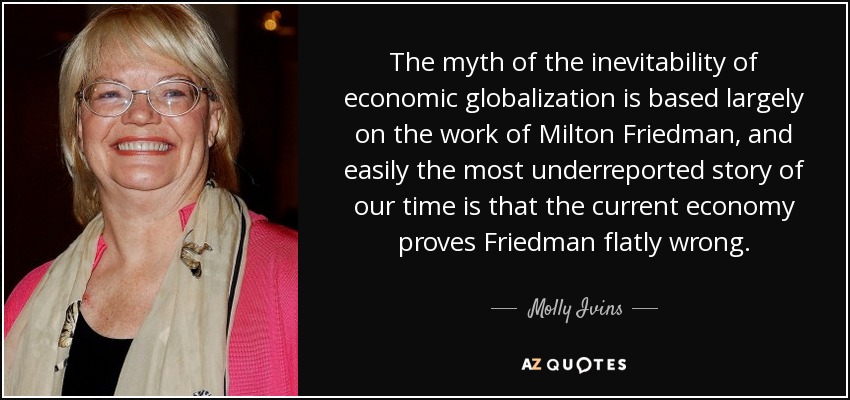
The myth of the inevitability of economic globalization is based largely on the work of Milton Friedman, and easily the most underreported story of our time is that the current economy proves Friedman flatly wrong.
Our struggle to put first things first can be characterized by the contrast between two powerful tools that direct us: the clock and the compass. The clock represents our commitments, appointments, schedules, goals, activities - what we do with, and how we manage our time. The compass represents our vision, values, principles, mission, conscience, direction - what we feel is important and how we lead our lives. In an effort to close the gap between the clock and the compass in our lives, many of us turn to the field of "time management."
Do not listen to those who say there is nothing you can do to the very real and large social and environmental issues of our time.
Nothing is more needed among preachers today than that we should have the courage to shake ourselves free from the thousand and one trivialities in which we are asked to waste our time and strength, and resolutely return to the apostolic ideal which made necessary the office of the diaconate. We must resolve that we will continue stedfastly in prayer, and in the ministry of the Word.
Despite our significant public-policy differences, I commend Jim Wallis for advocating religious belief as an invaluable resource in addressing the urgent moral and social crises of our time.
The tragedy of our time is that we've got it backwards, we've learned to love techniques and use people.
The cultural transformation from the love of power to the power of love is the drama of our time.
Love is a four-letter word, but you don't hear in nearly as often as you hear some other four-letter words. It may be a sign of our times that everyone talks openly about sex, but we seem to be embarrassed to talk about love.
Sweet springtime is my time is your time is our time for springtime is love time and viva sweet love.
There is no rush. If we think intelligently about what we can achieve with our time, we can be relaxed, even lazy. In fact, being lazy - having plenty of time to think - may actually be a precondition for achieving a great deal.
Many spend their time berating practitioners for not applying their method. We all need to disseminate our ideas, but most of our time should be spent applying and improving our methods, not selling them. The best way to sell a mouse trap is to display some trapped mice.
There is no shortage of time. In fact, we are positively awash with it. We only make good use of 20 per cent of our time.... The 80/20 principle says that if we doubled our time on the top 20% of activities, we could work a two-day week and achieve 60 per cent more than now.
Time is the one thing we possess. Our success depends upon the use of our time, and its by-product, the odd moment.
Our current use of time is not rational. There is therefore no point in seeking marginal improvements in how we spend our time. We need to go back to the drawing board and overturn all our assumptions about time.
Our time on this earth is sacred, and we should celebrate every moment. The importance of this has been completely forgotten: even religious holidays have been transformed into opportunities to go to the beach or the park or skiing. There are no more rituals. Ordinary actions can no longer be transformed into manifestations of the sacred. We cook and complain that it's a waste of time, when we should be pouring our love into making that food. We work and believe it's a divine curse, when we should be using our skills to bring pleasure and to spread the energy of the Mother.
We lose our time because we lose our attention
Talent warms-up the given (as they say in cookery) and makes it apparent; genius brings something new. But our time lets talent pass for genius. They want to abolish the genius, deify the genius, and let talent forge ahead.
We can't dwell upon another's ingratitude without using up our time and talents unprofitably.
They who know how to employ opportunities will often find that they can create them; and what we can achieve depends less on the amount of time we possess than on the use we make of our time.
The atmosphere of our time is fast being cleared of the fumes and deadly gases that arose during the carboniferous age of theology.
It is a paradox that in our time of drastic rapid change, when the future is in our midst devouring the present before our eyes, we have never been less certain about what is ahead of us.
But the point is, now, at this moment, or any moment, we're only cross-sections of our real selves. What we really are is the whole stretch of ourselves, all our time, and when we come to the end of this life, all those selves, all our time, will be us - the real you, the real me. And then perhaps we'll find ourselves in another time, which is only another kind of dream.
The person senses what it feels like to be free from inhibitions. At the same time he feels connected and integrated – with his body and, through his body, with his environment. He has a sense of well-being and inner peace. He gains the knowledge that the life of the body resides in its involuntary aspect. […] Unfortunately these beautiful feelings do not always hold up under the stress of daily living in our modern culture. The pace, the pressure and the philosophy of our times are antithetical to life.
If we spend all our time gazing at the wonders ahead without remembering where we're standing right now, we're going to trip and fall flat on our face, over and over again.
Life is meaningless only if we allow it to be. Each of us has the power to give life meaning, to make our time and our bodies and our words into instruments of love and hope.
Follow AzQuotes on Facebook, Twitter and Google+. Every day we present the best quotes! Improve yourself, find your inspiration, share with friends
or simply: