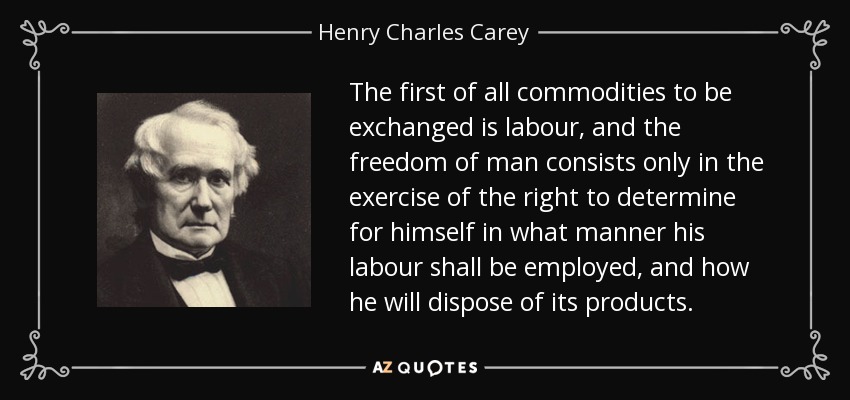
The first of all commodities to be exchanged is labour, and the freedom of man consists only in the exercise of the right to determine for himself in what manner his labour shall be employed, and how he will dispose of its products.
The first issue to be settled is whether socialism has a right to exist. Are its allegations concerning the present system true? Is industry proceeding on a principle of fraud? I wish to test the power of recent economic theory to give an exact answer to this question.
Capitalism is the exploitation of man by man. Well socialism is exactly the reverse.
The intellectual's hostility to the businessman presents no mystery, as the two have, by function, wholly different standards. While the businessman's motto is the customer is always right, the intellectual's task is to preserve his perceived standards against the weight of popular opinion.
It is therefore wish'd that all commerce were as free between all the nations of the world as it is between the several counties of England.
Poorly paid labor is inefficient labor, the world over.
Protectionism will do little to create jobs and if foreigners retaliate, we will surely lose jobs.
Socialism has never and nowhere been at first a working-class movement. It is by no means an obvious remedy for the obvious evil which the interests of that class will necessarily demand. It is a construction of theorists.
Everything we get, outside of the free gifts of nature, must in some way be paid for. The world is full of so- called economists who in turn are full of schemes for getting something for nothing. They tell us that the government can spend and spend without taxing at all; that it can continue to pile up debt without ever paying it off, because "we owe it to ourselves."
There is no more certain way to deter employment than to harass and penalize employers.
It is often sadly remarked that the bad economists present their errors to the public better than the good economists present their truths. It is often complained that demagogues can be more plausible in putting forward economic nonsense from the platform than the honest men who try to show what is wrong with it.
On Positive Liberty: The business of the State is to use its organizing powers for the purpose of furnishing the necessary conditions which allow this people freely to unfold its creative faculties.
Gold is a relic from a time when government's were less trustworthy in these matters (currency debasement) than they are now.
I expect to see the State, which is in a position to calculate the marginal efficiency of capital-goods on long views and on the basis of the general social advantage, taking an ever greater responsibility for directly organizing investments.
Goods move in response to price differences from points of low to points of higher price, the movement tending to obliterate the price difference and come to rest.
There is no sense in making statements that will not continue to be true after they are made.
Raising the minimum wage and lowering the barriers to union organization would carry a trade-off - higher unemployment. A better idea is to have the government subsidize low-wage employment. The earned-income tax credit for low-income workers - which has been the object of proposed cuts by both President Clinton and congressional Republicans - has been a positive step in this direction.
I've always believed that a speculative bubble need not lead to a recession, as long as interest rates are cut quickly enough to stimulate alternative investments. But I had to face the fact that speculative bubbles usually are followed by recessions. My excuse has been that this was because the policy makers moved too slowly - that central banks were typically too slow to cut interest rates in the face of a burst bubble, giving the downturn time to build up a lot of momentum.
Governments do not necessarily act in the national interest, especially when making detailed microeconomic interventions. Instead, they are influenced by interest group pressures. The kinds of interventions that new trade theory suggests can raise national income will typically raise the welfare of small, fortunate groups by large amounts, while imposing costs on larger, more diffuse groups.
It should be possible to emphasize to students that the level of employment is a macroeconomic issue, depending in the short run on aggregate demand and depending in the long run on the natural rate of unemployment, with microeconomic policies like tariffs having little net effect. Trade policy should be debated in terms of its impact on efficiency, not in terms of phoney numbers about jobs created or lost.
The bureaucracy is a circle from which no one can escape. Its hierarchy is a hierarchy of knowledge.
The aim of the popularization of economic studies is not to make every man an economist. The idea is to equip the citizen for his civic functions in community life.
German Marxian's coined the dictum: If socialism is against human nature, then human nature must be changed.
Used to the conditions of a capitalistic environment, the average American takes it for granted that every year business makes something new and better accessible to him. Looking backward upon the years of his own life, he realizes that many implements that were totally unknown in the days of his youth and many others which at that time could be enjoyed only by a small minority are now standard equipment of almost every household.
What does a tax do? It takes either from the producer or the consumer a more or less sizable portion of the product destined in part to consumption and in part to savings, in order to apply it to less productive or even destructive ends, and more rarely to savings.
Follow AzQuotes on Facebook, Twitter and Google+. Every day we present the best quotes! Improve yourself, find your inspiration, share with friends
or simply: