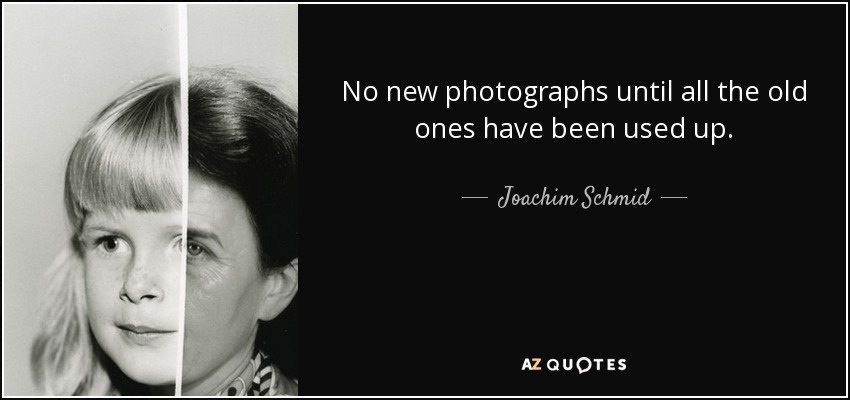
No new photographs until all the old ones have been used up.
I'm not modest about myself. I know for a fact that I am good. But good in the sense that I can put things together. I expound vociferously to students of architecture and photography, the significance of design. A photograph is a design in which you assemble thoughts in your mind.
Photography has always been capable of manipulation. Even more subtle and more invidious is the fact that any time you put a frame to the world, it's an interpretation. I could get my camera and point it at two people and not point it at the homeless third person to the right of the frame, or not include the murder that's going on to the left of the frame. You take 35 degrees out of 360 degrees and call it a photo. There's an infinite number of ways you can do this: photographs have always been authored.
Some of the people who are now manipulating photos, such as Andreas Gursky, make the argument - rightly - that the 'straight' photographs of the 1940s and 50s were no such thing. Ansell Adams would slap a red filter on his lens, then spend three days burning and dodging in the dark room, making his prints. That's a manipulation. Even the photographs of Henri Cartier-Bresson, with all due respect to him, are notoriously burned and dodged.
I'm very much against photographs being framed and treated with reverence and signed and sold as works of art. They aren't. They should be seen in a magazine or a book and then be used to wrap up the fish and chucked away.
I started to concentrate more upon how the viewer looks at photographs... I would insert my own text or my own specific reading of the image to give the viewer something they might not interpret or surmise, due to their educated way of looking at images, and reading them for their emotional, psychological, and/or sociological values. So I would start to interject these things that the photograph would not speak of and that I felt needed to be revealed, but that couldn't be revealed from just looking at an image.
I think all photographs lie. They capture such a small amount of a person's personality, if they capture anything.
I think I'm really fortunate to be an installation artist who is heavily invested in photography: I don't have the emotional problems with the loss of work that some installation artists have. The photographs wouldn't exist without the installation... but at the same time, I think I'd kill myself if I only did installations. There's something deeply tragic about doing work that you know is temporal.
To extend the depth of what has been called 'art' into photography requires... making available to the spectator the amazing transformations the subject undergoes to become the photograph.
I believe that photographs should be simple technically, and easy to look at. They shouldn't be directed at other photographers; their point is to make ordinary people react - to laugh, or to see something they hadn't taken in before, or to be touched. But not to wince, I think.
I'm not a great one for chatting people up, because it's phony. I don't want people to feel at ease. You want a bit of edge. There are quite long, agonized silences. I love it. Something strange might happen. I mean, taking photographs is a very nasty thing to do. It's very cruel.
My urge to photograph is activated by an almost biological instinct for preservation from disorder. The camera is a mechanical apparatus that extends my natural ability and desire for meaningful organization. I need it to survive.
In a world where the 2 billionth photograph has been uploaded to Flickr, which looks like an Eggleston picture! How do you deal with making photographs with the tens of thousands of photographs being uploaded to Facebook every second, how do you manage that? How do you contribute to that? What's the point?
I'm interested in photographs that have no personal signature.
A photograph permits a first viewing, and then an individual reflection. It solicits participation, and encourages individuality in interpretation. Television is an autarchy, a dictatorship.
For me, making a photograph is mostly an intellectual process of understanding people or cities and their historical and phenomenological connections. At that point the photo is almost made, and all that remains is the mechanical process.
[When] I am taking a photograph, I am conscious that I am constructing images rather than taking snapshots. Since I do not take rapid photographs it is in this respect like a painting which takes a long time where you are very aware of what you are doing in the process. Exposure is only the final act of making the image as a photograph.
The person who looks at a photograph as a complete picture, unable to say anything about anything except the facts which existed at the moment of exposure, does not see very far.
The relationship I have with my mother now, and photographing her in front of the grave, it opens up discussions, and dealings with the conversations with my mother about, when I was little, how we lived and about suicide and talking about it, so it's something positive, it brought us more together, because people might never discuss that. Some families never go near certain subjects because it's too hurtful or too close or too dangerous. But within doing these photographs, I also wanted to open up a conversation with her about certain things about life.
The true authenticity of photographs for me is that they usually manipulate and lie about what is in front of the camera, but never lie about the intentions behind the camera.
A single photograph is a mere fragment of an experience and, simultaneously, the distillation of the entire body of one's experience.
Like a ventriloquist who laughs at his dummy's jokes, I keep trying to make photographs that seduce me into believing in the image - all the time knowing better, but believing anyway.
I often had to pass over photographs because in a mass of animals invariably one would be wandering in the wrong direction, thereby disrupting the pattern I was trying to achieve. Today the ability to digitally alter this disruption is at hand.
For me, what was important was to record everything I saw around me, and to do this as methodically as possible. In these circumstances a good photograph is a picture that comes as close as possible to reality. But the camera never manages to record what your eyes see, or what you feel at the moment. The camera always creates a new reality.
When I began taking photographs I thought they might work better in magazines, in a journalistic sense, rather than as art.
Follow AzQuotes on Facebook, Twitter and Google+. Every day we present the best quotes! Improve yourself, find your inspiration, share with friends
or simply: