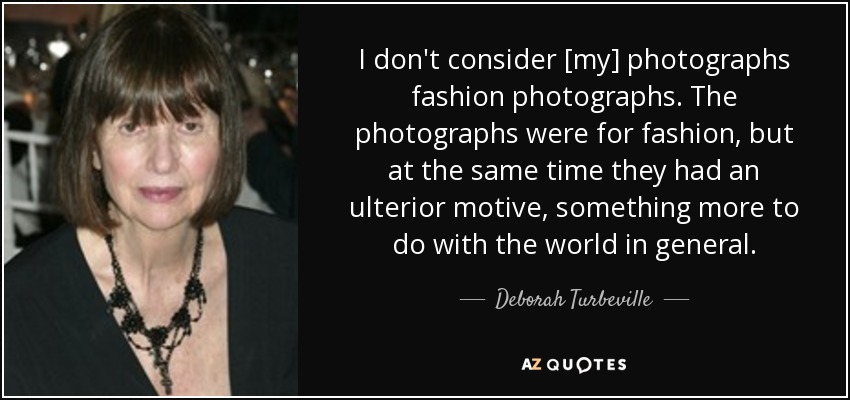
I don't consider [my] photographs fashion photographs. The photographs were for fashion, but at the same time they had an ulterior motive, something more to do with the world in general.
When I began taking photographs I thought they might work better in magazines, in a journalistic sense, rather than as art.
The viewer is yet another eye that is part of the compact that makes a photograph what it is.
It's not that I don't care about content, but content is not the only way a photograph has meaning.
I really feel lovely when I get up with my sweetheart. When I depart a photograph shoot, as a result of someway miracles have been labored.
The aesthetic discussion of photography is dominated by the concept of time. Photographs appear as devices stopping time and preserving fragments of the past, like flies in amber.
If you've ever had to recall your past in some way and you open a drawer of old photographs that your parents kept, there are always pictures of you smiling and charming, and then a bunch of people you don't know who they are. Could be aunts, uncles, could be the postman for all you know. Who are these people? Your parents are never in the picture, because they are the ones taking them. So you've got these unrelated images that are disconnected from your memories.
A photographer who does not know how to translate his feelings and ideas into a graphically satisfactory form is bound to produce ineffective photographs, no matter how idealistic, compassionate, sensitive or imaginative he may be. For in order to be considered good, a photograph must not only say something worthwhile, it must say it well.
For me, what was important was to record everything I saw around me, and to do this as methodically as possible. In these circumstances a good photograph is a picture that comes as close as possible to reality. But the camera never manages to record what your eyes see, or what you feel at the moment. The camera always creates a new reality.
"Study Bible" is the expression used for Bibles that include significant explanatory notes, usually at the bottom of the page, sometimes in the margins. Often a Study Bible will also include some brief articles, photographs of geographical and archaeological sites, fairly extensive maps, and charts that summarize a lot of information.
Exile is a series of photographs without texts.
In a place like Afghanistan where the society is completely segregated, women have access to women. Men cannot always photograph women and cannot get the access that I get.
But huge photographs of dead bodies are slightly different. I couldn't find much humor there.
Ideas for songs can come from something as simple as a photograph and letting my imagination run wild on an old photograph that I found, or to a film that I have seen or to just most of the time, just daily walking through life and keeping your eyes open.
Poetry is like a portrait of a moment or person, and the poem is almost like looking at a photograph; it slaps you in the face and kisses you at the same time. Nothing else does that, with that brevity. Songs try to do it, but that's three minutes. A poem, you read it and it kind of changes your life and you don't know how it happened and you can never forget it. It's like the best song lyric, the best line from a film-everything in the world that's short and great put together.
The more story-appeal there is in the picture or in the photograph, the more people would look at your ad
Great claims are being made for the photograph as truth. We are showing you things, we show you the war. I say you can't actually. The camera can't.
I love the Dutch impressionists - Vermeer, Rembrandt. What they were able to do with light was astonishing. As for photographers, I think mostly of the Hungarians: Robert Capa, Laszlo Moholy-Nagy, Jozsef Pesci. In fact, I have one of his photographs hanging in my house.
Often, I'm spending months with a person in a very intimate context, getting to know the ins and outs of what they ate for breakfast, not to mention dredging up the most traumatic experiences of their lives, digging through their documents and photographs from difficult times, all of that. And that process, I think, can be extraordinarily strange for subjects who've never been interviewed before, especially if you don't acquaint them from the get-go with what you're trying to do, what it entails, and why you care.
I started out, in the mid-'70s, taking photographs of rock bands that I liked but not because I really wanted to photograph them. Initially, I was pretending to be a photographer, simply so that I could go up to the front of the crowd and be a bit closer to the bands. But, I found I was gradually developing an interest in the photos I took.
The decisive moment, the popular Henri Cartier-Bresson approach to photography in which a scene is stopped and depicted at a certain point of high visual drama, is now possible to achieve at any time. One's photographs, years later, may be retroactively rephotographed by repositioning the photographer or the subject of the photograph, or by adding elements that were never there before but now are made to exist concurrently in a newly elastic sense of space and time.
I always look at my favourite photographs or favourite movies by James Bidgood or Sofia Coppola before I write my songs - they put me in the right frame of mind.
Authenticity is too big a subject to just toss in with the question about the photographs!
I did a lot of reading of first person accounts from Koreans and combatants and aid workers. And I spoke to relatives. A lot of wonderful photographs were made available to me from that period - 1950-1956 - and those were given to me by a Korean newspaper in Seoul. Ruined villages, refugees streaming through a river valley, GI's and orphans and orphanages, those tiny details that you can only see in a picture.
My mother photographed Donald Judd in Marfa, Texas, right before he passed away. He was actually the first artist whose work I collected. I just loved the photographs that my mom had done of Donald Judd and the installations in Marfa.
Follow AzQuotes on Facebook, Twitter and Google+. Every day we present the best quotes! Improve yourself, find your inspiration, share with friends
or simply: