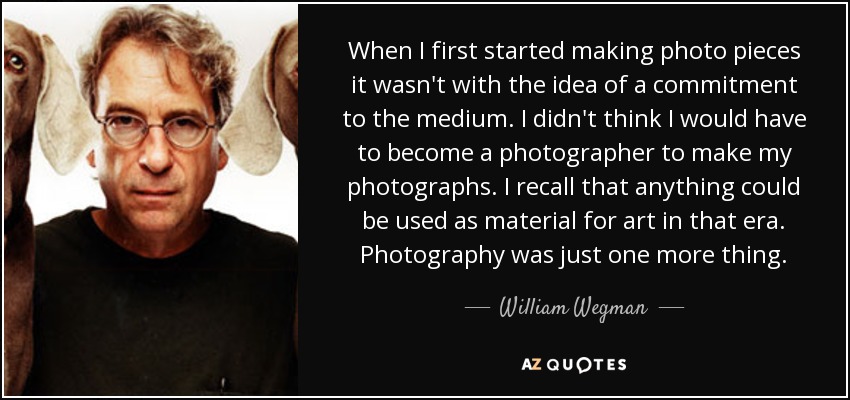
When I first started making photo pieces it wasn't with the idea of a commitment to the medium. I didn't think I would have to become a photographer to make my photographs. I recall that anything could be used as material for art in that era. Photography was just one more thing.
Photography isolates the world via an aperture and gives the photographer the means to see differently, to achieve a spontaneous vision that is direct and uncompromising.
It has been important to me, as an historian of photography, to understand photography by photographing.
Over the years, photography has been to me what a journal is to a writer - a record of things seen and experienced, moments in the flow of time, documents of significance to me, experiments in seeing.
When photography was invented, people had to make room in their minds for the idea that the dead would always be visible.
Photography is nature seen from the eyes outward, painting from the eyes inward. Photography records inalterably the single image, while painting records a plurality of images willfully directed by the artist.
We used the camera only as a means of expression and as a visual medium that offers possibilities found in no other artistic technique, possibilities that the eye cannot catch in their totality. We tried to establish a characteristic vision of photography.
Even in ordinary reproduction [photography] verges on facsimile.
A man with a camera was always suspected of being a spy. Moreover, the Jews did not want to be photographed, due to a misunderstanding of the prohibition against making graven images (photography had not been invented when the Torah was written!). I was forced to use a hidden camera.
What makes [photography] obscene is its terrible cruelty. Happiness may be fleeting, but it's the reason we go on living. Photography is the joy that precedes pain, the moment of life just before death.
I always said it kept me alive - photography - because it did. It was my catharsis.
One impulse of photography, as immediate as its impulse to extend the visible, is to theatricalize its subjects. The photographer's command, Watch the birdie! is essentially a stage direction.
So far as photography satisfied a wish, it satisfied a wish not confined to painters, but a human wish, intensifying since the Reformation, to escape subjectivity and metaphysical isolation - a wish for power to reach this world, having for so long tried, at last hopelessly, to manifest fidelity to another... Photography overcame subjectivity in a way undreamed of by painting, one which does not so much defeat the act of painting as escape it altogether: by automatism, by removing the human agent from the act of reproduction.
I don't even like photography at all. I'm just doing photography until I can do something better.
I adore [photography's] uneasy mix of fact and fiction - its dubious claim to truth - its status as history.
In my years of photography I have learned that many things can be sensed, seen, shaped, or resolved in a realm of quiet, well in advance of, or between, the actual clicking of shutters and the sloshing of films and papers in chemical solutions. I work to attain a state of heart, a gentle space offering inspirational substance that could purify one's vision. Photography, like music, must be born in the unmanifest world of the spirit.
No one can really explain in a rational way what makes a good photograph or a bad photograph... This is why the art world will not throw billions of dollars at photography the way it has at painting; and that is what makes it an exciting medium.
Even a fellow with a camera has his favourite subjects, as we can see looking through the Kodak-albums of our friends. One amateur prefers the family group, another bathing scenes, another cows upon an alp, or kittens held upside down in the arms of a black-faced child. The tendency to choose one subject rather than another indicates the photographer's temperament. Nevertheless, his passion is for photography rather than for selection, a kitten will serve when no cows are available.
It's a pity I am so impatient and careless, as any ordinary person could learn all the techniques of photography in a week. It is the democratic art, i.e. technical skill is practically eliminated - the more foolproof cameras become with focusing and exposure gadgets the better - and artistic quality depends only on choice of subject.
In the business of portrait photography, one must combine the artist and the craftsman.
White is the color of decomposition. White is also no color. White is nothing. In photography, the paper is white, next comes the light, which is also white, then the shadow is created, the apparition.
Don't you think that it is necessary to have a sense of brutality in photography?
It's entirely ridiculous and hopeless to try to compete with somebody who made such a huge contribution to photography... I knew when I went into photography that I would be compared to my mother. I thought to myself, what can I do about that?
Nudity in photography, whether involving adults or children, is a subject sinking under a freight of political and moral disapproval it could never hope to support, and this is not the place for me to get out the bilge pump. I will only say that critics who tremble so fiercely at the thought of the voyeuristic male gaze miss the point that distance generates mystery and enchantment, and expresses the awe with which the male imagination regards all women.
[Photography] tells you that every second in time is different from every other second. You want people to understand that the image in front of them has something to do with the truth, and it can never be repeated.
Follow AzQuotes on Facebook, Twitter and Google+. Every day we present the best quotes! Improve yourself, find your inspiration, share with friends
or simply: