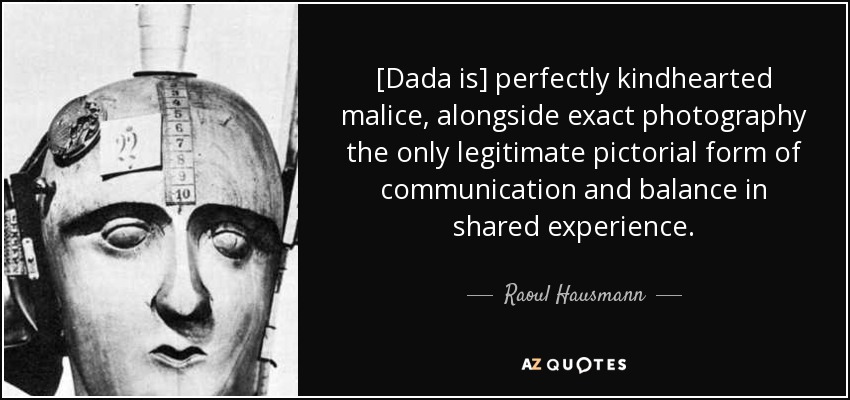
[Dada is] perfectly kindhearted malice, alongside exact photography the only legitimate pictorial form of communication and balance in shared experience.
[Postmodern photography] implies the exhaustion of the image universe: it suggests that a photographer can find more than enough images already existing in the world without the bother of making new ones.
...photography repeats itself unconsciously and unavoidably, producing stereotypes that then are repeated ad infinitum.
To me, photography was a completely new medium, and I did not... feel the urge to transfer to it my ideas about painting.
As is often said of photography, this photograph is a frozen moment. A frozen moment is not a moment at all.
...photography is made essentially of time. I often think that what we show is a point in time, more than a window onto space.
By trying many different approaches, you may slowly reach the point where you say more about yourself than about the objects or the landscapes or the people you photograph - and this is where photography really interests me.
There's this idea that photography is a kind of testimony and therefore we're forbidden to tell lies with it. I think that's nonsense. Photography isn't testimony.
To me photography can be simultaneously a record and a mirror or window of self-expression.
What the eye sees is a synthesis of who you are and all you have learned. This is what I would call the language of photography.
I earnestly advise women of artistic tastes to train for the unworked field of modern photography. It seems to be especially adapted to them, and the few who have entered it are meeting with gratifying and profitable success. (1898)
There is more in art, with an apology to that much abused word, as applied to photography, than startling display lines, on mounts and signs announcing artist Photographer, Artistic Photography Studio, etc., and the lower the standard the more frantic the claim.
I wanted [photography] to be more than a document, to be something that is as close as you could possibly be to the subject.
The moment you make a photograph you consign whatever you photograph to the past as that specific moment no longer exists, it is history. The photography that I practice takes place in a specific time and place, depicting real moments in people's lives. In some ways I think of myself as a historian, but not of the word. History is most often written from a distance, and rarely from the viewpoint of those who endured it.
I thought New York had it coming, that it needed a kick in the balls. When I returned to New York, I wanted to get even. Now I had a weapon, photography.
What's happening is that people are making a billion photographs a year of their cats, frequently with the cats wearing costumes. Do you think I should be doing shows of cat photography?
We used the camera only as a means of expression and as a visual medium that offers possibilities found in no other artistic technique, possibilities that the eye cannot catch in their totality. We tried to establish a characteristic vision of photography.
Speed, the fundamental condition of the activities of our day is the power of photography, indeed the modern art of today, the art of the split second.
I am trying to make some kind of connection to what is going on in the world, to make some sort of contact. And I use the instruments that our modern world offers, these extraordinary instruments of photography and film and computers.
It has been important to me, as an historian of photography, to understand photography by photographing.
Photography is the very conscience of painting. It constantly reminds the later of what it must not do.
Photography has been very, very generous to me, but at the same time has damaged me.
Ideally I would like the work to be a hybrid between painting and photography.
Photography is the art of anticipation, not working with memories, but showing their formation. As such, it has relentlessly usurped imaginative and critical prerogatives of older, slower literature and handmade visual art.
The dominant problem of pictorial art since the nineteen-fifties is photography, and, by extension, film and video. The basilisk eye of the camera has withered the pride of handworked mediums. Painting survives on a case-by-case basis, its successes amounting to special exemptions from a verdict of history.
Follow AzQuotes on Facebook, Twitter and Google+. Every day we present the best quotes! Improve yourself, find your inspiration, share with friends
or simply: