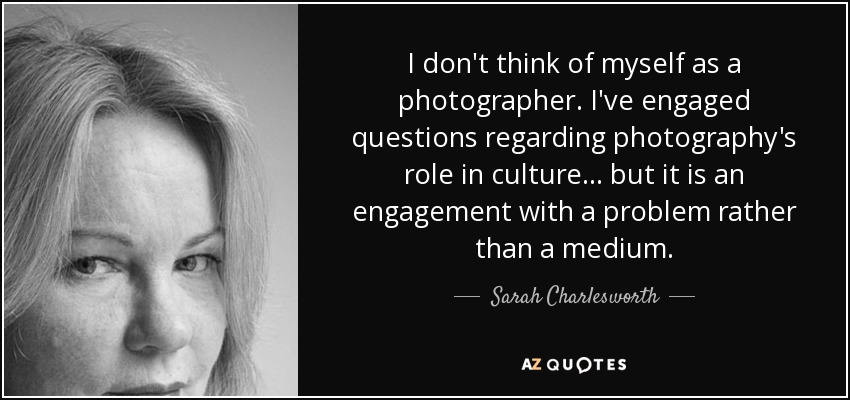
I don't think of myself as a photographer. I've engaged questions regarding photography's role in culture... but it is an engagement with a problem rather than a medium.
I turned to photography because I thought it was the dominant language of our culture.
Photography works hand in glove with image and memory and therefore possesses their notable epidemic power.
I cannot understand why some people try to write a history of photography that is separated from the history of modern art.
As the possibilities for straightforward photography seem to have become exhausted it has been the photographers who know about the history of art, not simply the history of photography, who have shaped important directions for the future.
It was only with the emergence of the Conceptualist approaches of the late 1960s that the opposition between artists using photography and photographers became explicit.
Any photographer worth his/her salt - that is, any photographer of professional caliber, in control of the craft, regardless of imagistic bent - can make virtually anything look good. Which means, of course, that she or he can make virtually anything look bad - or look just about any way at all. After all, that is the real work of photography: making things look, deciding how a thing is to appear in the image.
There's a reductiveness to photography, of course - in the framing of reality and the exclusion of chunks of it (the rest of the world, in fact). It's almost as if the act of photography bears some relationship to how we consciously manage the uncontrollable set of possibilities that exist in life.
Photography is, and has been since its conception, a fabulously broad church. Contemporary practice demonstrates that the medium can be a prompt, a process, a vehicle, a collective pursuit, and not just the physical end product of solitary artists' endeavors.
I think my pictures are really about a kind of tension between my need to make a perfect picture and the impossibility of doing so. Something always fails, there's always a problem, and photography fails in a certain sense... This is what drives you to the next picture.
Originally, one of the reasons I was drawn to photography, as opposed to painting or sculpture or installation, is that of all the arts it is the most democratic, in so far as it's instantly readable and accessible to our culture. Photography is how we move information back and forth.
Not only has photography so thoroughly saturated our visual environment as to make the invention of visual images seem archaic, but it is also clear that photography is too multiple, too useful to other discourses, ever to be wholly contained within traditional definitions of art.
Fashion is the opposite of the real, its worst enemy. Fashion photography is subversive; it makes you believe everything is true, whereas this could not be more false. It is the opposite of a mirror, a deformation.
The denunciation of suffering by photography has replaced the religious justification of suffering in painting. Denunciation is a function of photojournalism, and in itself that's a step in the right direction.
For me, photography must be visual, rather than intellectual and ideological.
Photography has fooled the world. There's no more convincing fraud. Its images are nothing but the expression of the invisible man working behind the camera. They are not reality, they form part of the language of culture.
[Photography is a] hair-raising joy ride in a medium that, despite being a mechanical trick, can break down the division between mind and matter like a superhero, or an artist.
Tactility was rejected in conceptual photography. I embrace the possibilities of my medium. Surface, texture, and tactility is something analog photography can do well, or it is something I can do well in analog photography. It can be hard to know what or who is in control.
In the beginning of my photography I controlled everything: rearranging the room, lighting it, and telling people what to do and where to put their hands. By the last project, I was basically totally at the mercy of serendipity.
It's entirely ridiculous and hopeless to try to compete with somebody who made such a huge contribution to photography... I knew when I went into photography that I would be compared to my mother. I thought to myself, what can I do about that?
We have a few things in common - smoking, drinking, and women. Photography just gets us out of the house. (To photographer Juergen Teller)
There are religions in which the representation of the world is banned as an usurpation of the power of a God, creator of all things. It is very possible that photography is a trick of the devil and each shot is a sin.
Photography... has lived under the tyranny of its subject matter: the object has exercised an almost total domination.
Every photograph is a fiction with pretensions to truth. Despite everything that we have been inculcated, all that we believe, photography always lies; it lies instinctively, lies because its nature does not allow it to do anything else.
Photography mirrored the [nineteenth century] will towards rigor, towards defining details, the need for miniscule description, the long-distance optics, for technology at the service of truth, for concepts of credibility, of objectivity, the need to archive, for the consolidation of institutions like the museum, in short, towards a need to control memory.
Follow AzQuotes on Facebook, Twitter and Google+. Every day we present the best quotes! Improve yourself, find your inspiration, share with friends
or simply: