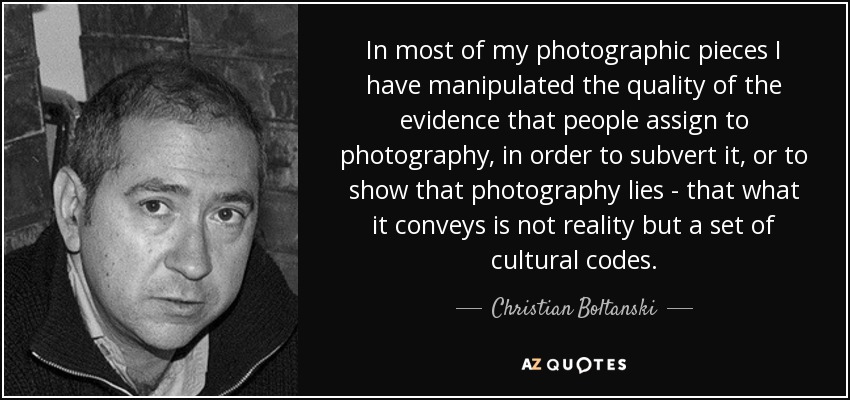
In most of my photographic pieces I have manipulated the quality of the evidence that people assign to photography, in order to subvert it, or to show that photography lies - that what it conveys is not reality but a set of cultural codes.
I am trying to make some kind of connection to what is going on in the world, to make some sort of contact. And I use the instruments that our modern world offers, these extraordinary instruments of photography and film and computers.
The photogram, or camera-less record of forms produced by light, which embodies the unique nature of the photographic process, is the real key to photography.
Photography's a case of keeping all the pores of the skin open, as well as the eyes. A lot of photographers today think that by putting on the uniform, the fishing vest, and all the Nikons, that that makes them a photographer. But it doesn't. It's not just seeing. It's feeling.
I feel shabby - because I've made a name, quite a good name, out of photography. And I still find myself asking the same questions: Who am I? What am I supposed to be? What have I done?
The dominant problem of pictorial art since the nineteen-fifties is photography, and, by extension, film and video. The basilisk eye of the camera has withered the pride of handworked mediums. Painting survives on a case-by-case basis, its successes amounting to special exemptions from a verdict of history.
We used the camera only as a means of expression and as a visual medium that offers possibilities found in no other artistic technique, possibilities that the eye cannot catch in their totality. We tried to establish a characteristic vision of photography.
In photography we possess an extraordinary instrument for reproduction. But photography is much more than that. Today it is [a method for bringing optically] some thing entirely new into the world.
When I first started making photo pieces it wasn't with the idea of a commitment to the medium. I didn't think I would have to become a photographer to make my photographs. I recall that anything could be used as material for art in that era. Photography was just one more thing.
Photography is used to give evidence, and the evidence is always deceiving.
It has been important to me, as an historian of photography, to understand photography by photographing.
I feel very lucky. I don't know what else there has to be. I'm happy, as corny as it sounds, to be living in a place where it's easy to live, easy to drive to the airport, easy to go pick up something at the supermarket and to have a circle of friends. Those were my goals in 1998, not to be queen of photography but to make a cultural adjustment to the West. And those are still more important goals to me than professional ones right now.
When photography was invented, people had to make room in their minds for the idea that the dead would always be visible.
Photography is nature seen from the eyes outward, painting from the eyes inward. Photography records inalterably the single image, while painting records a plurality of images willfully directed by the artist.
Photography is the art of anticipation, not working with memories, but showing their formation. As such, it has relentlessly usurped imaginative and critical prerogatives of older, slower literature and handmade visual art.
The act of photography is that of phenomenological doubt to the extent that it attempts to approach phenomena from any number of viewpoints.
By exposing the multiplicity, the facticity, the repetition and stereotype at the heart of every aesthetic gesture, photography deconstructs the possibility of differentiating between the original and the copy. [Photography calls] into question the whole concept of the uniqueness of the art object, the originality of the author, the coherence of the oeuvre within which it was made, and the individuality of so-called self-expression.
Photography's vaunted capture of a moment in time is the seizure and freezing of presence. It is the image of simultaneity, of the way that everything within a given space at a given moment is present to everything else; it is a declaration of the seamless integrity of the real.
It's a pity I am so impatient and careless, as any ordinary person could learn all the techniques of photography in a week. It is the democratic art, i.e. technical skill is practically eliminated - the more foolproof cameras become with focusing and exposure gadgets the better - and artistic quality depends only on choice of subject.
Photography should be redefined. It's largely technical... Photography is just unbelievably limiting. I always think of David Bailey and all the fashion photographers - they overlap, you can't always tell who did it. I don't really even like photography all that much. I just think it's so overdone.
My first reaction at the very idea of this interview was to refuse to talk about photography. Why dissect and comment a process that is essentially a spontaneous reaction to a surprise?
I often think we do not take this business of photography in a sufficiently serious spirit. Issuing a photograph is like marriage: you can only undo the mischief with infinite woe.
One impulse of photography, as immediate as its impulse to extend the visible, is to theatricalize its subjects. The photographer's command, Watch the birdie! is essentially a stage direction.
What makes [photography] obscene is its terrible cruelty. Happiness may be fleeting, but it's the reason we go on living. Photography is the joy that precedes pain, the moment of life just before death.
A man with a camera was always suspected of being a spy. Moreover, the Jews did not want to be photographed, due to a misunderstanding of the prohibition against making graven images (photography had not been invented when the Torah was written!). I was forced to use a hidden camera.
Follow AzQuotes on Facebook, Twitter and Google+. Every day we present the best quotes! Improve yourself, find your inspiration, share with friends
or simply: