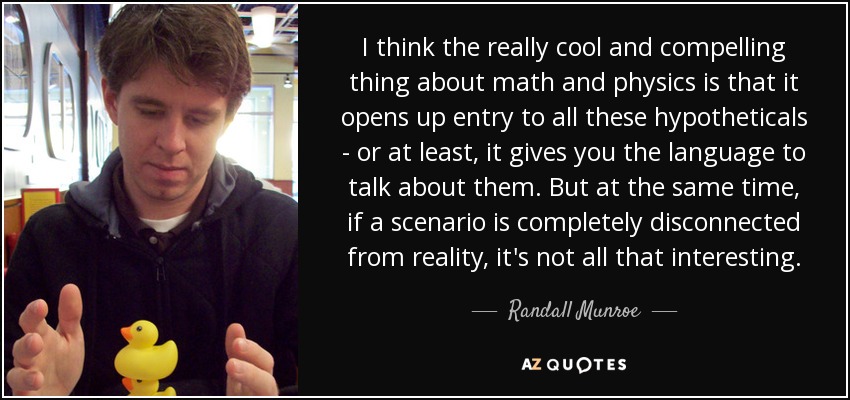
I think the really cool and compelling thing about math and physics is that it opens up entry to all these hypotheticals - or at least, it gives you the language to talk about them. But at the same time, if a scenario is completely disconnected from reality, it's not all that interesting.
Fundamental physics is like an art more or less. It's completely non-practical, and you can't use it for anything. But it's about the universe and how the world came into being. It's very remote from your daily life and mine, and yet it defines us as human beings.
I mean, if you've ever been a governor of a state, you understand the vast potential of broadband technology, you understand how hard it is to make sure that physics, for example, is taught in every classroom in the state. It's difficult to do. It's, like, cost-prohibitive.
My hope is that in the future, women stop referring to themselves as 'the only woman' in their physics lab or 'only one of two' in their computer science jobs.
The interaction between math and physics is a two-way process, with each of the two subjects drawing from and inspiring the other. At different times, one of them may take the lead in developing a particular idea, only to yield to the other subject as focus shifts. But altogether, the two interact in a virtuous circle of mutual influence.
I love physics with all my heart ... It is a kind of personal love, as one has for a person to whom one is grateful for many things.
In my teenage years I was put off the idea of a career in flying, because I'd convinced myself that you had to be a boffin with degrees in maths and physics, which were my weakest subjects.
That attitude does not exist so much today, but in those days there was a very sharp distinction between basic physics and applied physics. Columbia did not deal with applied physics.
My latter schooldays and my university days were during the war, when science - physics, in particular - was a very important and glamorous subject. A lot of us felt that if we couldn't get into science, we might try engineering or medicine.
By the year 2070 we cannot say, or it would be imbecile to do so, that any man alive could understand Shakespearean experience better than Shakespeare, whereas any decent eighteen-year-old student of physics will know more physics than Newton.
The physics of the 21st century shall deal essentially with non-spatial matter and non-spatial mechanics.
The Engineer is one who, in the world of physics and applied sciences, begets new things, or adapts old things to new and better uses; above all, one who, in that field, attains new results in the best way and at lowest cost.
If you assume continuity, you can open the well-stocked mathematical toolkit of continuous functions and differential equations, the saws and hammers of engineering and physics for the past two centuries (and the foreseeable future).
For many years quantum physics had been giving indications that there are levels of reality other than the material level.
Although I was four years at the University [of Wisconsin], I did not take the regular course of studies, but instead picked out what I thought would be most useful to me, particularly chemistry, which opened a new world, mathematics and physics, a little Greek and Latin, botany and and geology. I was far from satisfied with what I had learned, and should have stayed longer.
Physical changes take place continuously, while chemical changes take place discontinuously. Physics deals chiefly with continuous varying quantities, while chemistry deals chiefly with whole numbers.
When I began my physical studies [in Munich in 1874] and sought advice from my venerable teacher Philipp von Jolly...he portrayed to me physics as a highly developed, almost fully matured science...Possibly in one or another nook there would perhaps be a dust particle or a small bubble to be examined and classified, but the system as a whole stood there fairly secured, and theoretical physics approached visibly that degree of perfection which, for example, geometry has had already for centuries.
I was lucky to get into computers when it was a very young and idealistic industry. There weren't many degrees offered in computer science, so people in computers were brilliant people from mathematics, physics, music, zoology, whatever. They loved it, and no one was really in it for the money.
Quantum physics is the physics of possibilities. And not just material possibilities, but also possibilities of meaning, of feeling, and of intuiting. You choose everything you experience from these possibilities, so quantum physics is a way of understanding your life as one long series of choices that are in themselves the ultimate acts of creativity.
...physics is the study of the structure of consciousness.
I make figurative portraits as a way to explore theories of quantum physics.
We are made out of stardust. The iron in the hemoglobin molecules in the blood in your right hand came from a star that blew up 8 billion years ago. The iron in your left hand came from another star. We are the laws of chemistry and physics as they have played out here on Earth and we are now learning that planets are as common as stars. Most stars, as it turns out now, will have planets.
Yeah, I am a guy working on physics outside of academia. But I'm nowhere near Einstein's caliber.
This is absolutely correct and forms part of the larger concept that top-down causation is a key factor not just in the way the brain works but in broader contexts in biology and even physics.
Digital mechanics predicts that for every continuous symmetry of physics there will be some microscopic process that violates that symmetry.
Follow AzQuotes on Facebook, Twitter and Google+. Every day we present the best quotes! Improve yourself, find your inspiration, share with friends
or simply: