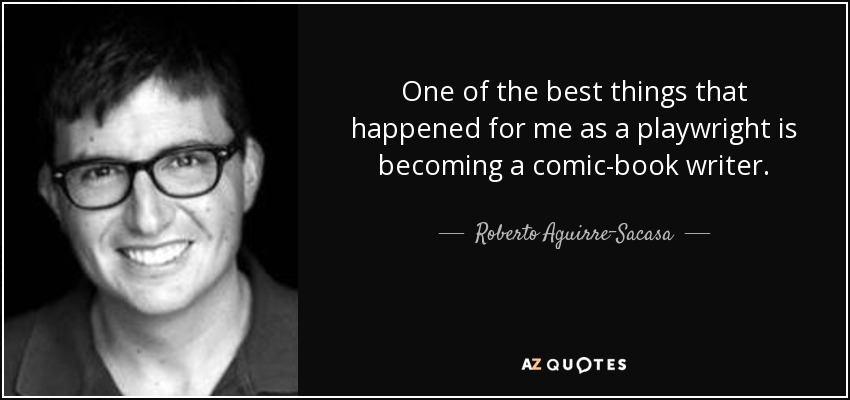
One of the best things that happened for me as a playwright is becoming a comic-book writer.
In terms of collaboration, working on a new piece is always thrilling, as I'm sure most people would say, because the playwright is in the room and the piece itself evolves in response to what is happening in the room.
It's a lucky circumstance when you get to usher in new work, because you are able to ask the playwright and the director (who in a new work is always in dialogue with the playwright) an unlimited amount of questions.
I remember being asked when I was in high school what do I want to do when I grow up and the answer is so indicative - I would like to have been a successful playwright.
You have to get beyond your own precious inner experiences. The actor cannot afford to look only to his own life for all his material nor pull strictly from his own experience to find his acting choices and feelings. The ideas of the great playwrights are almost always larger than the experiences of even the best actors.
I think that as a playwright, if I detail that environment, then I'm taking away something from them [designers]. I'm taking away their creativity and their ability to have input themselves, not just to follow what the playwright has written. So I do a minimum set description and let the designers create within that.
The great Norwegian playwright, Henrik Ibsen, wrote, "One of these days, the younger generation will come knocking at my door." The future is knocking at our door right now. Make no mistake, the next generation will ask us one of two questions. Either they will ask: "What were you thinking; why didn't you act?" Or they will ask instead: "How did you find the moral courage to rise and successfully resolve a crisis that so many said was impossible to solve?
If by any chance a playwright wishes to express a political opinion or a moral opinion or a philosophy, he must be a good enough craftsman to do it with so much spice of entertainment in it that the public get the message without being aware of it.
I am a playwright. I show What I have seen. In the man markets I have seen how men are traded. That I show, I, the playwright.
A rather ugly thing starts happening: the playwright finds himself knocked down for works that quite often are just as good or better than the works he's been praised for previously. And a lot of playwrights become confused by this and they start doing imitations of what they've done before, or they try to do something entirely different, in which case they get accused by the same critics of not doing what they used to do so well.
The one living playwright I admire without any reservation whatsoever is Samuel Beckett. I have funny feelings about almost all the others.
There are lots of young vital playwrights who are experimenting, and these are the plays that people who are interested in the theatre should see. They should go off Broadway. They should go to the cafe theatres and see the experiments that are being made.
I think that's foolishness on the part of the playwright to write about himself. People don't know anything about themselves.
By some curious mischance, a couple of my plays managed to hit an area where commercial success was feasible. But it's wrong to think I'm a commercial playwright who has somehow ceased his proper function. I have always been the same thing - which is not a commercial playwright. I'm not after the brass ring.
About four years ago I made a list, for my own amusement, of the playwrights, the contemporary playwrights, by whom critics said I'd been influenced. I listed twenty-five. It included five playwrights whose work I didn't know, so I read these five playwrights and indeed now I suppose I can say I have been influenced by them. The problem is that the people who write these articles find the inevitable similarities of people writing in the same generation, in the same century, and on the same planet, and they put them together in a group.
My theatrical background was in the great work of the South African playwright Athol Fugard.
In America they have to know just what you are-- novelist, poet, playwright... Well, I've been all of them... I think poems and novels and stories spring from the same seed. It's not like, say, playing polo and knitting.
For many playwrights, they write the plays anyway because they've got to be, the work has been started, it's got to be finished, but we all long, I think, to see the plays fleshed out on stage and I'm exactly like that. Yes, I'm not satisfied until I actually see it on stage.
As playwrights, as poets, we have to look to ourselves, listen to our guts for the final answers about what changes to make. Everyone has advice about how to end your play differently. And it's not about right or wrong. At the end of the day, it's your baby and you know what's best.
I have a great interest in Victorian musical & cabaret performances and Weimar artists so the references are there, to Cabaret and also All That Jazz and other films where, where there's a kind of (influential German playwright Bertolt) Brecht-ian approach, almost to the character standing outside of himself or, in this case, he's "self-séance-ing."
[Anton] Chekhov is the most produced playwright in the world after Shakespeare, and most of the people in my sort of audience would have seen at least one of his plays.
I was my class playwright and I wrote plays set in villages with kings and chiefs.My plays were about treason and betrayals. If they were influenced by Macbeth, they were also influenced by Nigerian plays I had seen and Village Headmaster, a television drama series I had watched as a child.
One of the things I love about my job as a playwright or as a screenwriter is that I get to do a lot of research and a lot of thinking and taking a lot of notes before I turn it in.
There's no reason why you can't say "August Wilson, playwright" even though all of my work, every single play, is about black Americans, about black American culture, about the black experience in America. I write about the black experience of men, or I write about black folks. That's who I am. In the same manner that Chekhov wrote about the Russians, I write about blacks. I couldn't do anything else. I wouldn't do anything else.
One of the things that's different about London and the English market is that theater and film and television are all based in London. It's not quite the same as in the States where if the playwright here wants a successful TV or film career, they're whisked away by Hollywood.
Follow AzQuotes on Facebook, Twitter and Google+. Every day we present the best quotes! Improve yourself, find your inspiration, share with friends
or simply: