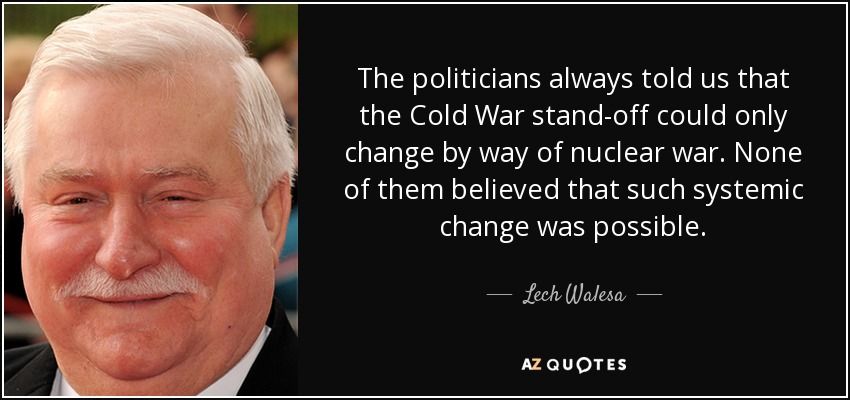
The politicians always told us that the Cold War stand-off could only change by way of nuclear war. None of them believed that such systemic change was possible.
Politicians often like to suggest that their policies come about through objective thinking, but if you look at British fascists, for example, what you see - what I see - is a group of people coming to the decisions they came to because something happened to them when they were nine-years-old, or because of some deep prejudice that formed in them subsequent to that.
I think we give Jimmy Carter too much credit to think he knew what was going to happen when he used the word "apartheid." It's provocative, but it was like a nuclear bomb in Israel. And yet that word is used all the time in the Israeli press. There's a double standard there. He probably picked it up in Israel, as it's commonly discussed. I'd be a little surprised if he understood how it was going to be used against him. He doesn't have a highly developed emotional detector. As a politician, that was a weakness.
This is something that Randi Weingarten said to me when I interviewed her once, which I think I quote in chapter nine. She talks about how only 7 percent of private sector workers in the American economy are in unions. So all the protections that teachers have that are due to collective bargaining - including generous pensions, generous health plans, limits to what they can be asked to do after school and in the summers - all of those things are sources of resentment to the public. And I think that politicians have played off of that quite effectively.
Coverage of Iraq has plummeted, because people in power no longer want to talk about it suddenly. Journalists should be over there demanding front-page coverage, lead-story coverage every day. They should be demanding that no politician running for federal office can go to bed until they say what the hell they're going to do about Iraq and what how accountable they are for it.
I am very cynical. That is absolutely what police is doing. But you don't even have to be cynical. I mean, politicians don't even pretend they're doing otherwise. The problem is the other side is not screaming bloody murder and saying, you know, "This is immoral, this is slavery, you're profiting from human bondage."
Some politicians are scared of Putin and some are extremely apologetic, actually. And I feel very sorry for this because some people who are like my friends from the left flank, they praise Putin because they see him as the fighter against American imperialism, which he is not. You know, why would you select between American imperialism and Russian imperialism? To my mind, it's exactly the same thing.
What we face in Canada are multiple overlapping crises. We have the climate crisis, which is screaming down on us - all of the predictions are coming true even faster than the scientists thought. We have the inequality crisis, where the Panama Papers are a great reminder that the one per cent have actually created their own economy. We still have the crisis of child poverty, which has never been dealt with despite decades of concerned words from politicians.
Ronald Reagan, and before him, Richard Nixon, and before Nixon, a slew of conservative politicians going back through American history, have played to the idea that the great majority of poor people are somehow "undeserving," and being undeserving, merit at best very limited, oftentimes deeply coercive and humiliating, government interventions to better their finances. That narrative isn't about to disappear overnight; but it strikes me as being like a weak gruel - there's no sustenance in it, no heft behind the argument.
To really tackle poverty, politicians, activists, academics will all have to think outside their boxes, will have to start developing much more integrated approaches to these problems. And a large part of this will involve working out ways to push for living wages. Partly this will involve re-empowering the union movement, which has been massively weakened in recent decades. Partly it will involve a willingness to restructure tax codes to penalize companies that don't provide basic benefits and decent wages to employees.
I think it's a good thing that we can have relatively non-partisan political conversations because I don't think that my premier necessarily should agree with everything the federal NDP says. I don't think she should disagree with everything the federal Conservatives say. I think that Albertans and Canadians as a whole, as I always say, are looking for pragmatic politicians with pragmatic solutions to their problems, and they want the best ideas to move forward, regardless of who has that idea.
Injustice drives me crazy! It really upsets me when I see politicians lying.
The fact is that in England so many of our politicians are career politicians - they've always been politicians since they left their education. And in the old days of course politicians used to be fish mongers or doctors or whatever. They'd lived life. These days, power seems to go to the hands of people that that's all they've done. And I'm not sure that's a good thing, because it does remove them from the realities of life.
When people want to inspire you to turn against some group of people, they'll often use empathy. When Obama wanted to bomb Syria, he drew our attention to the victims of chemical warfare. And in both of the Iraq wars, politicians said, "Look at the horrific things that are happening." I'm not a pacifist. I think the suffering of innocent people can be a catalyst for moral action. But empathy puts too much weight on the scale in favor of war. Empathy can really lead to violence.
When you define the audience, the performer becomes what the audience wants. Politicians do that all the time.
I think the stakes are always high when you're an artist of color - to get things right, to get things perfect and make everybody happy. But I'm not concerned with politicians and what they think. And I'm not always going to succeed. I'll have missteps, but I hope that people will be patient with the show and us and know that our intentions are good.
When Americans decry our politicians, we must remember that ultimately, politicians reflect us. When we demand more than mediocrity - and the passing comforts it bestows - we will certainly attain it. One hopes and prays it doesn't take an historic crisis for us to demand and reward excellence in public service.
Politicians like to talk about the income tax when they talk about overtaxing the rich, but the income tax is just one part of the total tax system. There are sales taxes, Medicare taxes, social security taxes, unemployment taxes, gasoline taxes, excise taxes - and when you add up all of those taxes [many of which are quite regressive], and then you look at how they affect the rich and the poor, you essentially end up with a system in which the best off 20 percent of Americans pay one percentage point more of their income than the worst off 20 percent of Americans.
I’m not a politician. I think that uniquely qualifies me to become president of the U.S.
Multinational corporations do control. They control the politicians. They control the media. They control the pattern of consumption, entertainment, thinking. They're destroying the planet and laying the foundation for violent outbursts and racial division.
Politicians are good listeners. Because if they're not, they aren't politicians for very long.
When I was a kid, politicians wanted to avoid talking about religion if they could. John F. Kennedy couldn't duck the issue, being Catholic and all. So how did he address it? By reminding Americans that religion shouldn't be an issue, that he was concentrating on big things like poverty and hunger and leading the space race.
A political leader must keep looking over his shoulder all the time to see if the boys are still there. If they arent still there, hes no longer a political leader.
I've often heard the complaint from both Democrat and Republican voters alike that they hate the fact that politicians get into office and they - and they're fearful, they're fearful to make tough decisions because they think more about the next election than they do about the next-generation.
I've seen many politicians paralyzed in the legs as myself, but I've seen more of them who were paralyzed in the head.
Follow AzQuotes on Facebook, Twitter and Google+. Every day we present the best quotes! Improve yourself, find your inspiration, share with friends
or simply: