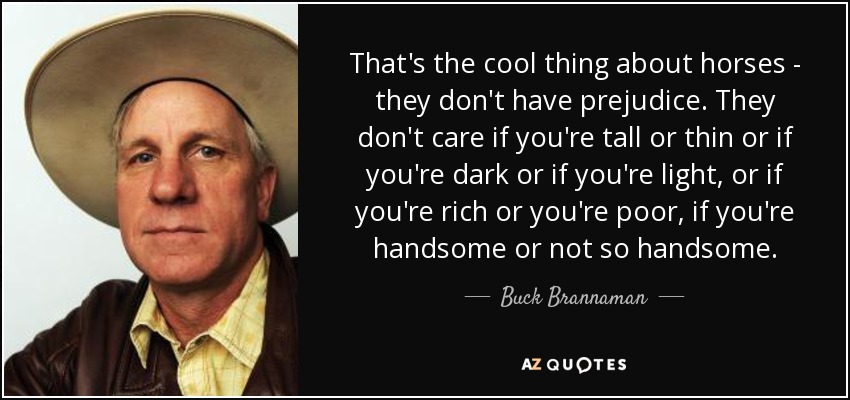
That's the cool thing about horses - they don't have prejudice. They don't care if you're tall or thin or if you're dark or if you're light, or if you're rich or you're poor, if you're handsome or not so handsome.
How can you trust people who are poor and own no property? ... Inequality of property will exist as long as liberty exists.
The profession of letters is, after all, the only one in which one can make no money without being ridiculous.
Culture is like the sum of special knowledge that accumulates in any large united family and is the common property of all its members. When we of the great Culture Family meet, we exchange reminiscences about Grandfather Homer, and that awful old Dr. Johnson, and Aunt Sappho, and poor Johnny Keats.
There is a vulgar persuasion, that the ignorance of women, by favoring their subordination, ensures their utility. 'Tis the same argument employed by the ruling few against the subject many in aristocracies; by the rich against the poor in democracies; by the learned professions against the people in all countries.
It is comparatively a faint and reflected beauty that is admired, not an essential and intrinsic one. It is because the old are weak, feel their mortality, and think that they have measured the strength of man. They will not boast; they will be frank and humble. Well, let them have the few poor comforts they can keep. Humility is still a very human virtue. They look back on life, and so see not into the future. The prospect of the young is forward and unbounded, mingling the future with the present.
It is true, we are such poor navigators that our thoughts, for the most part, stand off and on upon a harborless coast, are conversant only with the bights of the bays of poesy, or steer for the public ports of entry, and go into the dry docks of science, where they merely refit for this world, and no natural currents concur to individualize them.
The most sublime courage I have ever witnessed has been among that class too poor to know they possessed it, and too humble for the world to discover it.
If a man is indolent, let him be poor. If he is drunken, let him be poor.... Also--somewhat inconsistently--blessed are the poor!
The law is equal before all of us; but we are not all equal before the law. Virtually there is one law for the rich and another for the poor, one law for the cunning and another for the simple, one law for the forceful and another for the feeble, one law for the ignorant and another for the learned, one law for the brave and another for the timid, and within family limits one law for the parent and no law at all for the child.
What if all the forces of society were bent upon developing [poor] children? What if society's business were making people insteadof profits? How much of their creative beauty of spirit would remain unquenched through the years? How much of this responsiveness would follow them through life?
That piecemeal peace is poor peace. What pure peace allows Alarms of wars, the daunting wars, the death of it?
It is bad to be poor. I shall go to the wall for bread and meat, if I neglect my business this year as well as last.
In a virtuous and free state, no rewards can be so pleasing to sensible minds, as those which include the approbation of our fellow citizens. My great pain is, lest my poor endeavours should fall short of the kind expectations of my country.
It is not true that there is dignity in all work. Some jobs are definitely better than others.... People who have good jobs are happy, rich, and well dressed. People who have bad jobs are unhappy, poor and use meat extenders. Those who seek dignity in the type of work that compels them to help hamburgers are certain to be disappointed.
They have their belief, these poor Tibet people, that Providence sends down always an Incarnation of Himself into every generation. At bottom some belief in a kind of Pope! At bottom still better, a belief that there is a Greatest Man; that he is discoverable; that, once discovered, we ought to treat him with an obedience which knows no bounds. This is the truth of Grand Lamaism; the "discoverability" is the only error here.
So much of truth, only under an ancient obsolete vesture, but the spirit of it still true, do I find in the Paganism of old nations. Nature is still divine, the revelation of the workings of God; the Hero is still worshipable: this, under poor cramped incipient forms, is what all Pagan religions have struggled, as they could, to set forth.
It is commonly observed that a sudden wealth, like a prize drawn in a lottery or a large bequest to a poor family, does not permanently enrich. They have served no apprenticeship to wealth, and with the rapid wealth come rapid claims which they do not know how to deny, and the treasure is quickly dissipated.
I have a feeling-as compelling as a religious conviction-that if industry will constantly pass on to the worker and the customer all the savings of labor-saving machinery and invention, rather than siphon them off into the pools of watered securities, it will by that process keep distribution and production in balance and go as far toward Utopia as our poor human natures will go or be driven.
Day care poses no risk for children, provided that it is high quality.... Poor quality day care is risky for children everywhere.... The cost of poor quality day care is measured in children's lives. High quality day care costs only money.
Ancient worship . . . does truth. All one has to do is to study the ancient liturgies to see that liturgies clearly do truth by their order and in their substance. This is why so many young people today are now adding ancient elements to their worship. . . . This recovery of ancient practices is not the mere restoration of ritual but a deep, profound, and passionate engagement with truth—truth that forms and shapes the spiritual life into a Christlikeness that issues forth in the call to a godly and holy life and into a deep commitment to justice and to the needs of the poor.
The centuries will burn rich loads With which we groaned, Whose warmth shall lull their dreaming lids, While songs are crooned: But they will not dream of us poor lads, Left in the ground.
I was the rector's son, born to the anglican order, Banned for ever from the candles of the Irish poor; The Chichesters knelt in marble at the end of a transept With ruffs about their necks, their portion sure.
And you poor creatures--who conjured you out of the clay? Is God in show business, too?
I never pretend to be so superior a being as to be above having and indulging a hobby horse [her journal writing], and while I keep mine within due bounds and limits, nobody, I flatter myself, would wish to deprive me of the poor animal: to be sure, he is not formed for labour, and is rather lame and weak, but then the dear creature is faithful, constant, and loving, and though he sometimes prances, would not kick anyone into the mire, or hurt a single soul for the world--and I would not part with him for one who could win the greatest prize that ever was won at any races.
Follow AzQuotes on Facebook, Twitter and Google+. Every day we present the best quotes! Improve yourself, find your inspiration, share with friends
or simply: