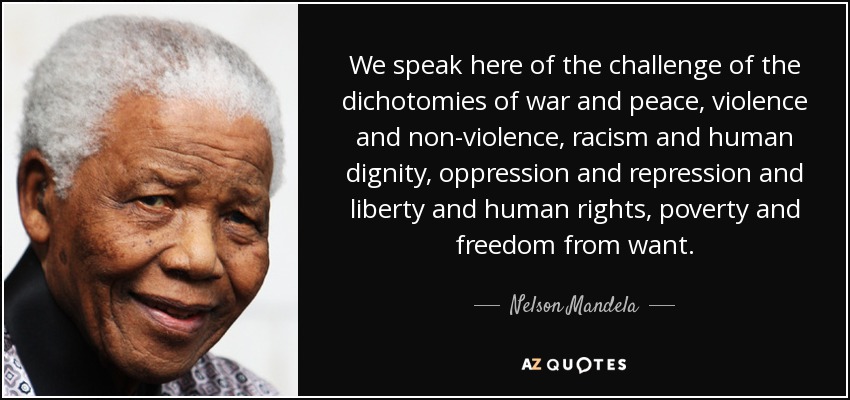
We speak here of the challenge of the dichotomies of war and peace, violence and non-violence, racism and human dignity, oppression and repression and liberty and human rights, poverty and freedom from want.
Brothers, you came from our own people. You are killing your own brothers. Any human order to kill must be subordinate to the law of God, which says, 'Thou shalt not kill'. No soldier is obliged to obey an order contrary to the law of God. No one has to obey an immoral law. It is high time you obeyed your consciences rather than sinful orders. The church cannot remain silent before such an abomination. ...In the name of God, in the name of this suffering people whose cry rises to heaven more loudly each day, I implore you, I beg you, I order you: stop the repression.
I will not tire of declaring that if we really want an effective end to violence we must remove the violence that lies at the root of all violence: structural violence, social injustice, exclusion of citizens from the management of the country, repression. All this is what constitutes the primal cause, from which the rest flows naturally.
What we call "normal" is a product of repression, denial, splitting, projection, introjection, and other forms of destructive actions on experience...It is radically estranged from the structure of being.
Love is the best, most insidious, most effective instrument of social repression.
British rule depends upon repression and collaboration and the Irish people should recognise that those who collaborate with Britain in exchange for a slice of the cake will implement British policy and remain silent when Irish people are murdered and oppressed. It is they who are responsible for prolonging the war in Ireland. Without the quislings, without the collaborators, we would already have reached freedom.
Our knowledge of the historical worth of certain religious doctrines increases our respect for them, but does not invalidate our proposal that they should cease to be put forward as the reasons for the precepts of civilization. On the contrary! Those historical residues have helped us to view religious teachings, as it were, as neurotic relics, and we may now argue that the time has probably come, as it does in an analytic treatment, for replacing the effects of repression by the results of the rational operation of the intellect.
Without question, purity is beautiful. We're not talking about repression or prudishness, but about having a confident and serene sense of your dignity and worth.
Sit peacefully in a church and think of church history: witchburning perhaps, or child abuse, genocide, the amassing of disgusting wealth, the repression of women, inquisitions, castrating child choir singers, the denial of Santa Claus and the support of fascists in power.
I advocate revolutionary changes...an end to capitalist exploitation, the abolition of racist policies, the eradication of sexism and the elimination of political repression. If that is a crime, then I am totally guilty
I am not ridiculing verbal mechanisms, dreams, or repressions as origins of poetry; all three of them and more besides may have a great deal to do with it.
Now they have come to the place where their faith can no longer feed on the bread of repression and violence. They ask for the bread of liberty, of public equality, and public responsibility. It must not be denied them.
So when I read this story, it unlocked a volcano of unanswered questions, because the questions had never been asked. It was an opportunity to come to terms with the lot of repressed history - and history of repression.
The witch-hunt was a perverse manifestation of the panic which set in among all classes when the balance began to turn toward greater individual freedom. The witch-hunt was not, however, a mere repression. It was also, and as importantly, a long overdue opportunity for everyone so inclined to express publicly his guilt and sins, under the cover of accusations against the victims.
Nowhere else did repressions, purges, suppressions, and all other kinds of bureaucratic hooliganism in general acquire such horrifying scope as in Ukraine, in the struggle against powerful forces concealed in the Ukrainian masses that desired more freedom and independence.
The policy of the repression of ideas cannot work and never has worked. The alternative to it is the long difficult road of education. To this the American people have committed.
The economic class struggle is a struggle against inessanlty intensified exploitation: not only against the brutal material form of exploitation, capitalism's tendency to reduce wages, and against the class 'techniques' for increasing productivity... but also around the question of the technical-social division of labor that prevails om enterprises, and against bourgeois ideology and repression.
The State has always one purpose: to limit, control, subordinate the individual and subject him to the general purpose Through its censorship, its supervision, and its police the State tries to obstruct all free activity and sees this repression as its duty, because the instinct of self-preservation demands it. The State does not permit me to use my thoughts to their full value and communicate them to other men unless they are its own Otherwise it shuts me up.
I think societal instinct much deeper than sex instinct — and societal repression much more devastating.
Leftists would like to pretend that any criticism of their views raises the specter of domestic repression. But in a country with a First Amendment, no suppression from government is likely, and in the citadels of the media and the academy, the far left is actually vastly overrepresented.
Against what is stupid, nonsensical, erroneous, and evil, [classical] liberalism fights with the weapons of the mind, and not with brute force and repression.
Despots play their part in the works of thinkers. Fettered words are terrible words. The writer doubles and trebles the power of his writing when a ruler imposes silence on the people. Something emerges from that enforced silence, a mysterious fullness which filters through and becomes steely in the thought.
We were that generation called silent, but we were silent neither, as some thought, because we shared the period's official optimism nor, as others thought, because we feared its official repression. We were silent because the exhilaration of social action seemed to many of us just one more way of escaping the personal, of masking for a while that dread of the meaningless which was man's fate.
Whereas Freud was for the most part concerned with the morbid effects of unconscious repression, Jung was more interested in the manifestations of unconscious expression, first in the dream and eventually in all the more orderly products of religion and art and morals.
Pop music is created by repression - and then the system takes it and makes even more money with it!
Follow AzQuotes on Facebook, Twitter and Google+. Every day we present the best quotes! Improve yourself, find your inspiration, share with friends
or simply: