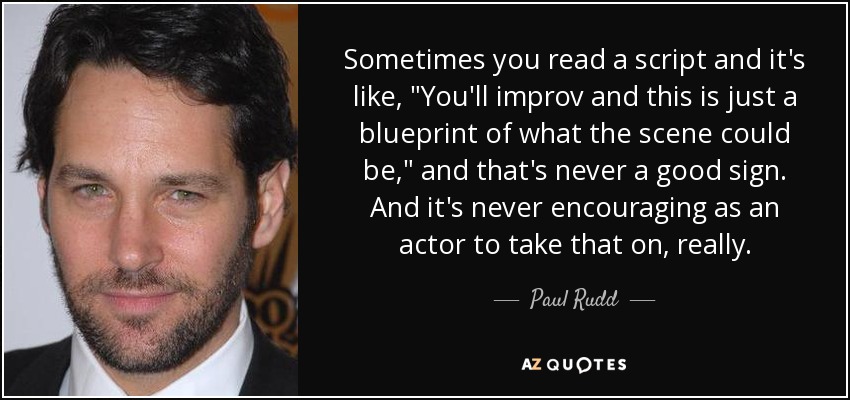
Sometimes you read a script and it's like, "You'll improv and this is just a blueprint of what the scene could be," and that's never a good sign. And it's never encouraging as an actor to take that on, really.
We had a work session [in "Moneyball"] where about 30 scouts came in and we're all riffing. And after it, [director] Bennett Miller said: Look at these faces and this is what we have to got to do. We got to get these guys in the scene.
Remember I came to Albuquerque to do a hair and makeup test and wardrobe fitting; you guys were already shooting. It's tough when the movie's already started and you kind of show up. You're the new kid on the block. I walked onto the set and Tommy [Lee Jones] was about to do the scene. I just kind of walked up to him. I was shaking, but I just gave him this big hug and he just had nothing to say. He was like, 'Gotta go to work now.' I had a great time working with him."
You don't write the kitchen scene just because you're eager to do it that day and you're avoiding something else. I think it has to move slowly, step by step. I pride myself on the construction of my stories but it's not something I impose on them.
Even if we don't see it, God is always working underneath the surface, behind the scenes and orchestrating His plans and purposes.
I don't walk around talking about my life and spouting my philosophy to people I don't know. I mean, if I get to know them, I'll talk for hours. I guess I like a lower-key scene.
The Beatles first appeared on our show on February 9, 1964, and I have never seen any scenes to compare with the bedlam that was occasioned by their debut. Broadway was jammed with people for almost eight blocks. They screamed, yelled, and stopped traffic. It was indescribable ... There has never been anything like it in show business, and the New York City police were very happy it didn't - and wouldn't - happen again.
The only episode which was completely my idea was for Mitch Pileggi, the actor who portrays Skinner, the Assistant Director of the FBI. He appears often in the series, but only for a few scenes. You know virtually nothing about him. I wanted him to have an episode that was his alone, so I wrote Avatar for him. He even has a scene that's pretty . . . hot [knowing smile]. He was very happy.
After my final Breaking Dawn scene, I felt like I could shoot up into the night sky and every pore of my body would shoot light. I felt lighter than I've ever felt in my life.
The scene isn't one of perpetual death but of life circulating within itself.
What characterized the whole punk scene for me in 1977 was there was no racism or sexism. It was an anarchy of -isms, and a matter of abolishing it all.
I went to Catholic high school, so my being in this [the craft] is not going to make my grandmother very happy. It's funny, because I was the only one who is Catholic in it. You have this thing in mass where you have to genuflect before you go into the pew, so I said you have to do this [for a scene] and they said why, and I said because you have to; I don't know why, it's a rule. Or like instinct. It's funny they set in a Catholic school. I went to St. Ignatius College Prep - "Where Modesty is our Policy."
Usually you'd do the summer scenes in the winter. So you're out there with a T-shirt and hope nobody sees your air that you're breathing out. We put ice cubes in our mouth to stop that from happening.
If the Constitution was a movie, the Preamble would be the trailer, the First Amendment the establishing shot, the 13th the crowd pleaser and the 14th the ultimate hero scene.
There's a word the teabaggers have wanted to use since Obama came on the scene, but they can't because it's not the 1950s. They would love to say this word. It begins with an N and ends with -er, and it's not "nation-builder."
And also, I'm most comfortable with like two people just sitting and talking about their feeling, you know, in a room with like two cameras and that's it. And I wanted to do something where there was like action and running and you know crowd scenes and big set pieces and certainly did a lot of that, so yeah.
Young people today are flooded with disconnected images but lack a sympathetic instrument to analyze them as well as a historical frame of reference in which to situate them. I am reminded of an unnerving scene in Stanley Kubrick's epic film, 2001: A Space Odyssey, where an astronaut, his air hose cut by the master computer gone amok, spins helplessly off into space.
Just to be seen strolling to or from a helicopter on the White House lawn, shouting an evasive answer to Sam Donaldson, must seem to the Reagans not quite satisfactory enough of a 7 PM presence, and this inane scene certainly galls the press.
Whereas, if you have a longer scene, then you have momentum to build it up. I thought I sucked, but Chris Weitz is an actor, so he understands that process and that you can get nervous in it, and he can look beyond that. Or, it was just me and I was over-thinking the entire thing.
I like the idea of having a film that is choreographic in all its aspects, not only in the dancing scenes, but also in the way the camera and the characters move in order to have that feeling that it's always musical.
We do want the freedom to move scenes from episode to episode to episode. And we do want the freedom to move writing from episode to episode to episode, because as it starts to come in and as you start to look at it as a five-hour movie just like you would in a two-hour movie, move a scene from the first 30 minutes to maybe 50 minutes in. In a streaming series, you would now be in a different episode. It's so complicated, and we're so still using the rules that were built for episodic television that we're really trying to figure it out.
It's funny, if you go back and look at all those old movies a lot of times they didn't have the budget for music. Each scene here was written to a different time, whether that be 'Breakfast in America' or just different soundtracks that we had for different parts of the movie. I'm interested to see how it all plays once it's all put together.
My dressing room was right on the water, and I would climb out of my window and walk around on the roof, whenever I needed time to think, or whenever I couldn't get a scene together. My father even came out there on the roof with me. We just walked around and talked up there, just to get away from everything, and nobody could get to us there. I really do love that place very much. It holds a very deep-rooted place in my heart.
It's wonderful. It's amazing. I mean we have such a great music scene and art scene and there's just a great group of young people, you know, temping their way through their 20's doing other amazing things. And I've been in...I spent like 10 years working here without ever having been shooting in Toronto. And it's so frustrating because it's a great city. And I remember seeing Montreal actually used as Montreal in that Ed Norton-Robert DeNiro.
Sex scenes are always a little uncomfortable at first.
Follow AzQuotes on Facebook, Twitter and Google+. Every day we present the best quotes! Improve yourself, find your inspiration, share with friends
or simply: