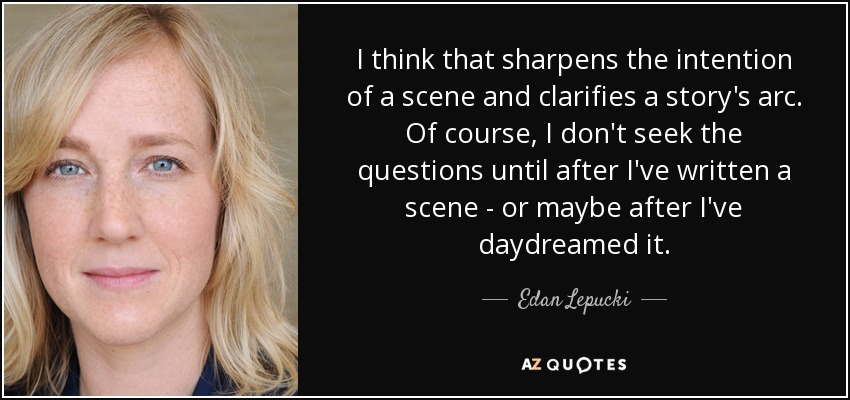
I think that sharpens the intention of a scene and clarifies a story's arc. Of course, I don't seek the questions until after I've written a scene - or maybe after I've daydreamed it.
You need great actors in this one, because there are moments where there's no way to get around it, you just need to come up with it. They have no time; they can't help you with coaches: "We've got to have it now!" Whether it's tears, whether it's a five-page scene. You can't put it off tomorrow because we're already behind; you've got to have it. I'm just amazed at the casting and how wonderful everybody was.
There were definitely scenes I struggled with more than others: the car accident and the thunderstorm are two that come to mind. It's difficult to write about a thunderstorm. There are only so many ways to describe it and our vocabulary is so limited. And the car accident scene required a tense, manic quality that had to be conveyed in the language, as well as the character's dialogue and actions. I was editing these scenes long after I thought I was finished with them.
Improv is not something I had a lot of experience with, because for a long time, my only experience in front of a camera was all television, which is pretty rigid script-wise, except for the occasional scene where you toss in an ad-lib just to elongate something.
You make the choice. You look at each scene and you make sure that this is not a person deceiving people.
It's not the subject of narration that interests me, but the structure. That's why I stay in touch with my old works, which I reread regularly. I don't hesitate to take up previously used images or even whole scenes.
I write with a fountain pen. And then revise word by word and line by line so that the first draft of a scene is usually the tenth or so draft.
Both the Beatles and The Rolling Stones broke on the music scene the summer I was in England. I can vividly remember hearing She Loves You in August 1963.
I don't think that those things [so called common practice] ever truly existed in the way that we like to believe that they do, the way we learn about them in music history class. Those things are defined at least decades after they happen. And even then, it's a fallacy because when you're in the moment, when you're in a thriving scene of musicians, inevitably everyone is going to be doing something completely different from everyone else
There's always going to be a fight between mainstream and underground because the mainstream is a very small bubble, and the underground scene is a very small bubble, and they both see themselves as secret societies.
I cut the scene out, but there was a moment where Christoph Waltz plays the piano in 'Django [Unchained]' - Jamie [Foxx] is a magnificent piano-player but there's never a moment where Django plays the piano.
One thing that is very different technically is that you don't get a lot of coverage in television. Not like you do on a film. I know we don't have time for separate set-ups, so I will design a scene where I'm hiding multiple cameras within that set-up. That way, if I don't have time to do five set-ups, I can do four cameras in one set-up. It's a different kind of approach for that. For the most part, a lot of television, in a visual sense, lacks time for the atmosphere and putting you in a place.
If you have someone falling out of the boat, you'd have to drag the boat up the river and film the same scene ten times, every time, dragging the boat exactly where it was up the river.
I'll never forget reading Chekhov's "A Doctor's Visit" on a train to Hawthorne, New York, and I got to the end - the scene where the patient says goodbye to the doctor and she puts a flower in her hair as a kind of thank you to him - and I felt like a cowboy shot from a canyon's top. This is a different experience from reading a novel, I think. The emotional effect is cumulative. Let's just hope market forces don't send short fiction the way of the dinosaur, because their sales are paltry compared to the novel and this is truly unfortunate.
I suppose also that watching marketing and publicity stuff play out from behind the scenes, making those plans and seeing each piece fall into place or not, each year, for each book, has made me a little more tranquil about the process for my own book than I might otherwise be.
The biggest problem in the fictional treatment of sex is that it's not treated as part of the story but as a pause from the story. The best sex scenes in fiction are the ones that advance the story.
I know when I watch a film at this point, if I completely lose myself in the characters and the story and the world of the film I know that it's at least in my opinion, that was great. Otherwise I'm thinking: "Oh I know they were just doing A, B and C, right before they walked into the scene, then the camera was there, then they probably took the shot from this reverse close-up and moved it into this." When all of that drops away then I'm like: "Okay this was phenomenal, this was fantastic." I mean, any film or TV performance in general is probably good.
I think there's just so much awesome music coming out of New Zealand, I've always loved The Naked And Famous, I absolutely love Ghost Wave... it just seems like there's a really cool scene happening out there, I'd love to go and spend some time there and see what other bands are popping up.
I eat broccoli. I think about the plot. I pace in circles for hours, counter-clockwise, listening to music. I try to think of one detail in the scene I'm about to write that I'm really excited about writing. Until I can come up with that one detail, I pace.
Plot and scene are still the hardest things for me, though I think they're the building blocks of what makes a story work.
I started out as a poet who primarily wanted to write about image and moment. Over the years I've been trying to teach myself how to do plot and scene. My first story collection had the most issues with the plotlessness, and when I was writing my second collection I was teaching myself how to make things happen.
I love to ride horses. I've ridden since I was a kid so I got to do some riding, which was a lot of fun. But most of the stunts were left to the girls. It's the girls rescuing the guys mostly. So it was kind of really kick-ass, girl power. It was wonderful to watch. It was particularly sexy. They would come in and just slay in these choreographed pentagram of death fight scenes. It was pretty impressive.
I think that almost every scene was an exploration - it was never going to be just what’s on the page. So I know I was very lucky - we all were - to work with a cast of this caliber. These are extremely experienced and intelligent actors, who are also deeply emotional and - as you say - are also engaged in the world.
I really feel that actors should really know who they are as characters; they should really study their lines; they should be prepared; but once they come to set, for me the most exciting way to shoot a scene is to really find it, really kind of grind your way through it, until you feel like you have something that you can put together.
I don't strive for balance. I just try to get through my to-do list, with my kids' homework being at the top of it, and then try to prepare for the next audition or whatever scene I'm shooting next. Balance.
Follow AzQuotes on Facebook, Twitter and Google+. Every day we present the best quotes! Improve yourself, find your inspiration, share with friends
or simply: