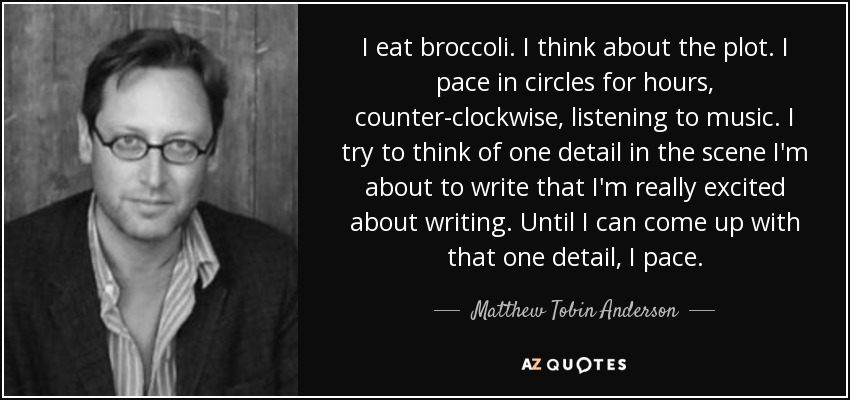
I eat broccoli. I think about the plot. I pace in circles for hours, counter-clockwise, listening to music. I try to think of one detail in the scene I'm about to write that I'm really excited about writing. Until I can come up with that one detail, I pace.
Unfortunately, we don't have a depth of African scriptwriters, so it's easier to Africanize something that already works. Local script writers are giving me James Bond budget scenes that I can't even produce.
We always need to have someone help with videos, I think all of our DVDs could've been better but our music video, I love all the music videos, but the actual behind-the-scenes and stuff of our music video DVD, it was rushed and didn't turn out great.
Always tell us where we are. And don't just tell us where something is, make it pay off. Use description of landscape to help you establish the emotional tone of the scene. Keep notes of how other authors establish mood and foreshadow events by describing the world around the character. Look at the openings of Fitzgerald stories, and Graham Greene, they're great at this.
A lot of individuals I've met that I've done a song or two with. But to be honest I'm not incredibly familiar with the scene. I mean, I'm more familiar with people coming from other countries like Latin-American MCs and African rappers... that type of stuff I'm really starting to get a hold on.
When you're young and you play music, you have a peer group, you come out of a scene. There's a lot of people you know, and then you have some success, and it all goes away.
As an actor, I feel that my work makes me very vulnerable. I have to be emotionally available to serve the scene I'm doing. You never quite know where your emotions will take you.
I was a grill cook at McDonalds for a little bit. I did landscape for a little bit. I played a lot in the bar scene, I played countless sets of acoustic songs in that arena.
Virgil Donati is clearly the best drummer to come along in the music scene in quite some time. He is extremely unique and has embraced an original sound that has given him a signature that is unmistakable and impossible to duplicate.
The good thing about having chemistry is, when you get to the improv section of a scene, you've got somebody to feed off. It can go on and on and on, and the sky's the limit.
There always should be something hanging unfinished before a scene ends so that there's a reason for going to the next scene.
During the time that my recording career seemed to be in a slump a music called disco came on the scene and literally took over radio stations as well as having radio stations created to play it which sort of negated my music as well as that of some of my peers.
My little secret before I do every scene is I say a short little prayer.
Sometimes I just want to write a really intense love scene. But I can't do that in my books for teens, or parents will complain - believe me, I've tried.
That's the thing about prep, is that it's a joy to have it there and you can spend all this time prepping, but ultimately you have to look at your script and turn up on the day. It's embedded in there somewhere but you have to forget it all and play the scene because we are storytelling.
I cut the scene out, but there was a moment where Christoph Waltz plays the piano in 'Django [Unchained]' - Jamie [Foxx] is a magnificent piano-player but there's never a moment where Django plays the piano.
I think the first couple of times you do make-out scenes, you psych yourself out and it's really nerve racking.
Sometimes they come to you and it's a small role, so it's about the experience and the journey and mixing with people you know you will learn from. Or sometimes it's a scene in a movie that you think, 'I just have to play this person.'
Kevin Bacon and I recently worked on a move together, R.I.P.D. Just before we'd begin a scene, when all of us would feel the normal anxiety that actors feel be- fore they start to perform, Kevin would look at me and the other actors with a very serious expression on his face and say: "Remember, everything depends on this!" It would make us all laugh. On the one hand, it's not true of course, but on the other, everything does depend on this, on just this moment and our attitude toward this moment.
My fans - I hate the word fans...my supporters - it's an international following that isn't from being in London and existing on the "scene." It came from being on the Internet, from being a teenager communicating with different artists, showing who I am, who KESH is, as well as connecting with other people around the world doing similar things.
There were some times when we did the winter scenes in the summer, and I had to wear that silly fur coat. Oh, my Lord! I was perspiring!
I look at it scene-by-scene. Whether it's a historical character or not, whatever, on the page is one thing and delving into the history or somebody is one thing, but making something work for an audience in front of a camera is another exercise and you bring whatever authenticity you can to it.
I think that sharpens the intention of a scene and clarifies a story's arc. Of course, I don't seek the questions until after I've written a scene - or maybe after I've daydreamed it.
It's not the subject of narration that interests me, but the structure. That's why I stay in touch with my old works, which I reread regularly. I don't hesitate to take up previously used images or even whole scenes.
There were definitely scenes I struggled with more than others: the car accident and the thunderstorm are two that come to mind. It's difficult to write about a thunderstorm. There are only so many ways to describe it and our vocabulary is so limited. And the car accident scene required a tense, manic quality that had to be conveyed in the language, as well as the character's dialogue and actions. I was editing these scenes long after I thought I was finished with them.
Follow AzQuotes on Facebook, Twitter and Google+. Every day we present the best quotes! Improve yourself, find your inspiration, share with friends
or simply: