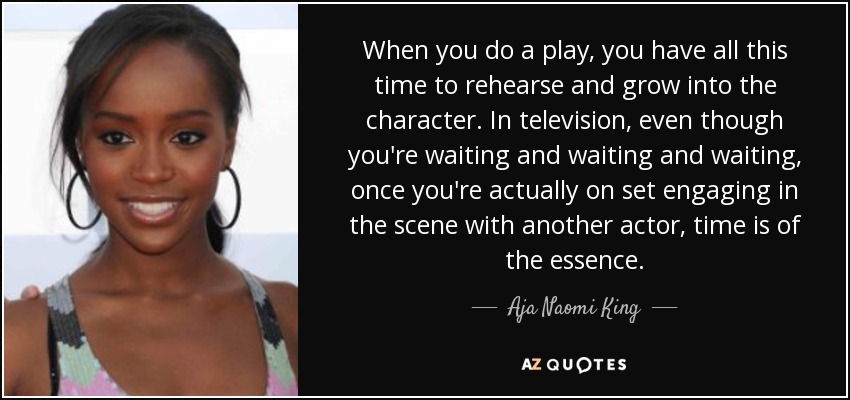
When you do a play, you have all this time to rehearse and grow into the character. In television, even though you're waiting and waiting and waiting, once you're actually on set engaging in the scene with another actor, time is of the essence.
I felt violated after certain scenes in the movie [Stone]. She [Lucetta] is a tough character. The choices she makes, especially her sexual choices... it was hard for me to put myself out there like that.
Usually, you have two people in a scene, and in the history of cinema the hero is most likely going to be the white guy. And the other guy is his friend who is carrying the bag or whatever, and you're not going to light for that guy.
The sole aim of the arts of scene-designing, costuming, lighting, is to enhance the natural powers of the actor.
We met [with Massimo Pupillo] many years ago in the halcyon days of the underground avant-prog math-rock scene when I was playing in Guapo.
Everyone sees the glory moments, but they don't see what happens behind the scenes.
Roger [Corman] didn't actually hire me, though. I was hired by AIP [American International Pictures], the studio that made the picture, which was Sam Arkoff and Jim Nicholson. It was a great learning experience for me, because not only did I work on the script, but they hired me back to go on location when they were making the movie, to write new scenes and so forth.
In the summer between my freshman and sophomore year, my grandfather got me a job at a local messenger company working on Wall Street. I was lucky enough to have been in the business during a stock market boom but just before the fax machine appeared on the scene, let alone email and the Internet. As a result, the messenger business was booming.
Besides acting which is my first love, I am also interested in behind the scenes.. Directing , writing and producing.
I found during the course of my political career on the national scene there's a point where the vanity burns away and you've had your fill of your name in the papers, or big adoring crowds, or the exercise of power. And for me that happened fairly quickly. And then you are really focused on: What am I going to get done with this strange privilege that's been granted to me? How do I make myself worthy of it?
It was a lot of fun to play a character [in Swiss Army Man] with no inhibitions, and with no knowledge of the world, and who comes into the world kind of like a blank slate. It means there's no template or blueprint for how you need to play certain scenes.
The rehearsal period is so far away from the time when the scene will actually be shot that very little is remembered.
When you are working hard, you don't have time for anything other than what you are doing in the scene and what the director wants.
When you're casting, you get a page or two - just enough to do the scene. Now that you're in the world, you get the whole script.
A scene can be created when people are coming together. Either to shop or to hang out.
The thing about running is, if I run in the morning before work, I feel like I'm ahead of the day. Whatever work I've done in terms of preparation or research or thinking about the scene or the character, it all kind of crystallizes in that moment in the morning. And sometimes I have the best ideas then.
We did monologues and scenes, and New York I did a scene from Amadeus and a monologue from Pounding Nails in the Floor With My Forehead by Eric Bogosian, and then in L.A. I switched the scene to This is Our Youth and did the same monologue. I was spiky-haired, super skinny. A lot of people were like, "You should come here and do a sitcom." That was the feedback that I got. Obviously it was quite a different journey than the one I've actually had, but I just listened to people.
It's true that compared with the scene when Unix started, today the ecological niches are fairly full, and fresh new OS ideas are harder to come by, or at least to propagate.
It's never the practice to shoot the scenes in the proper order. Sometimes you shoot the final scenes of a film before you've even started the beginning. So you get good at it because you have to sort of just eliminate the memories of something you've done as an actor, which you haven't done as the character yet. But it sometimes is a bit of a mind-f**k.
I didn't want to overstate anything, but at the same time, the scene expands on some of the themes in the film [ "Aquarius"].
I think of a movie as a human body. You can feel the pump of the heart and the blood going through the veins when you watch that scene.
Nobody who comes out of the movie [Aquarius] focuses on those [sexual] scenes, because they are not the heart of the film. They are a consequence of the story, but I don't remember hearing audiences talking about them afterward. They came out discussing themes of resistance, history and memory. They're talking about the beauty of the self and how it can become demolished.
D.C.'s always had a great scene.
In one of the scenes [in the Ordinary World], you can see a little cameo of my son, who's in the party. You've just gotta bring it all back home.
The movie [ The Innkeepers] is in no way a comedy, but I would put some of the funny scenes up against some of the funnier comedies this year. I think it's genuinely really funny, but it's out of the gallows.
Follow AzQuotes on Facebook, Twitter and Google+. Every day we present the best quotes! Improve yourself, find your inspiration, share with friends
or simply: