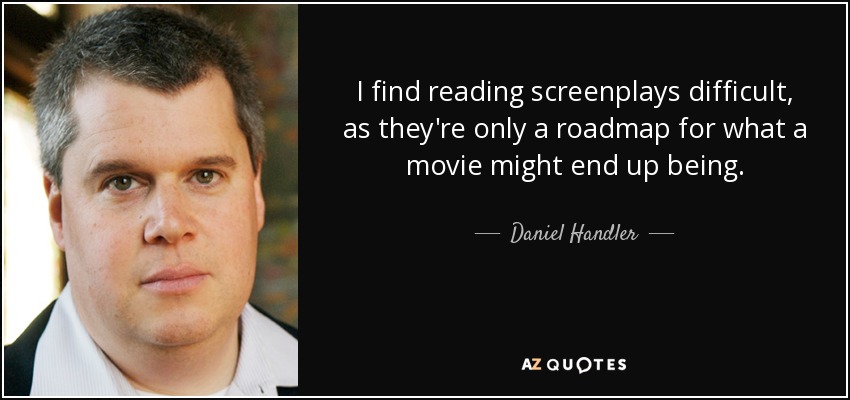
I find reading screenplays difficult, as they're only a roadmap for what a movie might end up being.
I can never read this book, just like I can never see a movie that I wrote a screenplay for. I can read it and see it physically, but I can't accurately judge it. I'm too close to it. If I read it ten times I'll have ten different reactions.
I don't think screenplay writing is the same as writing - I mean, I think it's blueprinting.
The first thing to look out for after your first big success are drugs and screenplays.
Movies are not the book. Movies are not even the screenplay. They are the movie.
I'm quite spontaneous in my decisions often. Your career is kind of what happens whilst you're busy developing other screenplays, and so it came out of the blue.
I simply asked if I could have a go at adapting a screenplay. But I did not want any money, in case I failed because I did not want a script out there with my name on it that might be completely dysfunctional.
The whole process of making movies and writing screenplays is visceral and intuitive.
My screenplays are very detailed. The reason they're detailed... you have to think on your feet. You have to be ready to change because there are no such things as ideal conditions.
I write mostly as a director. That's why my screenplays are very detailed. So I get into the images I see. I like that.
I've been a professional athlete, I've directed films, I've run a company with 150 employees, and nothing compares to writing a screenplay. Just the second I think I know what I'm doing, the rug gets pulled out and I have no idea what I'm doing. Because there are so many problems to solve.
When I'm writing novels, even screenplays, it's never an actor I have in mind; it's always the version in my head of who the character is. Once somebody gets cast, I have to adjust a little bit to who they are.
There have been screenwriters who I'm sure would gladly kill me, because I've been very fast and loose with their work, because I felt like it wasn't up to my high standards. I would push and pull it on set, and make changes all the time. But then when you're working with an original screenplay, my theater instincts kick in, and I suddenly become very keeper-of-the-words.
I'm very keen. Adaptations of other people's work, too. I got fascinated by the adaptation process, so I think that'd be a really interesting task. I would happily write original screenplays as well. I think it's become one of my favorite genres.
In a novel, language is your principal tool, you try to build pictures in the mind of the reader. When you write a screenplay, the language is just a transition, the final goal is a picture on the screen, it's the only thing the audience sees.
As I get older it gets harder and harder to hold on to the ephemeral excitement. When a documentary, or a screenplay, or even just a brainstorming session is going well I get to experience sense of hope, and expansiveness, even if it's just for a moment.
Screenplays aren't written to be read, they're written to be made into movies.
Anyone living in Los Angeles who has opposable thumbs is required to write a screenplay.
I'm a film guy. I love it. When I read the screenplay, I knew that there would be no HD camera that could achieve the look that I wanted for this film. I wanted it to be dirty, and 16mm provides all of that with the look and the grain. That's what I worked for, and that's what I wanted, and that's how I'd seen the movie in my mind.
I stopped doing that [photojournalism] and wrote some screenplays on speculation, because even though I wanted to direct, to direct you need a lot of money. Even for a cheap movie, you need film stock and equipment and actors.
Because I write the screenplay entirely and precisely, there is the danger that an actor might feel that this finite role is being imposed on them. I want the actors to feel that this is their own role, and that they can go back to point zero and develop this character.
The time came where I was able to write an original screenplay [Allied], and it would be read and noticed. I had a meeting with Brad [Pitt], just around the time that he was making World War Z. I basically told him the story and said, "This is what I want to do," and he really responded, so that helped me put the thing together and write it.
Everything has been for the [President] election for the last couple of months. Since the Democratic National Convention, it's been a dead run to get out as much content as possible and do as much as possible. Then, I go back to writing the screenplay I was working on, which is an original piece - a period piece that I will hopefully finish a couple of months after that, and hopefully I can convince some unsuspecting fool studio to buy.
I'm probably, if I might, if I stray I might write, go into screenplay or do something in film. Something like that but I think I'm pretty much going to stick to what I'm good at.
Writing a screenplay, I'm like, "All I'm responsible for is that final script, and I take great effort and pride in that." But once I give it to someone to make, I can disassociate with it entirely and not worry that my vision isn't being represented, because I understand fully that that's not how it works.
Follow AzQuotes on Facebook, Twitter and Google+. Every day we present the best quotes! Improve yourself, find your inspiration, share with friends
or simply: