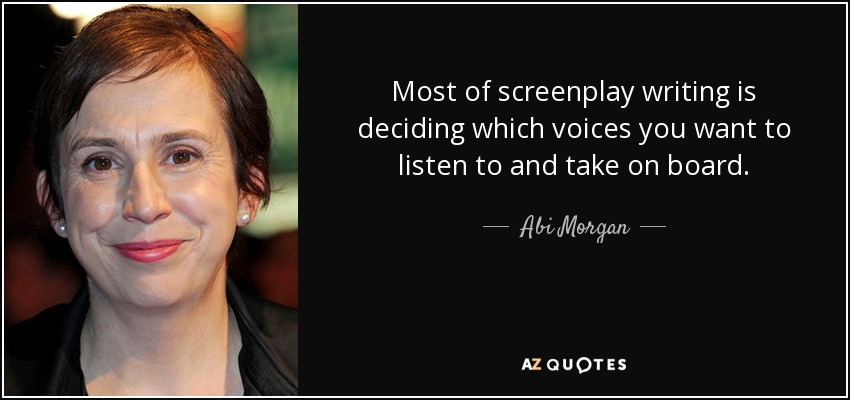
Most of screenplay writing is deciding which voices you want to listen to and take on board.
I don't take trouble at all to conform a screenplay to my iconography. I don't say, "We can't do that - the audience wouldn't accept it." I try to take the limitations of what is required to play a leading character and then screw with them.
I'm usually the first guy to propose a change because I'm continuing my process. We're in a context, in this business, a context in which most screenplays work on a very modest level of achievement, in that a lot of them aren't really written by what you would call writers.
You write a screenplay and then everybody is going to want to get in on it and we have to figure that out. I've written three screenplays that are at studios and I still haven't been making them yet so there is always something that is either going to trip something up or maybe get another pass.
Films are born from screenplays and they are guided by words. They are born very limited and there is no space for real creation: graphic creation, pictorial creation, or audiovisual creation. If we really want to use the art of animation with all its strength, we have to rethink the processes by which it's made because the medium is the message.
Since I worked with Danny Boyle before on Slumdog Millionaire, we have great success and everything. So, when I first got the script and the screenplay of Simon (Beaufoy) and I was reading it, even before the shoot, some kind of sounds came into my mind and I put some stuff [down] and sent it to Danny when he was cutting the movie.
The graphic novel? I love comics and so, yes. I don't think we talked about that. We weren't influenced necessarily by graphic novels but we certainly, once the screenplay was done, we talked about the idea that you could continue, you could tell back story, you could do things in sort of a graphic novel world just because we kind of like that world.
I've done some stuff with Thomas Jane and Tim Bradstreet in the comic world and it was interesting to me how close to a screenplay a comic can be. Certainly a four issue comic can be a four act structured screenplay and so I would totally be for that.
I really just love to open a blank document and spew, whereas with a screenplay I have to be more judicious.
I've come to find more satisfaction and enjoyment in writing screenplays over the years because that's what I do primarily now.
I have always had trouble recognizing myself in the features of the intellectual playing his political role according to the screenplay that you are familiar with and whose heritage deserves to be questioned.
If you have a good story idea, don't assume it must form a prose narrative. It may work better as a play, a screenplay or a poem. Be flexible.
I see everything visually. It's very visual for me. And so I think, from a plotting standpoint or what have you, there's obviously a certain amount of internal thinking that goes on in a novel (that) you can't do...in a screenplay. But I think, pacing wise, my novels move quickly because (they aren't overly) descriptive.
When I set out to write a screenplay, I have in my mind a beginning and an end but that end part continually changes as I start to write the middle. That way by the time the screenplay is finished I have taken myself and my audience from a familiar beginning point through the story to an unfamiliar ending point.
We now live in a world both in film and television where everything is based on something. You point out, "Star Wars" was an original screenplay, "Raiders of the Lost Ark," an original screenplay, "Ghostbusters" an original screenplay, "Back to the Future." All these things that people love were original ideas many years ago.
I look at the film without any music or sound. I try to grasp the story from the screenplay. I try to write to the novel or book if there is one. I try to create music that's honest and true to my heart for the story.
There is no screenplay-writing recipe that guarantees your cake will rise.
I'm currently writing a screenplay that I haven't started yet.
Most directors, I discovered, need to be convinced that the screenplay they're going to direct has something to do with them. And this is a tricky thing if you write screenplays where women have parts that are equal to or greater than the male part. And I thought, 'Why am I out there looking for directors?'—because you look at a list of directors, it's all boys. It certainly was when I started as a screenwriter. So I thought, 'I'm just gonna become a director and that'll make it easier.'
To be honest, I don't usually do very much research, especially if I'm working with a director who also wrote the screenplay. They've usually done a tonne of research. And they'll tell you about it from their perspective which is better than doing your own research.
Screenplay is the toughest form of writing for me, because you need to be in present tense. You need to be describing things as they occur.
If I know what my finale is when I'm writing a screenplay, then I don't always have to chart out every scene before that. I can adequately find my way. I'm experienced enough to do that.
I started writing stories when I was 9 or 10. I wrote my first screenplay-type document when I was 14.
I counted it up once. I think I have written 45 full screenplays. Of those, maybe 15 have been shot, in some form. That's a pretty good track record, but it's not 100%. It is frustrating that, as a screenwriter, I've seen all those movies and they don't exist in the real world. They're juts inside my head and on those pages.
If I get lucky and I can choose, I would always choose a really good story and screenplay, even if I don't know the director. If there's a good screenplay, there's a chance that something good is going to happen.
Follow AzQuotes on Facebook, Twitter and Google+. Every day we present the best quotes! Improve yourself, find your inspiration, share with friends
or simply: