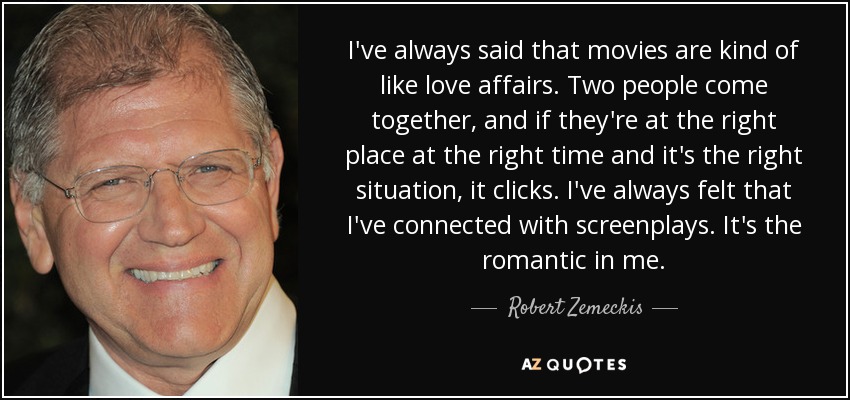
I've always said that movies are kind of like love affairs. Two people come together, and if they're at the right place at the right time and it's the right situation, it clicks. I've always felt that I've connected with screenplays. It's the romantic in me.
I believe that improvisation is really just a directorial tool. It's a writing tool. It's not so much that the actors get to say whatever they want, whatever pops into their head. It's an opportunity to write the last draft of the screenplay as you're working on it.
My understanding of films was just as much as any young girl who watches Bollywood films. I had no idea about the whole process of filmmaking, about dialogue writing, scripts, screenplay etc. I had probably gone to two or three film shoots in my childhood.
If you're writing a screenplay, you need to be prepared to let go: there's a good chance the words you write aren't going to be the ones that end up on screen.
Its much like writing a screenplay with someone else and thats how we view it, I think.
What I found interesting writing a screenplay as opposed to writing a novel is not the obvious thing, which is having to pare everything down and find the kind of essence, the skeleton if you like, which can then be fleshed out by performance and cinematography.
Stand-up life is really hard. At one point, I got so paralyzed I could write five screenplays before I could write three jokes for stand-up. Later, I've finally allowed myself to relax quite a bit, to think I can do it because I've done it in the past. The pressure to come up with the material is the same but the anxiety about whether I can do it is gone.
For 'So Cold the River,' I'm actually working on adapting the book with Scott Silver, who was just nominated for an Oscar for 'The Fighter,' and who also wrote '8 Mile,' which I think is a terrific screenplay. The chance to work with Scott is a tremendous pleasure and I'm learning a lot.
Douglas Adams did not enjoy writing, and he enjoyed it less as time went on. He was a bestselling, acclaimed, and much-loved novelist who had not set out to be a novelist, and who took little joy in the process of crafting novels. He loved talking to audiences. He liked writing screenplays. He liked being at the cutting edge of technology and inventing
Scrivener is where I live. I'm planning the next novel, two screenplays and a couple of short stories with it and it's amazing how fluid the software makes the process. I genuinely think this is the biggest software advance for writers since the word processor.
I don't read books on how to write screenplays just because I'm stubborn. So it's all sort of made up.
I was never conscious of my screenplays having any acts. It's all bullshit.
I set out to write a screenplay but, since my early 20s, had dreamed of writing a novel.
A screenplay is really an instruction manual, and it can be interpreted in any number of ways. The casting, the choice of location, the costumes and make-up, the actors' reading of a line or emphasis of a word, the choice of lens and the pace of the cutting - these are all part of the translation.
The movies are fun, but I'm a novelist. In many ways, screenwriting is much easier than writing novels. I find screenplays twenty times easier to write than a novel.
A book is maybe about 350 pages, and the prose allows for readers to get a glimpse into the internal lives of the characters. A screenplay is 120 pages, and it's all dialogue and action. The pacing of films is different, the structure is often different, and the internal lives of the characters must come across through the acting. Movies are just a different experience than reading - so it just depends on what an individual prefers.
Once I was in college, I was actually trying to write a comedy screenplay and I wrote basically the worst movie ever and just threw it away and never showed anybody. Everyone needs to get that first bad screenplay out of your system before you start writing other stuff.
Usually, when special effects get in the way, it's because the story isn't strong enough. If you don't start with a strong screenplay, it's easy to fall back on special effects, thinking it's going to carry you. But it never works. It's just tiresome.
Bob Glaudini, the writer, he's a wonderfully talented man and all his plays and his screenplays, they all have sense of something bigger, even though you're looking at something very simple.
I don't think I write differently when I'm writing a screenplay, as opposed to a stage play or a teleplay. Maybe if I were in a film class and there was time to think about it, we could point out differences.
One of the things about writing a novel is you can do it any way you want. It's your voice that's important and I see absolutely no reason why a screenplay can't be the same. It makes it a hell of a lot easier when you're the writer and the director.
There are a lot of bad screenplays so if you write a good screenplay people are going to respond to it.
I'm not writing novels, the screenplays are my novels, so I'm gonna write it the best that I can. If the movie never gets made, it'd almost be okay because I did it. It's there on the page.
I've always equated the writing process with editing, sort of like when I get through editing the movie, that's like my last draft of the screenplay.
If you're trying to drop ten pages from a screenplay, it hurts like hell, but if you just put it away for a month and then take it out, you can do it just like that!
Follow AzQuotes on Facebook, Twitter and Google+. Every day we present the best quotes! Improve yourself, find your inspiration, share with friends
or simply: