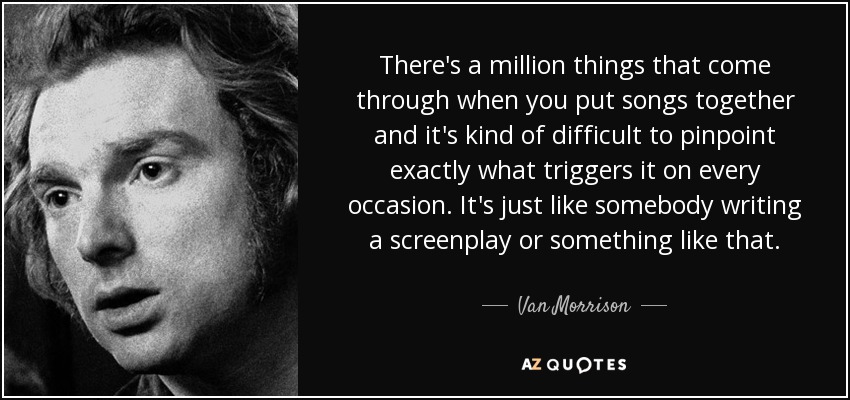
There's a million things that come through when you put songs together and it's kind of difficult to pinpoint exactly what triggers it on every occasion. It's just like somebody writing a screenplay or something like that.
In 2009, Scott Rudin sent me August's [Wilson] original screenplay [Fences] and asked me what I wanted to do with it. He wanted to know if I wanted to act in it, direct it or produce it. I said, "Well, let me read it first."
The time it would take me to write a screenplay it would take me the time to make two films. I would rather make the movies and I'm a better moviemaker than I a would be writer.
If youre writing a screenplay from scratch, it involves a lot of creation.
Writing a screenplay is like writing a big puzzle, and so the hardest part, I think, is getting the story.
It's intuitive in terms of when I read a piece of material or I hear about a project. I'm a writer, so I've written movies. I've read at this point thousands and thousands and thousands of screenplays. So if something gets me, then I don't ignore that.
I'm attracted to short screenplays. Nobody really wants a film to be over two hours, or at least I don't.
The idea of directing was something that I always had in the back of my mind, and writing as well. I began to write screenplays when I was in my 20's.
[Success] always starts with the material; it always starts with the truth and honesty of the characters that you read in the screenplay and that's rarely something that can be remedied if it's simply not there by the time you shoot the film. Thank God we had that.
Although I write screenplays, I don't think I'm a very good writer. I'm very interested in studying cultures and social issues, but as an academic I don't think I would have been too successful.
I see everything visually. It's very visual for me. And so I think, from a plotting standpoint or what have you, there's obviously a certain amount of internal thinking that goes on in a novel (that) you can't do...in a screenplay. But I think, pacing wise, my novels move quickly because (they aren't overly) descriptive.
When I set out to write a screenplay, I have in my mind a beginning and an end but that end part continually changes as I start to write the middle. That way by the time the screenplay is finished I have taken myself and my audience from a familiar beginning point through the story to an unfamiliar ending point.
We now live in a world both in film and television where everything is based on something. You point out, "Star Wars" was an original screenplay, "Raiders of the Lost Ark," an original screenplay, "Ghostbusters" an original screenplay, "Back to the Future." All these things that people love were original ideas many years ago.
I look at the film without any music or sound. I try to grasp the story from the screenplay. I try to write to the novel or book if there is one. I try to create music that's honest and true to my heart for the story.
There is no screenplay-writing recipe that guarantees your cake will rise.
I'm currently writing a screenplay that I haven't started yet.
Most directors, I discovered, need to be convinced that the screenplay they're going to direct has something to do with them. And this is a tricky thing if you write screenplays where women have parts that are equal to or greater than the male part. And I thought, 'Why am I out there looking for directors?'—because you look at a list of directors, it's all boys. It certainly was when I started as a screenwriter. So I thought, 'I'm just gonna become a director and that'll make it easier.'
To be honest, I don't usually do very much research, especially if I'm working with a director who also wrote the screenplay. They've usually done a tonne of research. And they'll tell you about it from their perspective which is better than doing your own research.
Screenplay is the toughest form of writing for me, because you need to be in present tense. You need to be describing things as they occur.
If I know what my finale is when I'm writing a screenplay, then I don't always have to chart out every scene before that. I can adequately find my way. I'm experienced enough to do that.
I've had a real lucky time working in Hollywood. I've talked to other screenwriters, and they're all kind of beaten down and their spirits are crushed, because they work on these screenplays and these projects, and then directors either take them and change everything, rewrite them and make them worse, or they film them and they're nothing like how they imagined it to be.
I started writing stories when I was 9 or 10. I wrote my first screenplay-type document when I was 14.
I counted it up once. I think I have written 45 full screenplays. Of those, maybe 15 have been shot, in some form. That's a pretty good track record, but it's not 100%. It is frustrating that, as a screenwriter, I've seen all those movies and they don't exist in the real world. They're juts inside my head and on those pages.
If I get lucky and I can choose, I would always choose a really good story and screenplay, even if I don't know the director. If there's a good screenplay, there's a chance that something good is going to happen.
If you don't have a brilliant screenplay, then you either have amazing actors who give you the chance to improve whatever is on the page, or an interesting director who has enough faith in the project that they can carry it through and get it somewhere. One of those factors needs to happen. If not, it's sad.
Follow AzQuotes on Facebook, Twitter and Google+. Every day we present the best quotes! Improve yourself, find your inspiration, share with friends
or simply: