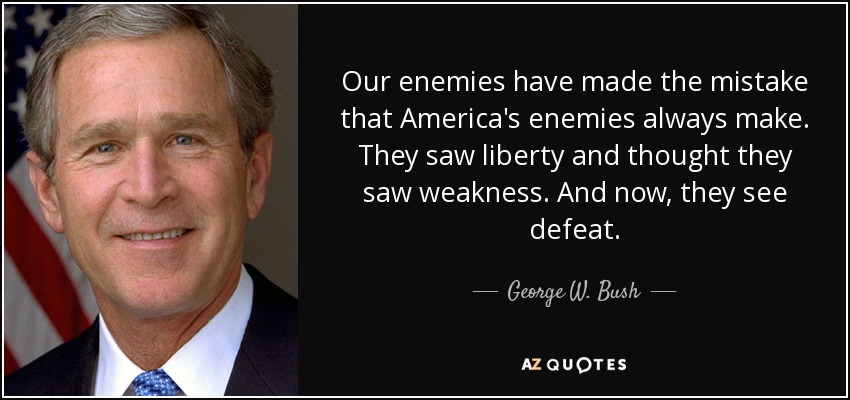
Our enemies have made the mistake that America's enemies always make. They saw liberty and thought they saw weakness. And now, they see defeat.
Remember the hours after Sept. 11 when we came together as one...It was the worst day we have ever seen, but it brought out the best in all of us.
Thousands of lives were suddenly ended by evil, despicable acts of terror. The pictures of airplanes flying into buildings, fires burning, huge structures collapsing, have filled us with disbelief, terrible sadness and a quiet, unyielding anger.
The terrorists are traitors to their own faith, trying, in effect, to hijack Islam itself. The enemy of America is not our many Muslim friends; it is not our many Arab friends. Our enemy is a radical network of terrorists, and every government that supports them.
These acts of mass murder were intended to frighten our nation into chaos and retreat.But they have failed; our country is strong.
The number of casualties will be more than any of us can bear ultimately. And I don't think we want to speculate on the number of casualties. The effort now has to be to save as many people as possible.
Our enemies are a radical network of terrorists - and every government that supports them.
One of the worst days in America's history saw some of the bravest acts in Americans' history. We'll always honor the heroes of 9/11. And here at this hallowed place, we pledge that we will never forget their sacrifice.
These individuals are tyrants, and so they hate democracy. They are bigots, zealots, and persecutors, and so they hate Americas freedom tolerance, and respect for all people. The terrorists of Sept. 11 live and flourish in darkness. They cannot survive in the liberating and inspirational sunlight of American freedom and democracy.
I think a lot of America turned to art and culture after Sept. 11. I know the sales of bibles went shooting up, but so did the sales of poetry. I think in a crisis one looks to one's culture, partially to give validation to why one would want that culture to survive.
The 19 hijackers that came over here to commit the attack on Sept. 11, there were those that were at the bottom of the line. There were those who were the principal conspirators. There were those who were the pilot. Everybody has a role.
Before Sept. 11, the idea that Americans would voluntarily agree to live their lives under the gaze of a network of biometric surveillance cameras, peering at them in government buildings, shopping malls, subways and stadiums, would have seemed unthinkable, a dystopian fantasy of a society that had surrendered privacy and anonymity.
Bombing embassies or destroying non-military installations like the World Trade Center is no jihad. “[T]hose who launched the Sept. 11 terrorist attacks not only killed thousands of innocent people in the United States but also put the lives of millions of Muslims across the world at risk. Bin Laden is not a prophet that we should put thousands of lives at risk for.
Shock, confusion, fear, anger, grief, and defiance. On Sept. 11, 2001, and for the three days following the worst terrorist attack on U.S. soil, President George W. Bush led with raw emotion that reflected the public's whipsawing stages of acceptance.
Unfortunately, after Sept. 11, there was an outburst in America of intense suffering and patriotism, and the Bush administration was very shrewd and effective in painting anyone who disagreed with the policies as unpatriotic or even traitorous.
On a normal day, we value heroism because it is uncommon. On Sept. 11, we valued heroism because it was everywhere.
We've only recently turned the corner on the Sept. 11 attacks being blamed on Jews and Israelis, as well as almost every other terrorist attack, whether in London, Madrid, Bali or Egypt.
But there is scant evidence to tie Saddam to terrorist organizations, and even less to the Sept. 11 attacks.
Saddam Hussein didn't kill 3,100 people on Sept. 11. Osama bin Laden did, and as far as we know he's still alive.
There are two kinds of terrorism. Rational terrorism such as Palestinian terrorism and apocalyptic terrorism like Sept. 11. You have to distinguish between the two.
By a museum, I assume you mean an institution dedicated to the events of Sept. 11 and the aftermath. If that is done with sensitivity, I think it would be most appropriate.
What happened I think on Sept. 11 was we were given graphic and clear evidence that things had changed.
Unfortunately, since the Sept. 11 tragedy, our business is not doing too well.
When you reflect on Sept. 11 and the tragedy of that day, one of the things that came out of that was the goodness of humanity
I predict that in the years ahead Enron, not Sept. 11, will come to be seen as the greater turning point in U.S. society.
Follow AzQuotes on Facebook, Twitter and Google+. Every day we present the best quotes! Improve yourself, find your inspiration, share with friends
or simply: