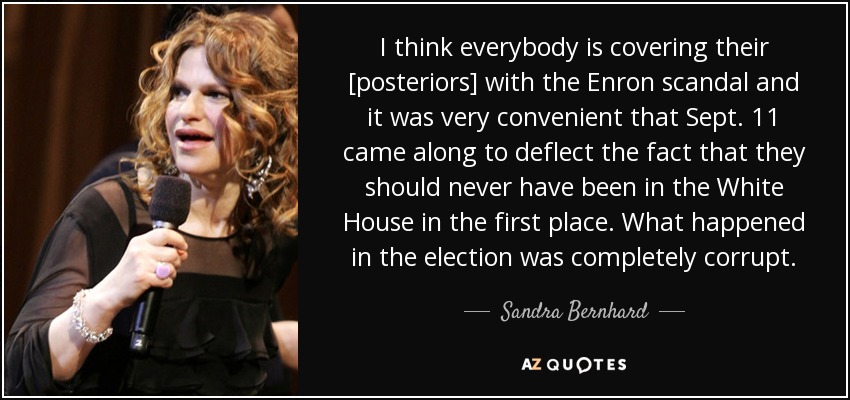
I think everybody is covering their [posteriors] with the Enron scandal and it was very convenient that Sept. 11 came along to deflect the fact that they should never have been in the White House in the first place. What happened in the election was completely corrupt.
One lesson of Sept. 11 is that a government that tries to do everything is likely to do most of it badly.
It is said by Bush men and women that we fought (the Iraq War) to strike against terrorism - except that Iraq had no documented role in the Sept. 11 attacks. It is said that we fought from a moral objection to tyranny - except that we don't seem all that troubled by tyrants in nations that lack huge oil reserves. Everything is said except the truth: that we rushed into an unnecessary war on a half-baked mission. And that the repercussions of our hubris will shadow us for years.
When we were attacked on Sept. 11, we knew the main reason for the attack was that Islamists hated our way of life, our virtues, our freedoms. What we never imagined was that the free press - an institution at the heart of those virtues and freedoms - would be among the first to surrender.
Unfortunately, since the Sept. 11 tragedy, our business is not doing too well.
Saddam Hussein didn't kill 3,100 people on Sept. 11. Osama bin Laden did, and as far as we know he's still alive.
There are two kinds of terrorism. Rational terrorism such as Palestinian terrorism and apocalyptic terrorism like Sept. 11. You have to distinguish between the two.
By a museum, I assume you mean an institution dedicated to the events of Sept. 11 and the aftermath. If that is done with sensitivity, I think it would be most appropriate.
What happened I think on Sept. 11 was we were given graphic and clear evidence that things had changed.
Obviously it is right that the Afghans take responsibility for their own future in the end, but they need to know and feel that we are there as partners for them if they are prepared to make the necessary changes. But we should be in no doubt as to why we are in Afghanistan. We ended up there because terrorism hatched there erupted thousands of miles away in New York on Sept. 11.
Unfortunately, after Sept. 11, there was an outburst in America of intense suffering and patriotism, and the Bush administration was very shrewd and effective in painting anyone who disagreed with the policies as unpatriotic or even traitorous.
But there is scant evidence to tie Saddam to terrorist organizations, and even less to the Sept. 11 attacks.
But it is equally incontrovertible that if our intelligence gathering process is seriously flawed, we had better find out and find out fast if we are to avoid another Sept. 11.
We've only recently turned the corner on the Sept. 11 attacks being blamed on Jews and Israelis, as well as almost every other terrorist attack, whether in London, Madrid, Bali or Egypt.
On a normal day, we value heroism because it is uncommon. On Sept. 11, we valued heroism because it was everywhere.
Before Sept. 11, the idea that Americans would voluntarily agree to live their lives under the gaze of a network of biometric surveillance cameras, peering at them in government buildings, shopping malls, subways and stadiums, would have seemed unthinkable, a dystopian fantasy of a society that had surrendered privacy and anonymity.
Bombing embassies or destroying non-military installations like the World Trade Center is no jihad. “[T]hose who launched the Sept. 11 terrorist attacks not only killed thousands of innocent people in the United States but also put the lives of millions of Muslims across the world at risk. Bin Laden is not a prophet that we should put thousands of lives at risk for.
Shock, confusion, fear, anger, grief, and defiance. On Sept. 11, 2001, and for the three days following the worst terrorist attack on U.S. soil, President George W. Bush led with raw emotion that reflected the public's whipsawing stages of acceptance.
Thank God we're safe. What I anticipated on Sept. 11 was that we would be attacked many times between then and now, and we haven't been.
On Sept. 11, 2001, thousands of first responders heroically rushed to the scene and saved tens of thousands of lives. More than 400 of those first responders did not make it out alive. In rushing into those burning buildings, not one of them asked, 'What God do you pray to?' What beliefs do you hold?'
When people endure a traumatic event, they are either defeated or made stronger. On Sept. 11, I told New Yorkers, "I want you to emerge stronger from this." My words were partially a hope and partially an observation that people in New York City handle big things better than little things. I could not be more proud of the way my city responded.
The attacks on Sept. 11 really sent a shock wave through our economy, and the full reverberation of that is not yet known.
[The answer to that, warns Saddam's eldest son, is no.] If they come, ... Sept. 11, which they are crying over and see as a big thing, will be a real picnic for them, Godwilling.
Just like Sept. 11, only with nuclear weapons this time, that's the threat. I think that is the threat. I think it's just facing reality. It's not a happy reality, but it's reality and if you don't deal with it, it will become even more unpleasant.
In the United States in 2009, more than 10.2 billion trips were taken on transit trains and buses. So far, the nation has not experienced a major transit attack since Sept. 11, but the March 2010 Moscow subway bombings and earlier train attacks in London and Mumbai show that we must be prepared.
Follow AzQuotes on Facebook, Twitter and Google+. Every day we present the best quotes! Improve yourself, find your inspiration, share with friends
or simply: