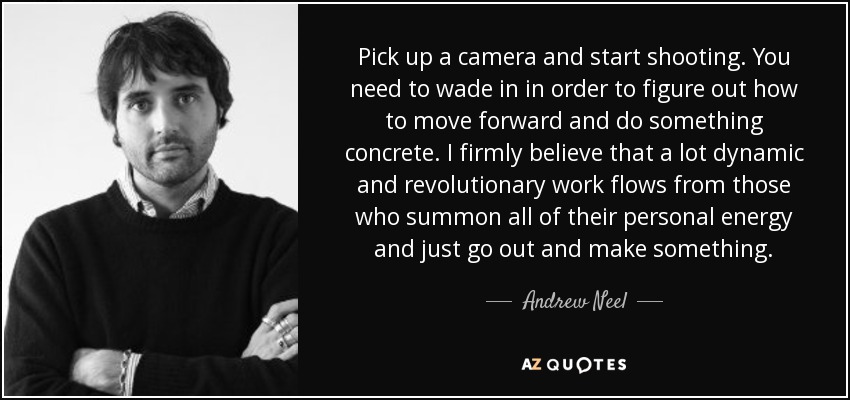
Pick up a camera and start shooting. You need to wade in in order to figure out how to move forward and do something concrete. I firmly believe that a lot dynamic and revolutionary work flows from those who summon all of their personal energy and just go out and make something.
I believe shooting chronologically gives you a very fresh perspective and you're always aware of where you are in the development of the characters.
I wrote the plot [for the Persepolis ]and Vincent [Paronnaud] and I wrote and discussed the shooting of the script. Vincent then took care of the production design, the actual shooting, and what was going on within each scene. It's very difficult, though, to draw a line between who did what. Because Vincent would say something, and I would add something, and at the end you have this film, yet no clear idea of who did what.
Sometimes when you're making a film and something happens during a scene that you've just thought of, it can be missed if the wrong lens is on or if you're shooting in the wrong direction but this [performance capture] doesn't miss a thing. So, you might do something that's genius - very rarely, admittedly - but it doesn't miss it.
Shooting an improv-based film is incredibly liberating, exhilarating, and fun, but editing that kind of movie can be difficult for obvious continuity reasons.
I'm in the gym pretty much every day. I've been very strict about my diet during shooting. It all helps me bring as much authenticity to the role as I can.
The trumpet player, Ronnie Hughes, has still got his chops today but for some strange reason the culture doesn't call him because he's 83-years-old. And these people are in their 70s and 80s and 90s and came with such verve every day and would still be shooting these 10 and 12 hour days. So, that in itself made this an extraordinarily special occasion for all of us. It wasn't a job for the crew after a few days, it took on another tone.
Today, shooting wars are won or lost before they start. If they are fought at all, they would be fought principally to confirm which side had won at the outset.
Any filmmaker, big directors, and I'm not dropping any names - I actually have couple names I want to say, but I will not - we have a ratio. Each thing you repeat, my ratio is one to four.Actually some people are ratio one to 34. I know couple directors, big directors, they are just shooting over and over.
Watching my own past heartache and experience day after day - it was gut-wrenching, cathartic, beautiful, and painful. That and shooting the film in less than a month.
I don't take Hollywood too seriously. I have kids that don't give a damn about what I'm shooting, they just want dinner. So that keeps me grounded.
The summer gig turned into my day job. I was an arts administrator who helped make indie flicks. At the filmmakers' encouragement, I tried shooting a couple of shorts of my own. Directing was stressful, it was not my strength. But writing the scripts and helping others with their scripts - that was a gas. Making stuff up the way I wanted to see it was the biggest kick I ever experienced.
As a young filmmaker, I shot a lot of stuff because I wanted to make sure that I got everything, but now I've gotten much more precise with my shooting. Editing is a whole other layer because then, sometimes you realize characters don't even need to say this or that. It becomes an issue of exposition, and over-explaining something. In the script, I'd reinforce certain things about what I wanted people to know two or three times, but in the editing room, I'd be like, "I only need to say this once, maybe twice."
Most indie shoots, or any kind of film shooting, even TV, it's out of Los Angeles, unfortunately. I wish that would change, that people could work where their families are, across the board - crew, cast. I wish we could all stay here.
Going from a short to a feature is like going from crawling to flying. It's a big jump, really. Everything triples - size of crew, budget, shooting days, the cast. Not to mention the stakes - as a first time feature filmmaker so much rides on this film.
[Having bigger budget] allowed me to be a full-time filmmaker for a couple months and not have to have a day job and be balancing a bunch of other stuff. It allowed me to bring in all these people from different parts of the country. It allows me to have an actual food budget, where we could eat healthy for the month we were shooting. It makes all the difference in the world.
I like shooting things in single takes. You have to rely on the idea itself to carry the full weight; you're always watching the idea, not the filmmaking.
I get very close to people when I'm shooting them. We would go and shoot a scene with Lucy, and I would spend the whole time telling her about Rob. Then I would go shoot a scene with Rob and tell him all about Lucy. Eventually they wanted to know each other. These are two people who would never have overlapped in any other way or context. We brought to the garden at Rob's office and just sat and watched what unfolded. I remember weeping behind the camera, because I was so moved by the way they connected.
In moviemaking, you learn to pay attention to detail, because so much is in the detail. And when you're shooting, you try to be very alert to what's going on, even if you're tired.
I think a lot of America turned to art and culture after Sept. 11. I know the sales of bibles went shooting up, but so did the sales of poetry. I think in a crisis one looks to one's culture, partially to give validation to why one would want that culture to survive.
Film is very much about capturing the essence of things - if you feel it, and you've got the right person shooting it, it'll come across. Theater's a different animal; it's physically different and requires a different discipline. In the theater, you're mining the same material, constantly honing the same thing, executing it and keeping it alive and fresh.
Whenever you take a subject you're obsessed with or that haunts you, and make a movie about it, you're converting it into work units that need to be completed. You gotta turn it into a treatment, a script, a grant application, a bunch of forms to be filled out, a shooting schedule, casting sessions, auditions, shooting, editing, music compositions, the film festival circuit, interviews even. And by the time you've finished the process you're so sick and tired by something that was once very precious to you that you're done with it.
I'm like a shooting star! I've come so far! I can't go back to where I used to be!
I never wanted to accept the position of the observer who is not involved in the situation. The technique and the aesthetics do not matter to me. Only the essence of what is happening is important to me. Here, for example, blurred pictures, they have appeared because for years I was shooting while being drunk.
When I was shooting 'The Bourne Identity,' I had a mantra: 'How come you never see James Bond pay a phone bill?' It sounds trite, but it became the foundation of that franchise.
Follow AzQuotes on Facebook, Twitter and Google+. Every day we present the best quotes! Improve yourself, find your inspiration, share with friends
or simply: