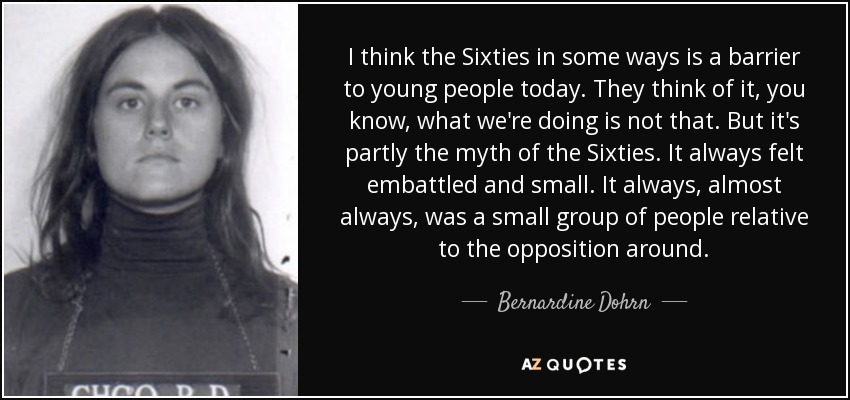
I think the Sixties in some ways is a barrier to young people today. They think of it, you know, what we're doing is not that. But it's partly the myth of the Sixties. It always felt embattled and small. It always, almost always, was a small group of people relative to the opposition around.
In 1860, sixty-three per cent of the couples married in Great Britain had families of four or more children; in 1925 only twenty per cent had more than four.
With sixty professors there are roughly eighteen hundred pairs of professors. Out of that many pairs it was not surprising that there were some whose members did not like one another.
What actually happened was that Rolling Stone paid me fifteen hundred dollars for the use of all the drawings - about twenty four of them - and then offered to buy the originals from me, which my agent urged 'was a good move!'. He sold the whole damn treasure trove to Jann Wenner for the princely sum of sixty dollars per drawing. I rue the day I let him convince me.
The black arrowed swoop of the moment swung high into the unceilinged future, ten, fifty, sixty years, may be: then, past seeing, up to that warmthless unconsidered mock-time, when nothing shall be left but the memorial that fits all (except, if there be, the most unhappiest) of human kind: I was not, I lived and loved, I am not.
I'm such a lucky guy. I've been able to make my own decisions for my own life for the last fifty years...or sixty ... well maybe not sixty. Even though I think I was making my own decisions at the tender age of eight.
The Church in the United States turned a corner about three decades ago, and the idea that we're going back to the incoherence of the late Sixties and Seventies is, frankly, silly. Let's have a little faith in what the Holy Spirit has done among us these past 35 years.
We are living in a Millennial culture that is attacking "patriarchy." The culture in America as zeroed in, and it's been going on and it's been building since the modern era of the feminazis began, since the late sixties and early seventies.
Nothing ruins the mood during foreplay more than the recurring image of your sixty-five-year-old homeroom teacher trying to stretch a condom over a cucumber.
A lot of people think that the music was responsible for a lot of changes in the Sixties, but I think the music came out of it. The music wouldnt have happened without the social changes.
I know that some of the great painters and some of the great artists didn't even start to 'peak', as you say, till they were in their fifties and sixties. And God knows, history is full of artistic people that weren't even recognized till they were dead and gone.
I grew up in the Fifties and early Sixties, which were still quite conservative, and I wasn't given any information about sex or anything like that... I went out with girls at school because one had to. I didn't experiment with sex for quite a long time.
I've always strived to maintain a very healthy, friendly working situation, and lo and behold, it only took forty years, so the next sixty are looking bright. You're dealing with human beings on the cutting edge, and there's bound to be tension. You have to be make room for that, and you can't be too unreasonable, because that's everybody else's role.
There's a lot of women that wanted no part of this feminist movement way back in the late sixties. The modern era can be traced back to then. See, that's the thing. They portray it as though something every woman in America is part of and believes in. And it's not.
In the fifties, you have your beauty as a treat. I thought that until I hit the sixties.In your sixties, life decides to reward you with certain kinds of profound appreciation, so that people name their children and schools and libraries after you! And you still have your sexuality and your sensuality. If you want your sexuality, you still have it.
Of course, you have politics, the Vietnam war and all that monkey business. There are all kinds of reasons. At every one of those demonstrations in the late Sixties about the Vietnam war, you could guarantee there'd be a series of speeches. The ostensible purpose was to protest the war. But then somebody came up and gave a black power speech, usually Black Muslims, then. And then you'd have a women's rights speech. It was terrible to listen to these things.
It was interesting; it's an interesting photographic problem [those demonstrations in the late Sixties]. But if I was doing it as a job, I think I'd have to get paid extra.
English suspenders not American. Could you imagine? Just a pair of knickers and some suspenders. I don't know. How would you wear that? I think this is kind of a cute first date look. A mini sixties Ossie Clark inspired mini dress with a pair on your trotters.
Unlike many Sixties rockers,[Bob] Dylan sang about getting old, about broken dreams. His return to roots music pointed the way for many of his contemporaries to forsake trying to sound 'current' and to instead make music that would stand the test of time.
When I need to take a side, I write a newspaper article and I tell my government, "You should not do that, you should do this." They don't listen to me, but I've been doing this for sixty years now. But, when I write a novel, I am not in that business.
[Michael] Chabon, who is himself a brash and playful and ebullient genre-bender, writes about how our idea of what constitutes literary fiction is a very narrow idea that, world-historically, evolved over the last sixty or seventy years or so - that until the rise of that kind of third-person-limited, middle-aged-white-guy-experiencing-enlightenment story as in some way the epitome of literary fiction - before that all kinds of crazy things that we would now define as belonging to genre were part of the literary canon.
It depends on what your dream might be, as to whether or not it's still possible when you're, say, fifty or sixty. You won't ever pitch for the big leagues, for example. But I believe anyone, regardless of age, can write if he or she is willing to do the work, and I'm talking about spending at least an hour or two at it almost every day for five to ten years.
Full Medicare-for-all, free choice of doctor and hospital: that comes in sixty to seventy percent without even further explanation. And if you ever explained it, given all the trouble people are having qualifying and not qualifying for all these healthcare so-called insurance plans, it would go up even higher.
I get to work on things I've never done before and I get better at it, and I can do things that are innovative. Which I've done in my fifties, and want to continue to do through my sixties.
We went 60 years or more with no immigration, folks. It can be done. The only reason that it started up again, Ted Kennedy started bellyaching about it in the mid-sixties, and then that led to Simpson-Mazzoli 20 years later, 1986, amnesty for about 3.9 million, and we were told that would be it, never again, and of course now we're where we are.
Follow AzQuotes on Facebook, Twitter and Google+. Every day we present the best quotes! Improve yourself, find your inspiration, share with friends
or simply: