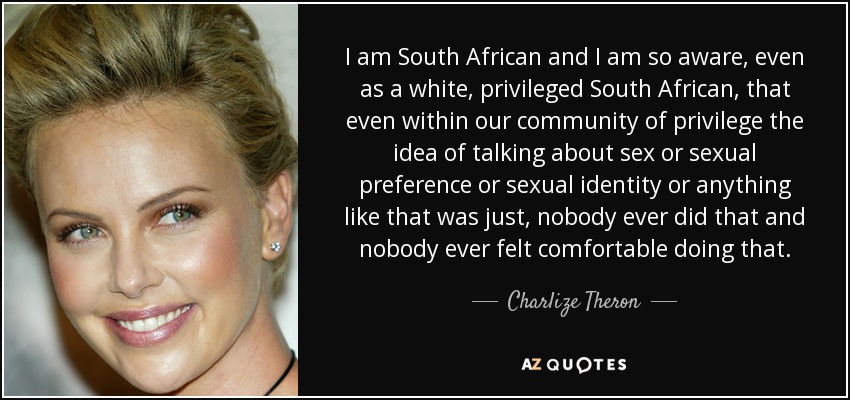
I am South African and I am so aware, even as a white, privileged South African, that even within our community of privilege the idea of talking about sex or sexual preference or sexual identity or anything like that was just, nobody ever did that and nobody ever felt comfortable doing that.
It's pretty impossible to be a South African and not have been personally affected by HIV or AIDS.
Too many people have died so unnecessarily; AIDS is completely preventable, yet it's killing more kids in South Africa then everything else, and that's just not how it should be.
Before I was a vegetarian, I traveled to South Africa and hung out there for a little bit. And they had different animals - did you know different parts of the world have different animals? Because I didn't until I got there! This is what being an American is like. You're like, "Every place has these animals."
It's very rare to find a place where news itself has a political bent. Normally, let's say in the U.K. for instance, newspapers might explicitly support one party or the other, but television is just straight-up facts that are not influenced by any party from either side. In South Africa we try to maintain the same thing. Unfortunately, the government sometimes intervenes, but for the most part, the facts are the facts.
Even in South Africa, the Commonwealth were not doing anything, and their attitude was to tolerate apartheid in South Africa. There was a lot of lip service being paid to the need to stop this practice, but nothing was done.
What I quickly discovered is that our so-called new South Africa has as much material for a story-teller as the old one. The landscape hasn't really changed. Who is in power now is different to who was in power then, but the squatter camps grow like cancer, the rich get richer, the poor get poorer.
Our daily deeds as ordinary South Africans must produce an actual South African reality that will reinforce humanity's belief in justice, strenthen its confidence in the nobility of the human soul, and sustain all our hopes for a glorious life for all.
I just wanted to sing, and I didn't want my music to be unique to the US. I wanted Africans to hear it and know that South African music was still alive.
It was very interesting growing up in South Africa then. It was extraordinary. It was multiculturalism before it became an issue.
My maternal family are South African and when I was small and my parents separated my mother and I went back to South Africa. So for me the emergence of my own childhood consciousness was in the context of 1970s and 1980s apartheid South Africa and the movement there.
In general, Iranians believe that all Palestinians have the right to return home and that there is no chosen people on this earth, whether Jewish, Muslim, Christian. Iran had the same policy towards apartheid South Africa and at the time when it was supporting and funding the ANC [African National Congress] among other groups in South Africa, these groups were also considered to be terrorist organizations by many western governments.
I feel like kids that grew up in New York City or in L.A. were exposed to all these subcultures and subgenres, whereas I was only exposed to the poppiest of pop music so I never had this negative connotation towards pop music. That's not South African music having an effect on me, but just how international music was filtered through South Africa affected me. It gave me a not-negative connotation towards pop music growing up.
I think I was just too young to even understand what was going on. When I was still living in South Africa, there was still so much racial tension.
The racial conversation in the States is so multifaceted and multilayered. Obviously it's not always a positive conversation, but it's just so much more detailed than it was when I was growing up in South Africa.
Nelson Mandela was in jail when I was really young, and Winnie Mandela was one of the biggest faces of the movement. In South Africa we have a common phrase - it's like a chant in the street and at rallies: "Wathint' abafazi, wathint' imbokodo." Which means, "You strike a woman, you strike a rock."
The anti-globalization movement is one of the biggest globalized events of the contemporary world, people coming from everywhere, Australia, Indonesia, Britain, India, Poland, Germany, South Africato demonstrate in Seattle or Quebec. What could be more global than that?
Everywhere I've been, from South Africa to Brazil, people are connected to it. For me, art is a way to bring people together. You can put people on the same level, the perception is the same. You can bring a worker, like a cleaning guy, or the richest guy on earth, and they will have the same feeling or they would be able to feel the same.
When President Mbeki said, if you get AIDS, you can have a shower and it goes away. It's like, oh, come on. Or it's caused by poverty. We faced those kind of issues. But now, with the new regime, they have really woken up, paid attention. And when South Africa speaks, then the whole of Africa will listen. And I have got great hopes for that.
Nothing exceptional [would happen to the world under a Hillary Clinton's presidency] - things would stay the same: sponsorship of "Color" or "Umbrella" or whatever "revolutions", some more coups, "regime changes", direct invasions, bombing, propaganda warfare against China, Russia, Iran, South Africa and what is left of the Latin American revolutions. There would be plenty of torture in "secret centers", but it would not be as advertised and glorified as it would be if [Donald] Trump were elected.
South Africa, it's like the little asshole of the whole world - it's, like, the bottom. It's, like, in the dark depths of the hallway.
I was 15 years old when I first heard the name Mandela, or Madiba, as he is fondly known in Africa. In apartheid South Africa he was public enemy number one. Shrouded in secrecy, myth and rumour, the media called him 'The Black Pimpernel'.
There is a seeded bread that I bring from South Africa. I bring home 10, 20 loaves. I am so bad with this bread. I've literally been in hotels and brought my own: "Please, can you toast this? I have my own bread." They're like, "You have your own bread?" And I'll pull it out!
I feel like I know South Africans. I feel like I know our culture.
It would be a huge mistake to abandon democracy promotion. Peaceful political change has been enormously successful in the past years in Eastern European countries as well as in countries like South Korea, South Africa, Chile and Indonesia. However, if possible, the use of force is something to avoid except in cases where genocide is threatened, like Bosnia or Libya or with regimes that threaten our security, like the Taliban and Saddam Hussein.
Follow AzQuotes on Facebook, Twitter and Google+. Every day we present the best quotes! Improve yourself, find your inspiration, share with friends
or simply: