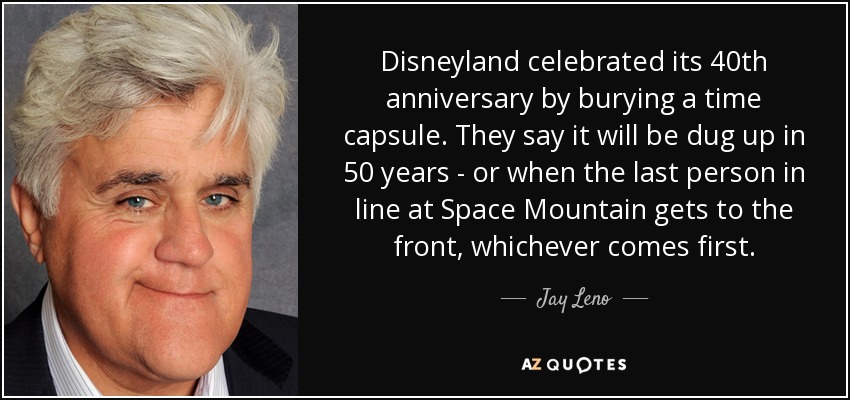
Disneyland celebrated its 40th anniversary by burying a time capsule. They say it will be dug up in 50 years - or when the last person in line at Space Mountain gets to the front, whichever comes first.
An electric chain seems to vibrate, as it were, between our brain and him or her preserved there [in a Daguerreotype] so well by the limner's cunning. Time, space, both are annihilated, and we identify the semblance with the reality.
Magazines are another medium I love, because 95% is simply based on 'How the hell are we going to fill all this blank space?
I want to launch a globe into space just to mess with the astronauts.
The camera can't see space. It sees surfaces. People see space, which is much more interesting.
Young people today are flooded with disconnected images but lack a sympathetic instrument to analyze them as well as a historical frame of reference in which to situate them. I am reminded of an unnerving scene in Stanley Kubrick's epic film, 2001: A Space Odyssey, where an astronaut, his air hose cut by the master computer gone amok, spins helplessly off into space.
Photography, if there is photography, is already snapped, already shot, in the very interior of things and for all points of space.
I think my first impression (of Bix Beiderbecke) was the lasting one. I remember very clearly thinking, 'Where, what planet, did this guy come from? Is he from outer space?' I'd never heard anything like the way he played-not in Chicago, no place. The tone-he had this wonderful, ringing cornet tone. He could have played in a symphony orchestra with that tone. But also the intervals he played, the figures-whatever the hell he did. There was a refinement about his playing. You know, in those days I played a little trumpet, and I could play all the solos from his records, by heart.
London and the south-east of England are very crowded spaces. Wherever a new runway is placed, thousands will be affected. Residents in nearby Longford, Harmondsworth and Sipson, which lie to the north of Heathrow, face having their homes compulsorily purchased for land to build the new runway.
The real mistake of women was to let the memoir, the collective, the history, space of producing history - to let it in the hands of men.
We've let too much time go by. We've been busy with war instead of being busy with peace. And that's what space travel is all about. It's all about peace and exploration and wonder and beauty.
My books are not about different components that fit together like pieces in a jigsaw puzzle, it's about creating the space around the components, which is almost as important as the components themselves. And that space changes and blends depending upon what the components are.
I don't believe space exists. You're not gonna put a camera on a roomba, stick it in the desert, and tell me it's Mars.
Photography's vaunted capture of a moment in time is the seizure and freezing of presence. It is the image of simultaneity, of the way that everything within a given space at a given moment is present to everything else; it is a declaration of the seamless integrity of the real.
Comedy clubs were something that came to pass in the '80s, but toward the end of that, in the early '90s, people started doing comedy again in alternative spaces.
[The photograph is] still a space to reorganize our thoughts about reality and our place in the world. How do you disentangle the surface of reality?
Space and time are figments of you're imagination, unless the guy you're flying next to won't shut up.
Discount air fares, a car in every parking space and the interstate highway system have made every place accessible - and every place alike.
My first pieces, in an art context, were ways to get myself off the page and into real space. These photographic pieces were ways to, literally, throw myself into my environment. They were photographs not of an activity, but through an activity; the activity (once I planted a camera in the instrument of that activity - once I, simply, held a camera in my hands) could produce a picture.
I photograph in public and semi-public spaces that date from various epochs. These are spaces accessible to everyone. They are places where you can meet and communicate, where you can share or receive knowledge, where you can relax and recover. They are spas, hotels, waiting rooms, museums, libraries, universities, banks, churches and, as of a few years ago, zoos. All of the places have a purpose, as for the most part do the things within them.
...photography is made essentially of time. I often think that what we show is a point in time, more than a window onto space.
I wanted to make pictures that contradicted themselves. I wanted to put one picture on top of another so that there were times when both pictures disappear and other times when they were both manifest. That vibration is basically what the work was about for me - that space in the middle where there is no picture, rather an emptiness, an oblivion.
[Love] can be found in making little dresses for stuffed birds, or in a garden of tenderness like I have done - mixing writing, photography, and real spaces. There are all kinds of acts of love.
The decisive moment, the popular Henri Cartier-Bresson approach to photography in which a scene is stopped and depicted at a certain point of high visual drama, is now possible to achieve at any time. One's photographs, years later, may be retroactively rephotographed by repositioning the photographer or the subject of the photograph, or by adding elements that were never there before but now are made to exist concurrently in a newly elastic sense of space and time.
You come to the photograph as an aesthetic object with no context... Then you step in and read the text and then out again to revisit the image in a completely different way. I'm interested in that space between text and image. The piece becomes the negative space between the two.
Follow AzQuotes on Facebook, Twitter and Google+. Every day we present the best quotes! Improve yourself, find your inspiration, share with friends
or simply: