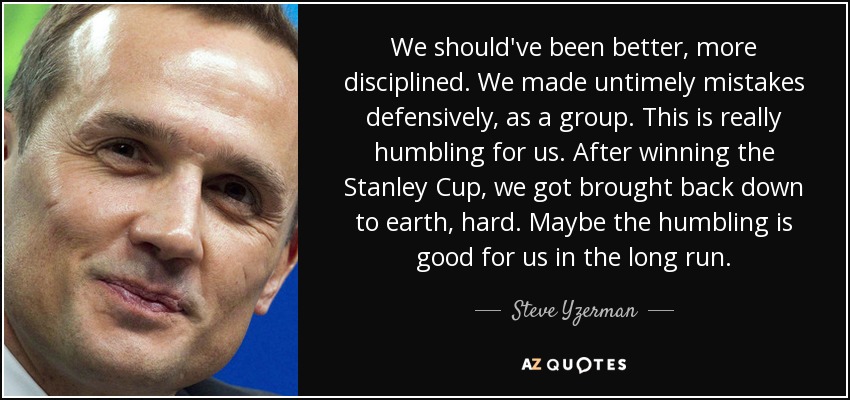
We should've been better, more disciplined. We made untimely mistakes defensively, as a group. This is really humbling for us. After winning the Stanley Cup, we got brought back down to earth, hard. Maybe the humbling is good for us in the long run.
Early on, before rock 'n' roll, I listened to big band music - anything that came over the radio - and music played by bands in hotels that our parents could dance to. We had a big radio that looked like a jukebox, with a record player on the top. The radio/record player played 78rpm records. When we moved to that house, there was a record on there, with a red label. It was Bill Monroe, or maybe it was the Stanley Brothers. I'd never heard anything like that before. Ever. And it moved me away from all the conventional music that I was hearing.
[Stanley] Kubrick was a fascinating, larger than life guy who had been a friend for many years prior to our working together on that film. I found the best part of working with him to be the long conversations we had between set-ups.
We told Stanley Roberts to go on a water diet, and Lake Superior disappeared.
When I came to New York, to Brooklyn, I met Alvin Ailey and Stanley Crouch and August Wilson. They were always putting things in a philosophical context. All the great jazz musicians did, too. There was always a sub-context to what they were saying about music even though they would be very down home and earthy. So I started to develop, in addition to my power and ability to simply hear, a way to place myself in a time.
It's just amazing how many companies suddenly want you to hold up their products after you've held up the Stanley Cup.
[The way Stanley Kubrick] tells a story is antithetical to the way we are accustomed to receiving stories.
I don't want to infantilize the actor; I want to empower the actor. Actors can be many things, but all of the really good ones are really great storytellers, and I'm interested in that. If you're not interested in that as a director then you better be Stanley Kurbrick.
I like collaboration, I like to incorporate other people's ideas [and] that's what happens when you do a big movie. Unless you're called Stanley Kubrick and you do an independent movie for like $200 million.
I try to make everything creative because it's stimulating. There is this great Stanley Kubrick quote somewhere about how life is sort of bad and how creating is important because it lets a little light in.
When you think of diversity, George Duke fits that bill better than a lot of people. He's played a lot of straight-ahead jazz with people like Nancy Wilson and Cannonball Adderley; he's played a lot of fusion with his own groups, with Stanley Clarke; and, you know, he did the rock thing with Frank Zappa. He's written all kinds of big arrangements for people like Burt Bacharach. So, he's covered the board. He's still a great pianist.
I couldn't find any good pictures in magazines of ordinary modern street corners in America, so I persuaded this guy I knew in Sacramento - Stanley Something-or-other - to spend a day with me driving around just to take snapshots.
What pitching is in a short series in baseball, goaltending is in the Stanley Cup playoffs.
I'm sure I've all but lost friends by maintaining that, despite their love for it, I always saw Stanley Kramer's 'It's a Mad, Mad, Mad, Mad World' as more of an exercise in anti-comedy than humor.
I can only write one novel at a time. The author of the Perry Mason novels, Erle Stanley Gardner, often worked on four novels simultaneously, and produced a million words a year. I'm envious.
My only goal is to win the Stanley Cup and do what I have to to win that.
In terms of fiction, there are a number of writers who are thinking about the future of the environment whose work complements mine. Kim Stanley Robinson's novel 2312 is a great example, as is Tobias Buckell's novel Arctic Rising.
I remember hearing a good story about Jack Nicholson working with Stanley Kubrick on The Shining [1980]. Nicholson was saying that, as an actor, you always want to try to make things real. And believable. When he was working with Kubrick, he finished a take and said, "I feel like that was real." And Kubrick said, "Yes, it's real, but it's not interesting".
In the '80s, I loved the movies of the '70s. Also I remember loving Klute [1971]. I loved Jane Fonda. Actually, I auditioned for the last movie she made before she retired for a while, Stanley and Iris [1990], which Martha Plimpton got.
Most influential of all is the philosopher Stanley Cavell, and a younger generation of philosophers who have attempted to follow his pioneering work in thinking about literature philosophically.
At age 12 I had an obsession with Kubrick's A Clockwork Orange and then proceeded to watch all the other Kubrick films I could including a doc called Stanley Kubrick: A Life in Pictures in which it was revealed to me that he started as a photographer...I got a camera sometime shortly after, but spent many years just photographing flowers in my neighborhood.
This In Friendship - out of it came certain connections with the liberal labor establishment. Among the personalities that were involved were Bayard Rustin and a person from the American Jewish Congress, Stanley Levinson.
Individual honors and scoring championships are great, but my No. 1 goal is to win the Stanley Cup.
'Love' has that Kubrick tonality to it, but this is not a Stanley Kubrick movie - there will never be another. At the same time, 'Love' has a modern feel. For example: In one scene, these astronauts go through a wormhole sequence, and you feel like you're being slapped around inside your head by a sonic boom.
Thanks to a deal finalized in 2008, Chicago’s parking meters will be operated for the next 75 years by a group of investors put together by Morgan Stanley, including the sovereign wealth fund of Abu Dhabi.
Follow AzQuotes on Facebook, Twitter and Google+. Every day we present the best quotes! Improve yourself, find your inspiration, share with friends
or simply: