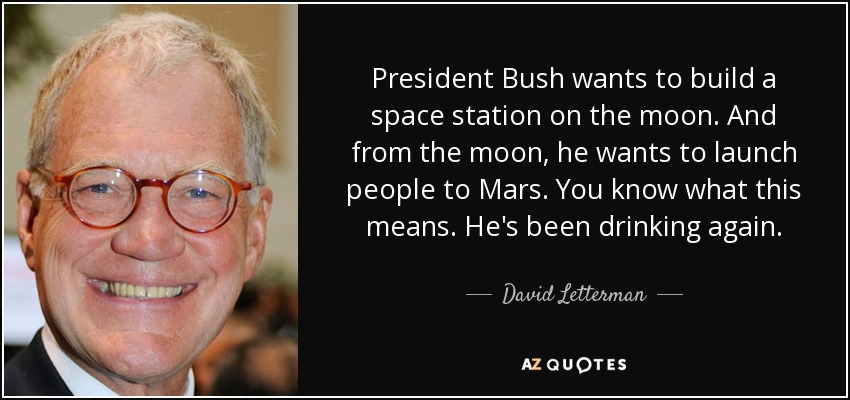
President Bush wants to build a space station on the moon. And from the moon, he wants to launch people to Mars. You know what this means. He's been drinking again.
Somalis have made my city of Wilmington, Delaware, [their home] on a smaller scale. There is a large, very identifiable Somali community, i might add if you ever come to the train station with me you'll notice I have great relationships with them because there's an awful lot driving cabs and are friends of mine. For real. I'm not being solicitous. I'm being serious.
The man of affluence is not in fact more happy than the possessor of a bare competency, unless, in addition to his wealth, the end of his life be fortunate. We often see misery dwelling in the midst of splendour, whilst real happiness is found in humbler stations.
No, he probably wouldn't mention it - except to another flier. Then they will talk for hours. They will re-create all the things seen and felt in that wonderful world of air: the sense of remoteness from the busy world below, the feeling of intense brotherhood formed with those who man the radio ranges and control towers and weather stations that bring the pilot home, the clouds and the colors, the surge of the wind on their wings.
ISS leak is just like on a ship, there are bulkheads that, if there's an emergency, can separate an area that's no longer airtight from the undamaged portion of the station. The former Russian space station Mir actually did once develop a leak, after colliding with an unmanned cargo ship. Everyone survived.
Terrorism threat is serious, and not just to American interests. The assaults in Russia against two airliners, bringing them out of the sky, and against a subway station, and then that horrible scene at the school in Beslan. This kind of terrorist activity no one is immune from it. And so it suggests that we have to do even more together to make sure the civilized worlds join together in the war against terrorism.
All the things I used to count on to get my music out there - record companies, they're all gone. And radio stations, they're gone - they're completely controlled by the government. If they're not controlled by the government, they're controlled by a programmer who's controlled by the government. Mainstream radio is suspect. You can't trust it.
Oil companies have gas stations. There's this whole huge structure that is about finding a new liquid for the tank. And the idea that maybe there shouldn't be a liquid, that maybe the best is an electrical grid, a sustainably powered electrical grid that we all plug into, that doesn't sit well with oil companies.
I wanted to be a broadcaster, sportscaster, or gameshow host from a very early age. I did my first broadcasting when I was 10 or 11 - into a tape recorder for my brother's football game, and for local events. A local radio station was experimenting with high school disc jockeys for rock and roll shifts - I applied - and got the job.
I already tried that. Something heavy metal like. And sunglasses. But it didn't work; I went to the gas station and when I left the guy at the counter said, 'bye Mr Schumacher
I think there's good music out there. I just think that radio stations don't play it.
Stores are the same everywhere; small downtowns are done. Not just in America, but globally. You hear the same music on every station, all our building materials look the same, and all our clothes look the same. But I thought that it couldn't be that simple, because Arizona is not Minnesota. There is this other reality, which is a reality of landscape.
During terms, Professor Marsden lives in Cambridge with his wife, chess player extraordinaire and distinguished physician and surgeon Bryony Asquith Marsden. His favorite time of day is half past six in the evening, when he meets Mrs. Marsden's train at the station, as the latter returns from her day in London. On Sunday afternoons, rain or shine, Professor and Mrs. Marsden take a walk along The Backs, and treasure growing old together.
For the first time American astronauts on the International Space Station ate vegetables grown in space. In other words, even space is getting more rain than California.
It is our human need - to circle back to the station of our sorrow.
The Internet makes it easier to find good music I would have to say. The radio stations that play the kind of music you were talking about, I don't think me and Curt Smith would be that inclined to listen to. It doesn't really affect us and I certainly don't remember the last time I watched MTV.
I don't think my grandmother would ever be convinced, but my family was convinced that I was convinced, and actually, they came around. My mother ended up going to fundraisers in Chicago that were raising money to send to the students in the South and actually, over years, she went to an elevated train bus station one day at 6:00 a.m. to hand out leaflets protesting the war.
Our life has become so economic and practical in its orientation that, as you get older, the claims of the moment upon you are so great, you hardly know where the hell you are, or what it is you intended. You are always doing something that is required of you. Where is your bliss station? You have to try to find it.
I had spent years working in radio at different stations in Toronto; I wasn't in the stage company of Second City.
Nothing will convince and convict those around us like the peaceful and positive way you and I respond to our twentieth century hurts and distress. The unbelieving world-your neighbors, the guy at the gas station, the postman, the lady at the cleaners, your boss at work-is observing the way we undergo our trials.
I don't like the idea of missionaries. In fact, the whole business fills me with fear and alarm. I don't believe in God, or at least not in the one we've invented for ourselves in England to fulfill our peculiarly English needs, and certainly not in the ones they've invented in America who supply their servants with toupees, television stations and, most importantly, toll-free telephone numbers. I wish that people who did believe in such things would keep them to themselves and not export them to the developing world.
And your typical TV series, you've got your police station, your apartment, the hospital, the starship, or whatever it is, and you're constantly going back to those sets and shooting, which saves you a lot of money and time. You can do that faster because you become really familiar with it and you become really good at it.
I haunted streets, whorehouses, police stations, courtrooms, theater stages, jails, saloons, slums, madhouses, fires, murders, riots, banquet halls and bookshops. I ran everywhere in the city like a fly buzzing in the works of a clock, tasted more than any fit belly could hold, learned not to sleep, and buried myself in a tick-tock of whirling hours that still echo in me.
I sleep equally well in a soft bed or on the grass beside the road. If I am given food and shelter, fine. If not, I'm just as happy. Many times I am given shelter by total strangers. When hospitality is not available there are always bus depots, railroad stations and all night truck stops.... When no shelter is available to me, I sleep in the fields or by the side of the road with God to guard me.
I have said, and I believe, that potentially we have in this country a free enterprise system of radio and television which is superior to any other. But to achieve its promise, it must be both free and enterprising. There is no suggestion here that networks or individual stations should operate as philanthropies. But I can find nothing in the Bill of Rights or in the Communications Act which says that they must increase their net profits each year, lest the Republic collapse.
Follow AzQuotes on Facebook, Twitter and Google+. Every day we present the best quotes! Improve yourself, find your inspiration, share with friends
or simply: