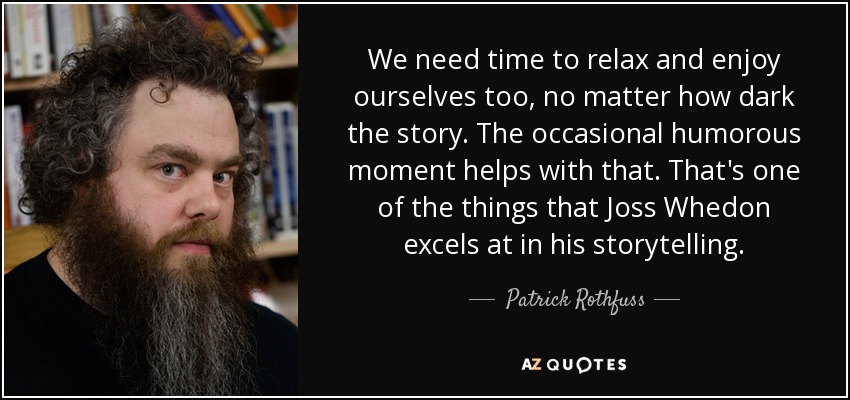
We need time to relax and enjoy ourselves too, no matter how dark the story. The occasional humorous moment helps with that. That's one of the things that Joss Whedon excels at in his storytelling.
We aren't natural statisticians. What we are is natural storytelling machines. And so what we do after we have the facts in hand is build a story to explain the facts.
I've been very passionate about storytelling ever since I was a kid. I really don't remember a time when I didn't want to be an actor, and ever since I could remember, I had a really extravagant imagination.
["John F. Kennedy" movie] was just really clever storytelling.
If you do really good storytelling, things that people also might anticipate and that they might have seen before - there's a reason we go back to stories that we love - so, even if there is a familiarity, if you can do it a different way and hopefully do it well enough, you actually feel the satisfaction of that anticipation given back to you.
Before Gutenberg, there was this really very strong oral storytelling culture where being able to relay stories from person to person was sufficient. And then, with the introduction of printing and mass communication, suddenly somebody had a lot of authority invested in the idea of a single canonical expression of a document or a piece of communication.
While the storytelling in games is getting so much better, you look at something like Grand Theft Auto V, which I thought was really beautifully written, it doesn't really need a movie because it is a movie. So I think you need a unique game - you either need an incredibly talented writer and director to come in and put together an amazing vision, or you need a game like Metal Gear, which is very cinematic, has a huge amount of history behind it, but whose cinematic experience is very different from what you'd get in a theater.
The persona in my stories may be truer to my "real" self than any alleged objective, factual "I" that I could replicate for the purposes of storytelling.
Tribeca has always celebrated the most exciting new forms of storytelling, from video games to virtual reality.
Even if I made pornography, the trauma would show, though. It will always be there because it's my verité. It's my kind of narrative, it's my kind of storytelling. It's not style; it's just there.
There are a number of times when we have found, there's a number of old-school special effects in here that are fantastic, but there are definitely some times that we went digital and you're not going to tell the difference, I don't think. I think it just serves the storytelling because that's just the era that we live in.
But I do think that, when you slow the conveyor belt down, the quality control tends to go up. You have a lot more time between seasons to talk about what worked and what didn't work, and plan for the future. And the pacing of the storytelling, particularly for on-going serialized dramas, means that you don't need to do non-essential episodes, just because you have to fill this pre-existing schedule.
I think the idea that television has evolved to this place of real thematic richness and the fact that you no longer have to get 10 million people to watch your show in order to propagate its survival are the best things that have ever happened to storytelling in this medium.
Hopping around time in a non-linear storytelling fashion (on 'Lost') allows you to bring back characters who are dead and, in some cases, buried. Now that time travel is the story itself, it opens up even more doors. So when an actor reads that they're getting killed off on the show, they're basically, like, 'Okay, but should I still bother to show up next week?'
I was lucky enough to see the original cast of 'In the Heights.' This one blew my mind. The infusion of Latin, hip hop and rap with musical theatre, great storytelling and talent was a powerful combination to me during a time when I'd not been moved by much!
It's main storytelling hell because it's really hard to keep a secret. It's really hard to not communicate. But I think that's what's great about this world is it's a world where he is off the grid, and for me, it's a way to step back.
I grew up with probably three different authors having a seminal influence on my childhood, Dr. Seuss being one and Maurice Sendak being another. That was my parents, who exposed me to their stories. That's how I was introduced to the whole idea of not just reading, but storytelling in general.
I was desperately unhappy with it [Blade Runner]. I was compelled by contract to record five or six different versions of the narration, each of which was found wanting on a storytelling basis. The final version was something that I was completely unhappy with. The movie obviously has a very strong following, but it could have been more than a cult picture.
The teacher always used me as an example to the class of good English and good storytelling because we all had to write the same stories. But she used to make me go out front - which I hated - and read my story to the class and I would get huge applause. Not because of who I was but because they truly enjoyed the stories I wrote.
I like directing much better. It's more fun, that's all there is to it. It's essentially the same job, which is storytelling, but you have more control over the way you want to tell the story. It's a high. I love it.
I think in Russia, there's a lot of storytelling and anecdotes.
I was a Spidey fan as a kid. I always liked the complexity and the teenaged angst that Spider-Man, Peter Parker, always had to deal with. It was kind of a deeper, darker storytelling that just good-guy-beats-bad-guy.
I used to do more melodic stuff, and I used to do more actual rap - like traditional hip hop vocals. I think my method of storytelling has led me to this point, at which I want to pare down my style. I think I give the lyrics more thought, and then when I try to perform the lyrics over the track I'll try it over and over again, and eventually the lyrics will sink into the track by the way I project them.
I just loved storytelling. That's what I thought I would end up doing. I thought I would probably go to school and end up writing for a magazine or something.
The funny thing is that in Bosnia there are no words that are equivalent to fiction and nonfiction. From the storytelling point of view, the difference is artificial.
Follow AzQuotes on Facebook, Twitter and Google+. Every day we present the best quotes! Improve yourself, find your inspiration, share with friends
or simply: