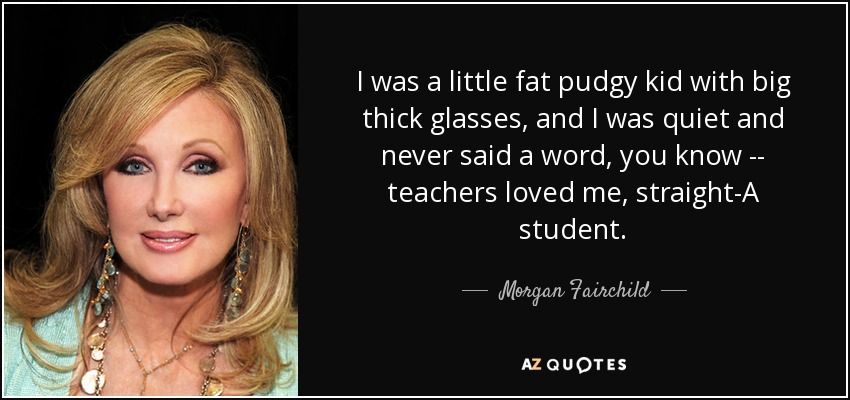
I was a little fat pudgy kid with big thick glasses, and I was quiet and never said a word, you know -- teachers loved me, straight-A student.
In some ways, [the student anti-sweatshop movement] is like the anti-apartheid movement, except that in this case its striking at the core of the relations of exploitation. Much of this was initiated by Charlie Kernaghan of the Institute for Global Labour and Human Rights.
If you can get a teen leader in each sector of a student population, you can pull people in. Everybody wants to get involved, but most are too afraid. When they see a person they think is cool leading it, they're first to join.
If you want help in starting to write memoirs, you don't want to fall into the clutches of a famous writer who has been hired to teach at a writing workshop solely because of his name's ability to attract students, rather than because of any teaching skill. You should not have to grapple with someone who secretly thinks you should be writing about his life rather than your own.
I often tell my students that you can't worry about the end of an improv scene because the end is not up to you. You just play as hard as you can until someone changes the scene. The scene has changedthe end is not up to us.
I had studied piano since I was 13, but I was surrounded by students who'd been playing since they were 5. I realized I was never going to be anything but mediocre.
As a lifelong student of the world’s wisdom literature, it is my duty to inform students that “ridding the world of evil” is a goal very different from any recommended by Jesus, Buddha, or Muhammad, though not so different from some recommended by the Josephs Stalin and McCarthy and by Mao Tse Tung.
I flunked my exam for university two times before I was accepted by what was considered my city's worst university, Hangzhou Teachers University. I was studying to be a high school English teacher. In my university, I was elected student chairman and later became chairman of the city's Students Federation.
I think many of my students have followed the advice I gave years ago, to give more than you take.
What do teachers and curriculum directors mean by 'value' reading? A look at the practice of most schools suggests that when a school 'values' reading what it really means is that the school intensely focuses on raising state-mandated reading test scores- the kind of reading our students will rarely, if ever, do in adulthood.
Every time a bank swoops down to snatch up a home, it should be met with a crowd of jeering, obstructive neighbors. And although this may be point 4.5, how about organizing a mass refusal to pay back student loans?
The idea that human-transforming technology that mingles the dna of natural and synthetic beings and merges man with machines could somehow be used or even inspired by evil supernaturalism to foment destruction within the material world is for some people so exotic as to be inconceivable. Yet nothing should be more fundamentally clear, as students of
The only person who can fix education is the student.
I'm still a student of fashion, but I like hooking up with the people that really know how to make cool clothes.
In this new war, our enemy's platoons infiltrate our borders, quietly blending in with visiting tourists, students, and workers. They move unnoticed through our cities, neighborhoods, and public spaces. They wear no uniforms. Their camouflage is not forest green, but rather it is the color of common street clothing. Their tactics rely on evading recognition at the border and escaping detection within the United States. Their terrorist mission is to defeat America, destroy our values and kill innocent people.
How index-learning turns no student pale, Yet holds the eel of science by the tail!
When I was younger, I was in love with everything about the British Isles, from British folklore to Celtic music. That was always where my passions were as a young girl, and so I studied folklore as a college student in England and Ireland.
We can do it better, more consistently, and in the end, it will cost us less because the students that we produce will be superior to those without technology experience.
Students who have attended my [medical] lectures may remember that I try not only to teach them what we know, but also to realise how little this is: in every direction we seem to travel but a very short way before we are brought to a stop; our eyes are opened to see that our path is beset with doubts, and that even our best-made knowledge comes but too soon to an end.
I am encouraged as I look at some of those who have listened to their "different drum": Einstein was hopeless at school math and commented wryly on his inadequacy in human relations. Winston Churchill was an abysmal failure in his early school years. Byron, that revolutionary student, had to compensate for a club foot; Demosthenes for a stutter; and Homer was blind. Socrates couldn't manage his wife, and infuriated his countrymen. And what about Jesus, if we need an ultimate example of failure with one's peers? Or an ultimate example of love?
Of all forms of mental activity, the most difficult to induce even in the minds of the young, who may be presumed not to have lost their flexibility, is the art of handling the same bundle of data as before, but placing them in a new system of relations with one another by giving them a different framework, all of which virtually means putting on a different kind of thinking-cap for the moment. It is easy to teach anybody a new fact...but it needs light from heaven above to enable a teacher to break the old framework in which the student is accustomed to seeing.
Creativity, my students learn, is as natural a function of the mind as breathing or digestion are natural functions of the body.
If the process don't transfer, they cannot even be called thinking. They can be called learning, memory, or habit, but not thinking. The purpose of a course on thinking is to enhance student's abilities to face new challenges and to attack novel problems confidently, rationally and productively.
One of the most difficult problems of our age is that leaders, and perhaps academics as well, cannot readily admit that things are out of control and that we do not know what to do. We have too much information, limited cognitive abilities to think in systemic terms and an unwillingness to appear to be in control and to have solutions for our problems. We are afraid that if we admit to our confusion, we will make our followers and students anxious and disillusioned. We know we must learn how to learn, but we are afraid to admit it.
The best answer to the question, 'What is the most effective method of teaching?' is that it depends on the goal, the student, the content, and the teacher. But the next best answer is, 'Students teaching other students.'
Follow AzQuotes on Facebook, Twitter and Google+. Every day we present the best quotes! Improve yourself, find your inspiration, share with friends
or simply: