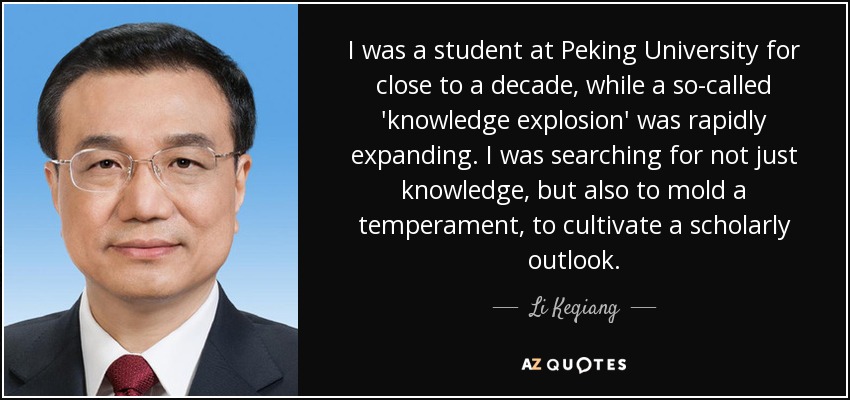
I was a student at Peking University for close to a decade, while a so-called 'knowledge explosion' was rapidly expanding. I was searching for not just knowledge, but also to mold a temperament, to cultivate a scholarly outlook.
As a student of life I just want to be constantly progressing mentally, physically, and spiritually.
If the professors of English will complain to me that the students who come to the universities, after all those years of study, still cannot spell 'friend,' I say to them that something's the matter with the way you spell friend.
So our student will flit like a busy bee through the entire garden of literature, light on every blossom, collect a little nectar from each, and carry it to his hive.
Take Washington, D.C., which spends over $10,000 per student for education whose student achievement would be dead last if Mississippi chose to secede from the Union. Suppose Washington gave each parent even a $5,000 voucher - that wouldn't mean less money available per student. To the contrary, holding total education expenditures constant, it'd mean more money per student remaining in public schools.
Political journalists love graduate student intelligence, the ability to make clever allusions in seminars, and in 1999-2000, they hassled George W Bush for not having it. They didn't realise what this book succinctly displays: that the president has something far more important - CEO intelligence, the ability to ask tough questions, garner essential information and make discerning decisions.
The day of my departure at length arrived. Clerval spent the last evening with us. He had endeavoured to persuade his father to permit him to accompany me and to become my fellow student, but in vain. His father was a narrow-minded trader, and saw idleness and ruin in the aspirations and ambition of his son. Henry deeply felt the misfortune of being debarred from a liberal education. He said little, but when he spoke I read in his kindling eye and in his animated glance a restrained but firm resolve not to be chained to the miserable details of commerce.
On the one hand, we had great filmic spectacles that brought in big audiences, adults as well as primary and secondary school students. On the other hand, there were attempts to create contemporary Polish film.
Literary or scientific, liberal or specialist, all our education is predominantly verbal and therefore fails to accomplish what it is supposed to do. Instead of transforming children into fully developed adults, it turns out students of the natural sciences who are completely unaware of Nature as the primary fact of experience, it inflicts upon the world students of the humanities who know nothing of humanity, their own or anyone else's.
Every good teacher and every good parent has somehow learned to negotiate the paradox of freedom and discipline. We want our children and our students to become people who think and live freely, yet at the same time we know that helping them become free requires us to restrict their freedom in certain situations.
My rule in making up examination questions is to ask questions which I can't myself answer. It astounds me to see how some of my students answer questions which would play the deuce with me.
At MIT, I had the good fortune for seven years to teach network theory, which is basic to many disciplines, to one-third of the undergraduate student body. It was an experiment to see how high we could bring their level of understanding, and it exceeded all of my expectations.
Pity wraps the student of the past in an ambrosial cloud, and washes his limbs with eternal youth.
At North Hollywood High School, I was shunned by everyone. I would sit down in the cafeteria, and students would get up from the table and walk away. They thought I was from the Mafia...
Give more than you receive. That is the principle I tell all my students.
Teacher cannot solve or heal all student stress. The teacher can be vigilant in trying to guide the child toward solutions;but the teacher's job in relation to this stress is ultimately to help the child learn to manage his or her own stress wisely. In accomplishing this, the teacher mentors higher academic learning by removing distracting stress, and teaches valuable life-survival skills.
To the student I would say, "Life is principally multiple choice, but at the end there's a tough essay question.
There are two men in Tolstoy. He is a mystic and he is also a realist. He is addicted to the practice of a pietism that for all its sincerity is nothing if not vague and sentimental; and he is the most acute and dispassionate of observers, the most profound and earnest student of character and emotion.
Most subjects at universities are taught for no other purpose than that they may be re-taught when the students become teachers.
You [the teacher] do not merely insert a lot of facts, if you teach them [the students] properly. It is not like injecting 500 cc. of serum, or administering a year's dose of vitamins.
I have always been - I think any student of history almost inevitably is - a cheerful pessimist.
Writing is very cathartic for me. As a teacher, I hear many students say that writing can be painful and exhausting. It can be, but ultimately I believe that if you push through, the process is healing and exhilarating.
Students who don't want to get anywhere are sure to get somewhere.
You know, there are some areas of the state that are providing enormous help to their students; there are others where they're not doing what they can.
The atmosphere [in the school lunchroom] is not quite that of a prison, because the students are permitted to talk quietly, under the frowning scrutiny of teachers standing around on duty, during their meal-they are not supposed to talk while standing in line, though this rule is only sporadically enforced.
Follow AzQuotes on Facebook, Twitter and Google+. Every day we present the best quotes! Improve yourself, find your inspiration, share with friends
or simply: