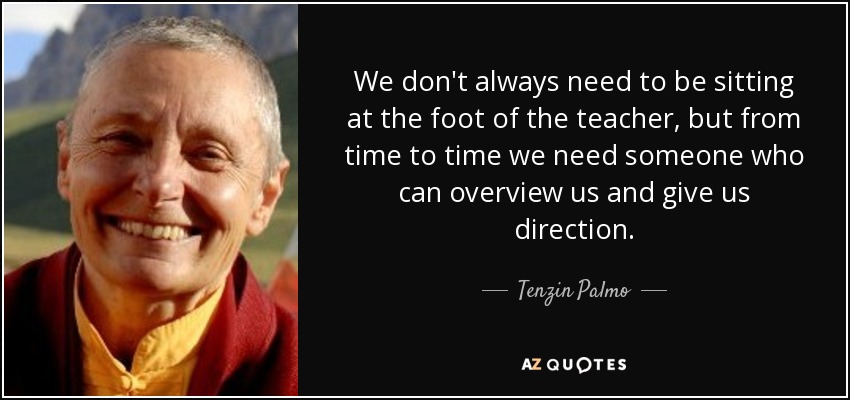
We don't always need to be sitting at the foot of the teacher, but from time to time we need someone who can overview us and give us direction.
Many people have overcome that home situation simply by having at least one caring adult, whether a teacher, mentor or religious leader.
We all have our own karma and so different teachers will be meaningful to different students.
What you're experiencing now [on "MasterChef," on "Junior"] is what life's going to be like for the next four, five decades. You're going to go through those bumps. Bringing you back in contention and giving you that kind of confidence, they're huge. But they let it go, there's no fear, they're naughty, they're rude, and they know there's no parents and there's no school teacher so they can have fun, and it shows.
I'd say look at the teacher's students. Do you want to be like them? If you see a good and harmonious sangha, and if they're practicing well and are good people with good hearts, then you have a cause for trust.
Doing retreats, getting personal teachings from time to time from inspiring teachers, all of this helps to recharge our batteries. Then we get inspired and can carry what we've gained into our daily life, which is very important.
There's all kind of evidence that there is enormous corruption in the distribution of that money. For example, they gave about $100 to $150 dollars to each of the teachers. They gave about $500 dollars to those who were getting married. Through this process, they obviously collected a lot of votes, but these monies could not solve the structural problems that these people face. But the only result, the only consequence, was that a big sum from the budget was wasted this way.
That's what we do on "MasterChef," on "Junior." No school teachers, no parents, let it go. You're going to go on a challenge. We're going to go to hell and back, and we're going to have some bumps.
Paul Gleason played the teacher. I just tortured him as best I could. 'Cause he wasn't one of the kids, you know, so it was okay. He was great.
What was on the agenda was school and social life and those kinds of things. So I was the middle of five kids. So I had the great advantage of being able to play up to the older kids and play down to the younger kids and I think that's part of what propelled me to become a teacher at some point in my life. But it was a comfortable childhood. It was a privileged childhood.
Anybody who puts a book into someone else's hands inspires me - teachers, librarians, booksellers, parents.
I'm grateful for every teacher or librarian who reads a book and says, "This is exactly the book that so-and-so needs to read; I'll get it in his hands." I'm amazed at the network of adults who make sure that kids get books.
Books have always been important to me - my mom was a first grade teacher, so I grew up reading all the time.
We need more good jobs, and that means we've got to start educating young people, starting literally in the first five years of life making sure that every kid in every zip code has good teachers and good schools, making college affordable, helping people pay down their debt.
I didn't see [Luigi St. Omer] as a teacher. I saw him as a comrade I respected and I could go to see anytime something was bothering me. He was indeed my "big brother". He praised me when I did something exceptional and scolded me when I did things which were out of the way.
Many of my family members are teachers in the arts, and I picked up the camera years ago, in high school.
Judo has been part of Japanese culture for a long time. It makes sense to me that this sport, which is both athletic and philosophical, was created in Japan. It is based on respect for the partner and for our elders as our teachers, which is very important and makes a strong, positive contribution to human relationships, and not only in sports. I am happy that life brought me to this wonderful sport as a child. It is like my first love.
Have you ever seen the stereotype of the angry yoga teacher? There are some people that are at an 11 and yoga takes them down to a nine. That's me.
I also got encouragement from my teachers at primary school but one person in particular who had a significant impact on my lean towards art is Mr. Luigi St. Omer. Mr. St. Omer was the one who always reminded me that I should not settle for less than greatness in my art. He saw that I had the potential and he helped me develop that talent.
The First Man is completely autobiographical. The mother [Albert Camus] describes is the woman I knew, and she was exactly as he describes her. And this teacher really existed.
[Albert] Camus writes his acceptance speech for the Nobel Prize in thanks to his teacher.
Obviously, ["Fences"] is a character-driven piece in every sense of the word, and Denzel [Washington] knows the actor. He gave us two weeks of rehearsal. He is a truth teller, and he is a truth seer. So he knows when something is not going in the right direction, and he will call you on it. But, he knows the word to use to unlock whatever is blocking you. So I think he's fabulous and he's a teacher.
I had the opportunity, as a child, to grow up in a community center where I was exposed to theater, music, art, and computer science; things that I would have never had the opportunity to even meet had it not been for those people taking time out of their schedules, helping us as children to travel all over the world while sitting in a gymnasium. That's what I did before I was a musician, before I was a recording artist, I was a teacher and a community leader.
Man, I wouldn't know where to begin on education reform, but one thing we have to do is add teacher accountability WITHOUT stressing standardized test scores.
I just remember a creepy sex-ed teacher putting a banana on a condom and then saying, "It goes in the girl if she gets all juicy." We didn't even believe it. We were like, "Well, that's weird."
Follow AzQuotes on Facebook, Twitter and Google+. Every day we present the best quotes! Improve yourself, find your inspiration, share with friends
or simply: