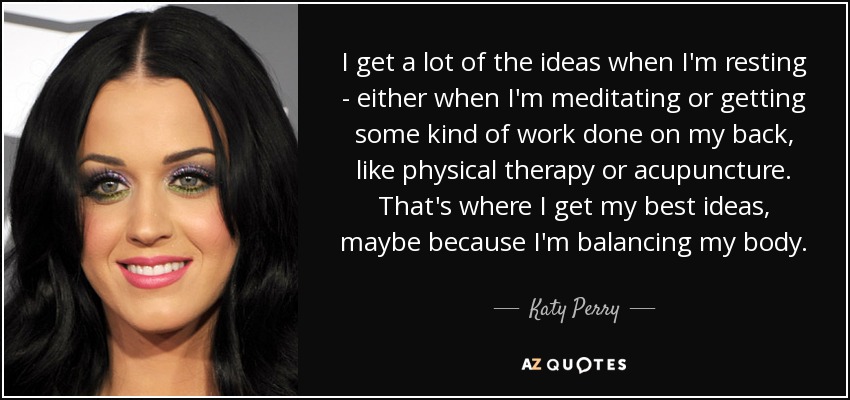
I get a lot of the ideas when I'm resting - either when I'm meditating or getting some kind of work done on my back, like physical therapy or acupuncture. That's where I get my best ideas, maybe because I'm balancing my body.
Believe it or not, Marshal, I believe in talk therapy, basic interpersonal skills. I have this radical idea that if you treat a patient with respect and listen to what he's trying to tell you, you just might reach him. (87)
The music does bring us together and it's cheaper than therapy!
I recommend a balance between the therapies that are available, the medicines that are available but not to give up on the body as a result.
Therapists need to have a long experience in personal therapy to see what it's like to be on the other side of the couch and see what they find helpful or not helpful. And if possible, get into therapy at different stages of their life with different kinds of therapists just to sample a bit.
One doesn't do existential therapy as a freestanding separate theory; rather it informs your approach to such issues as death, which many therapists tend to shy away from.
You know, I think everybody I've seen has come from some other therapy, and almost invariably it's very much the same thing: the therapist is too disinterested, a little too aloof, a little too inactive. They're not really interested in the person, he doesn't relate to the person. All these things I've written so much about. That's why I've made such a practice really, over and over to hammer home the point of self-revelation and being more of yourself and showing yourself. Every book I write I want to get that in there.
One reason patients are reluctant to work in a therapy group is they fear that things will go too far, that the powerful therapist or the collective group might coerce them to lose control--to say or think or feel things that will be catastrophic. The therapist can make the group feel safer by allowing each patient to set his or her limits and by emphasizing the patient's control over every interaction.
To the best of my knowledge, every acute inpatient ward offers some inpatient group therapy experience. Indeed, the evidence supporting the efficacy of group therapy, and the prevailing sentiment of the mental health profession, are sufficiently strong that it would be difficult to defend the adequacy of the inpatient unit that attempted to operate without a small group program.
History is replete with examples of what happens when any group of authorities do not have to answer to empirical evidence but are free to define truth as they see fit. None of the examples has a happy ending. Why should it be otherwise with therapy?
I have occasionally thought that some [TV] hosts have needed treatment, and some of these hosts have even admitted they could benefit from therapy. Having said that, I think most people can benefit from treatment. Those who need it and refuse to get it generally have the most "issues.
Most doctors are uncomfortable with medical conditions that have a psychological basis.
What were the bodies like on the beach? Ugly and white and ruined by offices.
There is a groan that unites men and women, rich and poor, in any nation. These muscle pains are "explained" in every culture, but the universal fact of this persistence must mean that no adequate therapy exists.
Medical thinking usually sees stress as highly disturbing but isolated events such as, for example, sudden unemployment, a marriage breakup, or the death of a loved one. These major events are potent sources of stress for many, but there are chronic daily stresses in people's lives that are more insidious and more harmful in their long-term biological consequences. Internally generated stresses take their toll without in any way seeming out of the ordinary.
... While nervous tension may be a component of stress, one can be stressed without feeling tension.
Some patients do seem to have some kind of post-infection meltdown. They don't still have an infection any more in any sense that we understand infection. But someone is going to have to explain these patients to me someday.
I still am amazed that people would never buy a car if they were told it gets 75 miles to the gallon - they're absolutely clear on what's a scam. But when it comes to their health they will immediately fall for somebody telling them, "Take this pill and you'll live to be a hundred years old." There's something about medicine that allows us to fall for stupid sales pitches more easily.
I must have physical exercise, or my temper'll certainly be ruined.
To pretend to be calm is to be calm, in a way.
Paper after paper, study after study, have shown that chairs give us back problems because they shorten our hip flexors, give us weak backs, of course it make us sedentary. We take years off our lives probably by sitting in chairs, but we like them because they're comfortable. You go to an African village, you find me a chair with a back. That's a rare thing out there.
The method of science, as stodgy and grumpy as it may seem, is far more important than the findings of science.
... our diagnosis and treatment of of tension myositis syndrome represent yet another instance of what is possible when the power of the mind is mobilized for healing the body. It's not magic; it is as scientific as the appropriate use of antibiotics, for science encompasses everything that is true in nature.
We must learn to recognize nature's truths even though we don't understand them, for some of those truths may still be beyond the ability of the human mind to comprehend. What we need is a compound prescription of humility, imagination, devotion to the truth and, above all, confidence in the eternal wisdom of nature.
A knowledgeable physical therapist can slowly build up patients' confidence by reassuring them that there is no structural problem and reminding them of the physiologic reason for the pain.
Follow AzQuotes on Facebook, Twitter and Google+. Every day we present the best quotes! Improve yourself, find your inspiration, share with friends
or simply: