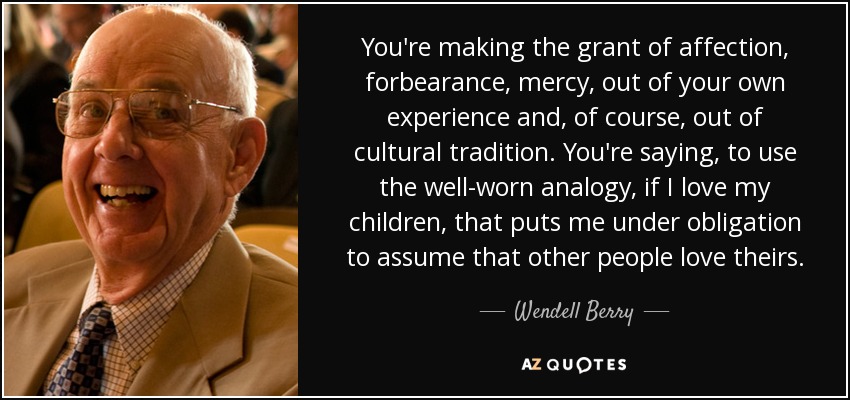
You're making the grant of affection, forbearance, mercy, out of your own experience and, of course, out of cultural tradition. You're saying, to use the well-worn analogy, if I love my children, that puts me under obligation to assume that other people love theirs.
I'm very optimistic that there are sincere believers out there that are okay with tradition but don't want to endorse traditionalism for the sake of traditionalism but want to embrace tradition because it's God-honoring. I think that's a beautiful thing.
One of the traditions of film acting is a sort of mumbled realism. Be minimal, and do less. 'Even less than that.'
Bullfighting is anachronistic - you enter into a bullring and you're leaving behind the values of the world outside the ring. I suppose that what I would want to acknowledge is that perhaps the tension, the crucial tension, isn't necessarily between the view of bullfighting as a tradition versus as an art form, but between the values inside the ring and the values outside the ring.
I was a bullfighter. I'd like to see the tradition continue. I'm sorry that Catalonia is robbing itself of a tradition that belongs in Catalonia.
Incidentally, I am intrigued by how many European and Latin American writers expressed their political views in the columns they routinely wrote or write in the popular press, like Saramago, Vargas Llosa, and Eco. This strikes me as one way of avoiding opinionated fiction, and allowing your imagination a broader latitude. Similarly, fiction writers from places like India and Pakistan are commonly expected to provide primers to their country's histories and present-day conflicts. But we haven't had that tradition in Anglo-America.
Broadly speaking, it is my conclusion that a pretty good guide to most issues of natural law is to look at those areas where you find a consensus in the Judeo-Christian tradition. I think that is roughly, not unerringly, the outline of what I would call natural law.There must be some moral values underlying any civilization; that's my guide.
Albert Murray's The Omni-Americans is the most valuable non-business book because it discusses how you have to draw upon everyone's creativity. America is a mash-up of cultures and traditions, and great businesses know how to tap the strengths of all their employees, whatever their background may be.
I often say that I'm a Buddhist-Episcopalian. I say that partly to annoy people.I like to annoy people who think that a religion can contain the whole truth. No religion, it seems to me, contains the whole truth. I think it's mad to think that there is nothing to learn from other traditions and civilizations. If you accept that other religions have something to offer and you learn from them, that is what you become: a Buddhist-Episcopalian or a Hindu-Muslim or whatever.
I don't think religions will merge into a great global faith. But I do believe we're moving toward a global ideology that has a place for religion and recognizes the contributions of the different traditions. Hopefully, it will have an overarching view as to how we can work together for the promotion of human values and spirituality.
Tolerance has been a very important feature of Christianity from its very roots, despite all the other things that have gone on since. And that, I think, must be the global perspective. Tolerance implies more than saying, "Well, let the Muslims go on with what they are doing." It also means trying to learn something from them and adding that to your own tradition. That is the attitude I think needs to inform the global citizen of the future.
I was nurtured in the church; I went to a Catholic school; I was an altar boy; I went to a Catholic university; I was steeped in the moral tradition of the Catholic Church. My Catholicism plays a very strong role. But I thought President John F.Kennedy answered rather well when he said that ultimately my conduct as a public official does not come ex cathedra from Rome; it comes from my conscience.
When Europeans came to the New World the first thing they said is, well, Indians don't appreciate property. They're savage. They're backwards. They're uncivilized. ... Nothing could be farther from the truth. Tribes have very clear conceptions of their traditional boundaries, they maintain their rights and their claim sovereignty over the lands according to their own honored traditions and tribal elders. And so, you can go out there on the reservation, and there might be a reservation boundary established by the United States. But then there's traditional land boundaries.
This is a tradition of resistance to the term that's as old as the term itself, especially because that term has been used to commodify and reduce black creativity, and also to appropriate and sell it. That's what John Coltrane said in an interview with a Japanese journalist: "Jazz is a word they use to sell our music, but to me that word does not exist." And he's treated as one of the central figures in the history of jazz. So if he rejected it, then why is it weird when I do it? I'm in the tradition!
I think the progressive audience that loves Star Trek will be happy that we're continuing that tradition being progressive and all-inclusive. Star Trek's not necessarily a universe where I want to hear a lot of profanity.
My poems are certainly in the lyric tradition, but perhaps a reader can tell me more precisely who I am as a poet. How can I be so old and not know? I have always been deeply grateful for the urge to write, the desire to create, that's certain. Writing has always been the way I make sense of life. Perhaps my poems define me, rather than the other way around. They do constantly surprise me.
I think that America is an ideal place for the privileged homeless, who are used to different cultures. It's easiest and most accommodating because it is a country of exiles and immigrants and newcomers. There are no walls, in that sense. There is always the sense that traditions are being made as we speak. So you can slot yourself in. If you are living at a distance in society, this is one of the most congenial societies to live in.
Jorge Luis Borges was lamenting a variety of Orientalism that was used to measure the alleged authenticity of Argentine and Latin American writers in the midcentury. The Argentine literary tradition was believed by many, including many Argentines, to be concerned with a national imaginary in which the gauchos and the pampas and the tango were fundamental tropes. Borges, in part to legitimize his own Europhilia, correctly pointed out that expecting writers to engage with these romantic nationalist tropes was arbitrary and limiting, a genre that was demonstrative of its own artificiality.
I have this very kind of like heterodox idea of what an education is, what underpins identity. I don't think I'm very easily pigeon holed in any of those boxes, so I confront this. I have a staff full of young people who came up in a very different tradition and who feel very fired up about the big identity battles. I listen and I try to navigate them, but I don't find them mapping onto my life in a personal way which is, which is hard.
The communal experience of sharing something, and being part of it, and watching something visually striking, that's what film is all about. Seeing everything on a big screen, and to be able to see something phenomenal in that way, and being moved by it. We have kind of lost the tradition of that, and we're not nurturing the next generation in that tradition, and maybe that's why they're not turning up.
Over the past 40 years, the tradition of Southern progressivism has been somewhat successfully erased by right-wing revisionist historians.
I have no expertise of other religious traditions so I'm not going to opine on them, but in Islam the more you know about the religion, the more likely you're going to go to hell. Many people will find that paradoxical because we tend to think of religion as a way of making ourselves feel better and a way of damning and excluding infidels or reprobates or heretics or what have you. It was very hard for me to find an Islam that belongs to me and doesn't feel like it's been imposed on me.
Barcelona, the tournament is, for all the Spanish players, an amazing event. I think is one of the top events on tour because is a historic event with a lot of tradition. A lot of years of the tournament, a lot of great players have been playing there. And it's in a real tennis club.
Donald Trump hasn't been specific, but if you go back over some of the campaign rhetoric, well, obviously, there's the bully pulpit, just publicly shaming out-sourcing companies. And that again is not new to Trump. If you remember, back in 2004, John Kerry was making noises about Benedict Arnold CEOs in a similar context. So, that's got a long and gloried tradition.
Any country is hard to govern, even a very small country. It's not a question of whether the country is large or small. It's a question of how you relate to the work, to what extent you feel responsible for it. Russia is also hard to govern. Russia is at the development stage of both its political system and the creation of a market-based economy. It's a complicated process, but very interesting. Russia, actually, is not just a large country, it's a great country. I mean its traditions, and its cultural particularities.
Follow AzQuotes on Facebook, Twitter and Google+. Every day we present the best quotes! Improve yourself, find your inspiration, share with friends
or simply: