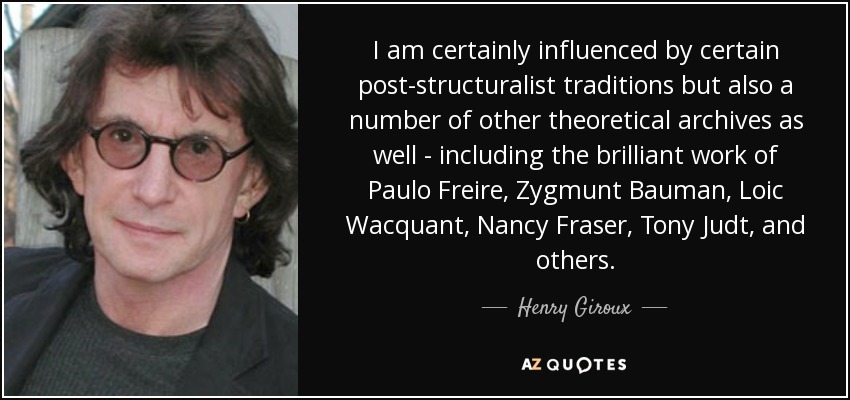
I am certainly influenced by certain post-structuralist traditions but also a number of other theoretical archives as well - including the brilliant work of Paulo Freire, Zygmunt Bauman, Loic Wacquant, Nancy Fraser, Tony Judt, and others.
Everyone understood [Charlie Hebdo], as people had understood for hundreds of years, knowing that Rabelaisian tradition of French satire, they knew how to read it. And they understood the kind of release from piety that it represented every week.
[Tibet] is a small country based on religious principle, religious traditions. It never wanted any conquest.
The South actually has a very strong tradition of activism. The civil rights movement came from down here! It was black activists demanding that their voices be heard. People say these are red states. No they're not!
What I'd like to see developing is an American radicalism, libertarian in character, which relies, however weak, faint, and even mythic these traditions may be, on the American libertarian tradition. I don't mean right-wing libertarianism obviously.
I think we have two conflicting traditions in this country. I think it's important for us to recognize that we've got a tradition of handgun ownership and gun ownership generally. And a lot of people - law-abiding citizens use if for hunting, for sportsmanship, and for protecting their families. We also have a violence on the streets that is the result of illegal handgun usage. And so I think there is nothing wrong with a community saying we are going to take those illegal handguns off the streets.
New England has a strong tradition of localism. What is ordinarily called election day in most of the United States is called town meeting day in Vermont.
In the Buddhist tradition, where mindful meditation comes from, anger is regarded as a somewhat unhealthy,unskillful emotion because we can be blinded by it. We don't see clearly and tend to do things and say things that are harmful out of the anger because we don't have clarity.
I admire the Shabbat tradition, and no matter which faith you are of, there is nothing more wonderful than dedicating a certain day to spend time with your family and loved ones, absent of TV, phone, and other interruptions.
I celebrated my 18th birthday in Japan, which was quite memorable; I was quite fascinated by the different traditions and the culture; it was so completely different to Australian culture.
We must embrace our differences, even celebrate our diversity. We must glory in the fact that God created each of us as unique human beings. God created us different, but God did not create us for separation. God created us different that we might recognize our need for one another. We must reverence our uniqueness, reverence everything that makes us what we are: our language, our culture, our religious tradition.
People read a lot of stories about witches, fairies, paranormals, and children possessed by evil spirits. They go to films showing rituals featuring pentagrams, swords, and invocations. That's fine, people need to give free reign to their imagination and to go through certain stages. Anyone who gets through those stages without being deceived will eventually get in touch with the Tradition.
A great unification is now taking place between science and spirituality. The most advanced discoveries of modern science are rising to reaffirm the timeless wisdom of the great religious and spiritual traditions of every culture.
Games were moved to New Year's Eve as part of a plan by college football executives where they want to create a tradition of watching football on New Year's Eve.
I became a pedant of the form. I did my graduate work in art history and particularly in the history of French satirical cartooning. And that made me aware of what a rich and resilient tradition this seemingly scabrous sacrilegious magazine still represented in French life.
It's once I discover the people inside that the story really gets going, and then the formal invention becomes less important. It's just the way in; it's the door; and then what's behind it is always some kind of people, which I think probably makes me more in the tradition of realistic fiction because that's usually what I'm interested in, the people.
That became my aesthetic - a very Chekhovian, American realist aesthetic in the tradition of Raymond Carver, Richard Ford, and Tobias Wolff. The perfectible, realist story that had these somewhat articulate characters, a lot of silence, a lot of obscured suffering, a lot of manliness, a lot of drinking, a lot of divorces. As my writing went on, I shed a lot of those elements.
One of the things that bugs me about the Western Literary Tradition is that the conventions of narrative in particular seem to confine the stories you can tell about characters to tropes of bone-headed action and old models of psychological realism. And as readers, too, we have been conditioned to understand characters as - and forgive me for saying it out loud - what the market says they should be. Namely, safe, clean, proper.
Certainly I'm participating in an already established and awesome tradition, but it's a tradition that sort of shoots up and through the mainstream in short bursts and pulses and then gets diluted. Walt Whitman and Emily Dickinson shot up and then got sucked back down underground under more entertaining and less radical versions of body and self - poetry and prose that posited bodies in more perfect union with good citizenship.
Most of my formal choices are a combination of everything I learned about form - semiotics, linguistics, and the history of style experimentations tethered to literary movements (formalism, deconstruction, modernism, and postmodernism), and the basic principal of breaking every rule I ever learned from a patriarchal writing tradition that never included my body or experience, and thus has nothing to offer me in terms of representation.
Thanksgiving, you know - Thanksgiving - it's like we didn't even try to come up with a tradition. The tradition is we overeat.
Over the past 40 years, the tradition of Southern progressivism has been somewhat successfully erased by right-wing revisionist historians.
I don't feel the individualist anarchists, particularly in the American tradition, including the Transcendental tradition of New England, in any way deserve the derogatory comments that are often made about them by the left. When one gets down to it ultimately, my anarcho-communism stems from a commitment to true individuality. My attempt to recover the power and the right of the individual to control his or her life and destiny is the basis to my anarcho-communism.
My concern is to develop a North American type of anarchism that comes out of the American tradition, or that at least can be communicated to Americans and that takes into consideration that Americans are not any longer people of European background.
Certainly, the country can't have two presidents at once, so the tradition has been to hang back if you're the president-elect and wait for your time in office. [Donald] Trump is not a hang-back kind of guy.
Follow AzQuotes on Facebook, Twitter and Google+. Every day we present the best quotes! Improve yourself, find your inspiration, share with friends
or simply: