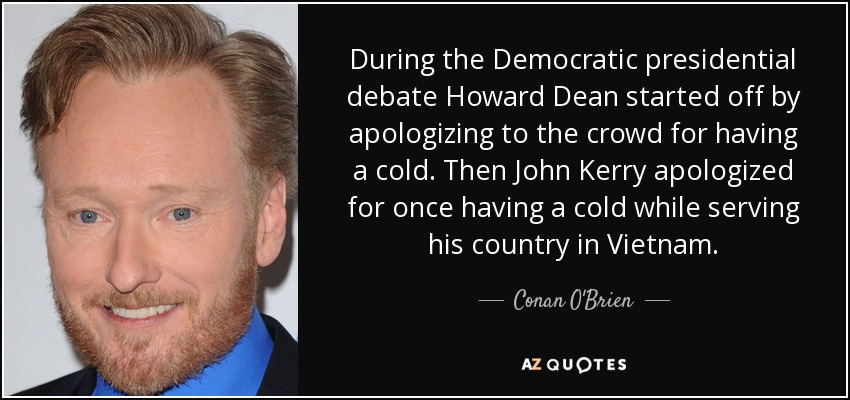
During the Democratic presidential debate Howard Dean started off by apologizing to the crowd for having a cold. Then John Kerry apologized for once having a cold while serving his country in Vietnam.
Fiction is a very powerful tool for teaching history. The Philippines was the first Iraq, the first Vietnam, the first Afghanistan, in the sense that it was the United States initial or baptismal experience in nation-building.
It is a damned sight easier to start wars than to end them. This truth has been stated for as long and as often as it has been ignored. High time and thank God, we are at least moving toward de-escalation in Vietnam. The road to extrication will be long, painful, bitter. But it must be trod. We are so bogged down in Vietnam that we cannot respond effectively anywhere else in the world to a military power play except through atomic bombardment.
The vast silence of Buddha overtakes and overrules the oncoming roar of tragic life that fills alleys and avenues; it blocks the way of pedicabs, police, convoys.
We forget now, but during his life, Dr. King wasn't always considered a unifying figure. Even after rising to prominence, even after winning the Nobel Peace Prize, Dr. King was vilified by many, denounced as a rabble rouser and an agitator, a communist and a radical. He was even attacked by his own people, by those who felt he was going too fast or those who felt he was going too slow; by those who felt he shouldn't meddle in issues like the Vietnam War or the rights of union workers.
For the past several years, I've been harboring a fantasy, a last political crusade for the baby-boom generation. We, who started on the path of righteousness, marching for civil rights and against the war in Vietnam, need to find an appropriately high-minded approach to life's exit ramp.
Power tends to corrupt. But the power in Washington resides in Congress, if it wants to use it. It can do anything-it can stop the Vietnam War. It can make its will felt, if it can ever get its act together to do anything.
When I first came to Washington in the 1960s, even at the height of the Vietnam War, until the end there in '68 there was a certain climate of cooperation. And then in the late sixties and in through the seventies, politics began getting more mean. And then from the eighties on it seemed to be institutionalized, this personal attack business. And I just hate it.
I think the Republicans and conservatives generally were alienated by America's unsuccessful effort in Vietnam, and a lot of them, as Henry Kissinger admitted the other day, never got over President Nixon's impeachment, and didn't think, even though there was a pattern of illegal conduct there, sanctioned by the White House and proved by the tapes and other documentary evidence and testimony, they didn't believe that the impeachment was justified, and they didn't think he should have resigned.
It would be good for the workers in Vietnam even as it helps make sure that they're not undercutting competition here in the United States.
What we do with this peace-whether we preserve it and defend it, or whether we lose it and let it slip away-will be the measure of our worthiness of the spirit and sacrifice of the hundreds of thousands who gave their lives in two World Wars, Korea, and in Vietnam.
If people become ecstatic the whole society will have to change, because this society is based on misery. If people are blissful you cannot lead them to war -- to Vietnam, or to Egypt, or to Israel. No. Someone who is blissful will just laugh and say: This is nonsense!
The American people today are involved in a warfare more deadly than the war in Vietnam, but few of them seem aware of it and even fewer of them are doing anything about it. This is a war that is being waged against the American environment, against our lands, air, and water, which are the basis of that environment.
I wrote, I think, half a dozen films that were completely out of genre. Comedies, love stories, even one serious film about Vietnam, and we couldn't get backing for any of it. And we both sort of drifted from making, at that time, serious money on Last House to going through it all in the course of almost three years and only getting offers to do something scary again.
There was a generation of kids who were just kind of emulating distant heroes and wearing peace symbols, and parents who were thinking of themselves as liberal and removed from barbarity, but it also was the era of Vietnam. I very much was influenced - and I think the whole country was kind of in a state of shock - for the first time seeing the horror and cruelty of war.
I'm a child of the '60s, I came of age then. I went to a couple of demonstrations, and then in the late '60s when the Vietnam anti-war movement grew as the Vietnam War was heating up, I became very involved in that.
Nixon's genius was that he was able to portray himself as the toughest of the anti-communists, and yet run on a platform that he had a plan to end the Vietnam War. And, of course, his plan was to prolong it until his second election - but he didn't tell us that then.
Before I became President, in the aftermath of the Vietnam War, there had been fairly dramatic, and I think excessive, reductions in the capability of our military forces, and as a former military man myself - I was a professional naval officer, a submarine officer - I thought it was better, on a step-by-step, very carefully planned way, to increase the technical, or technological, capability of our weapons systems.
Who cares what entertainers on the air think about international affairs? Who would want to hear me about Vietnam? They can hear all they want from people with reason to be respected as knowledgeable.
The whole thing about whether you smoke marijuana or not is so ridiculous. That and whether you protested the Vietnam War. Give me a break. Especially the marijuana thing.
I lost my athletic scholarship by injuring my right knee. That right knee kept me out of Vietnam, and I went into Drama. I put them all together with a football foundation and the house was built on Drama - and love and kindness and understanding and grace.
Yeah, I love living in New York, man, and people who live in New York, we wear that fact like a badge right on our sleeve because we know that fact impresses everybody! I was in Vietnam. So what? I live in New York!
The dichotomies, the brokenness of the culture around things like the Vietnam war, and then a lot of it has to do with war and where we put our energy and money and attention. And the military industrial complex, which dominates our whole economy. Even with the vision of democracy in other places we know the dark side.
I did go to Vietnam in 2000 as a kind of pilgrimage and to feel my generation was very much a part of this. I felt responsible but also connected and empathetic. It was a very complicated relationship we had, whichever side you were on. The shock of being there was very few people my own age - I was primarily in the North in the streets of Hanoi. A whole generation was essentially decimated.
Did you know that the percentage of young people in the crucial 'youthquake' age bracket of 15 to 24 was higher in 1973 than in 1967 ? Therefore it was glam rock that ended the war in Vietnam.
Follow AzQuotes on Facebook, Twitter and Google+. Every day we present the best quotes! Improve yourself, find your inspiration, share with friends
or simply: