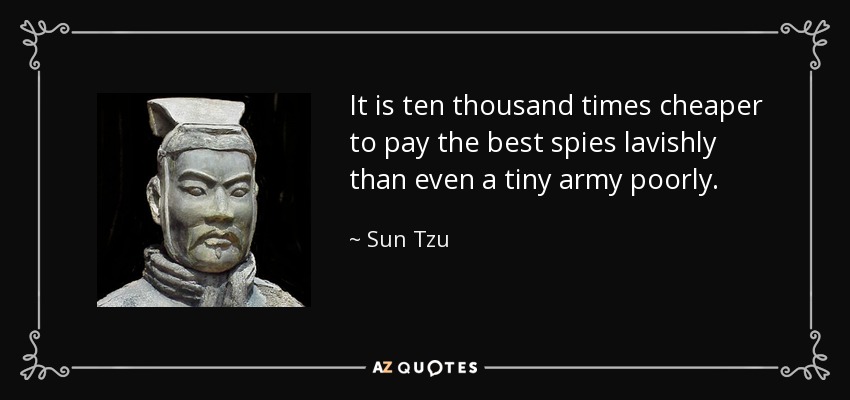
It is ten thousand times cheaper to pay the best spies lavishly than even a tiny army poorly.
So the important thing in a military operation is victory, not persistence.
The art of war teaches us to rely not on the likelihood of the enemy's not coming, but on our own readiness to receive him; not on the chance of his not attacking, but rather on the fact that we have made our position unassailable.
If asked how to cope with a great host of the enemy in orderly array and on the point of marching to the attack, I should say: "Begin by seizing something which your opponent holds dear; then he will be amenable to your will." Rapidity is the essence of war: take advantage of the enemy's unreadiness, make your way by unexpected routes, and attack unguarded spots.
What enables the wise sovereign and the good general to strike and conquer, and achieve things beyond the reach of ordinary men, is foreknowledge.
All warfare is based on deception. Hence, when able to attack, we must seem unable; when using our forces, we must seem inactive; when we are near, we must make the enemy believe we are far away; when far away, we must make him believe we are near.
And therefore those skilled in war bring the enemy to the field of battle and are not brought there by him.
Be subtle! be subtle! and use your spies for every kind of business.
Thus it is that in war the victorious strategist only seeks battle after the victory has been won, whereas he who is destined to defeat first fights and afterwards looks for victory.
If ignorant both of your enemy and yourself, you are certain to be in peril.
The clever combatant looks to the effect of combined energy, and does not require too much from individuals. Hence his ability to pick out the right men and utilize combined energy
What is of the greatest importance in war is extraordinary speed: One cannot afford to neglect opportunity.
There are routes not to be followed, armies not to be attacked, citadels not to be besieged, territory not to be fought over.
Attack where he is unprepared; sally forth when he does not expect you.
Thus the highest form of generalship is to balk the enemy's plans, the next best is to prevent the junction of the enemy's forces, the next in order is to attack the enemy's army in the field, and the worst policy of all is to besiege walled cities.
The skillful tactician may be likened to the shuai-jan. Now the shuai-jan is a snake that is found in the Ch'ang mountains. Strike at its head, and you will be attacked by its tail; strike at its tail, and you will be attacked by its head; strike at its middle, and you will be attacked by head and tail both.
Perfection in war lies in so sapping your opponents will that he surrenders without fighting.
Act after having made assessments. The one who first knows the measure of far and near wins - this is the rule of armed struggle.
Bring war material with you from home, but forage on the enemy... use the conquered foe to augment one's own strength.
All warfare is based on deception. If your enemy is superior, evade him. If angry, irritate him. If equally matched, fight and if not: split and re-evaluate.
Peace proposals unaccompanied by a sworn covenant indicate a plot.
Thus those skilled in war subdue the enemy's army without battle .... They conquer by strategy.
Fierce language and pretentious advances are signs that the enemy is about to retreat.
Knowledge of the enemy's dispositions can only be obtained from other men.
You can ensure the success of your attacks if you only attack places that are undefended. You can ensure the safety of your defense if you only hold positions that cannot be attacked. Therefore, that general is skillful in attack whose opponent does not know what to defend; and he is skillful in defense whose opponent does not know what to attack.
Follow AzQuotes on Facebook, Twitter and Google+. Every day we present the best quotes! Improve yourself, find your inspiration, share with friends
or simply: