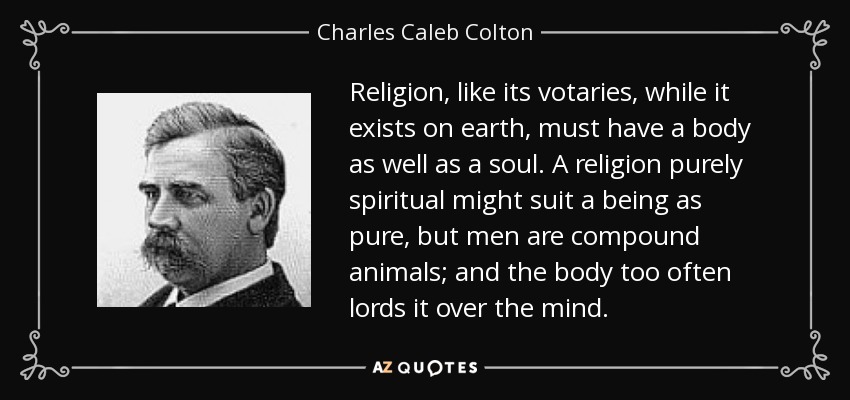
Religion, like its votaries, while it exists on earth, must have a body as well as a soul. A religion purely spiritual might suit a being as pure, but men are compound animals; and the body too often lords it over the mind.
God is on the side of virtue; for whoever dreads punishment suffers it, and whoever deserves it, dreads it .
Slight sorrow for sin is sufficient, provided it at the same time produces amendment.
Some well-meaning Christians tremble for their salvation, because they have never gone through that valley of tears and of sorrow, which they have been taught to consider as an ordeal that must be passed through before they can arrive at regeneration. To satisfy such minds, it may be observed, that the slightest sorrow for sin is sufficient, if it produce amendment, and that the greatest is insufficient, if it do not.
Some are cursed with the fullness of satiety; and how can they bear the ills of life when its very pleasures fatigue them?
The most notorious swindler has not assumed so many names as self-love, nor is so much ashamed of his own. She calls herself patriotism, when at the same time she is rejoicing at just as much calamity to her native country as will introduce herself into power, and expel her rivals.
There are too many who reverse both the principles and the practice of the Apostles; they become all things to all men, not to serve others, but themselves; and they try all things only to hold fast that which is bad.
If sensuality be our only happiness we ought to envy the brutes, for instinct is a surer, shorter, safer guide to such happiness than reason.
Shakespeare, Butler and Bacon have rendered it extremely difficult for all who come after them to be sublime, witty or profound.
The sceptic, when he plunges into the depths of infidelity, like the miser who leaps from the shipwreck, will find that the treasures which he bears about him will only sink him deeper in the abyss.
As we ascend in society, like those who climb a mountain, we shall find that the line of perpetual congelation commences with the higher circles; and the nearer we approach to the grand luminary the court, the more frigidity and apathy shall we experience.
It is in the middle classes of society that all the finest feeling, and the most amiable propensities of our nature do principally nourish and abound. For the good opinion of our fellow-men is the strongest though not the purest motive to virtue. The privations of poverty render us too cold and callous, and the privileges of property too arrogant and confidential, to feel; the first places us beneath the influence of opinion--the second, above it.
Those who have resources within themselves, who can dare to live alone, want friends the least, but, at the same time, best know how to prize them the most. But no company is far preferable to bad, because we are more apt to catch the vices of others than their virtues, as disease is far more contagious than health.
We submit to the society of those that can inform us, but we seek the society of those whom we can inform. And men of genius ought not to be chagrined if they see themselves neglected. For when we communicate knowledge, we are raised in our own estimation; but when we receive it, we are lowered.
It is curious that we pay statesmen for what they say, not for what they do; and judge of them from what they do, not from what they say. Hence they have one code of maxims for profession and another for practice, and make up their consciences as the Neapolitans do their beds, with one set of furniture for show and another for use.
Miss Edgeworth and Mme. de Stael have proved that there is no sex in style; and Mme. la Roche Jacqueline, and the Duchesse d'Angouleme have proved that there is no sex in courage.
Style is indeed the valet of genius, and an able one too; but as the true gentleman will appear, even in rags, so true genius will shine, even through the coarsest style.
When I meet with any persons who write obscurely or converse confusedly, I am apt to suspect two things; first, that such persons do not understand themselves; and secondly, that they are not worthy of being understood by others.
So blinded are we by our passions, that we suffer more to be damned than to be saved.
Villains are usually the worst casuists, and rush into crimes to avoid less. Henry VIII. committed murder to avoid the imputation of adultery; and in our times, those who commit the latter crime attempt to wash off the stain of seducing the wife by signifying their readiness to shoot the husband.
We are ruined, not by what we really want, but by what we think we do; therefore never go abroad in search of your wants; if they be real wants, they will come home in search of you; for he that buys what he does not want, will soon want what he cannot buy.
Wars are to the body politic, what drams are to the individual. There are times when they may prevent a sudden death, but if frequently resorted to, or long persisted in, they heighten the energies only to hasten the dissolution.
He that can please nobody is not so much to be pitied as he that nobody can please.
Short as life is, some find it long enough to outlive their characters, their constitutions and their estates.
The brightest thunder-bolt is elicited from the darkest storm.
Follow AzQuotes on Facebook, Twitter and Google+. Every day we present the best quotes! Improve yourself, find your inspiration, share with friends
or simply: