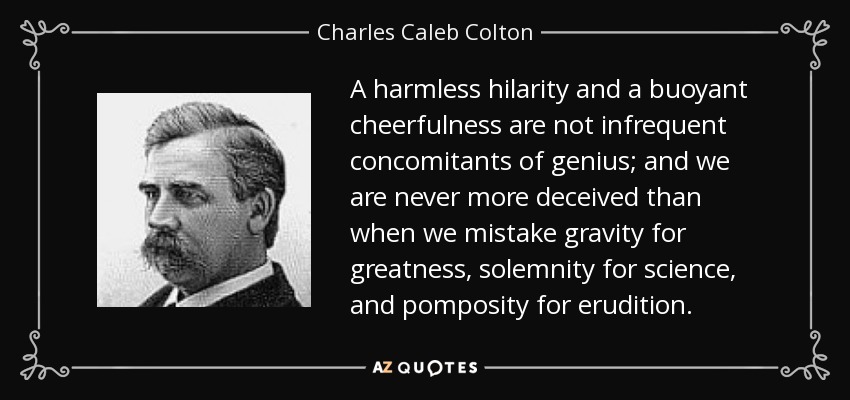
A harmless hilarity and a buoyant cheerfulness are not infrequent concomitants of genius; and we are never more deceived than when we mistake gravity for greatness, solemnity for science, and pomposity for erudition.
In the pursuit of knowledge, follow it wherever it is to be found; like fern, it is the produce of all climates, and like coin, its circulation is not restricted to any particular class.
Where we cannot invent, we may at least improve; we may give somewhat of novelty to that which was old, condensation to that which was diffuse, perspicuity to that which was obscure, and currency to that which was recondite.
As the rays of the sun, notwithstanding their velocity, injure not the eye, by reason of their minuteness, so the attacks of envy, notwithstanding their number, ought not to wound our virtue by reason of their insignificance.
The road to glory would cease to be arduous if it were trite and trodden; and great minds must be ready not only to take opportunities but to make them.
If we steal thoughts from the moderns, it will be cried down as plagiarism; if from the ancients, it will be cried up as erudition.
He [the miser] falls down and worships the god of this world, but will have neither its pomps, its vanities nor its pleasures for his trouble.
Women generally consider consequences in love, seldom in resentment.
Men of strong minds and who think for themselves, should not be discouraged on finding occasionally that some of their best ideas have been anticipated by former writers; they will neither anathematize others nor despair themselves. They will rather go on discovering things before discovered, until they are rewarded with a land hitherto unknown, an empire indisputably their own, both right of conquest and of discovery.
The consequences of things are not always proportionate to the apparent magnitude of those events that have produced them. Thus the American Revolution, from which little was expected, produced much; but the French Revolution, from which much was expected, produced little.
Time ... advances like the slowest tide, but retreats like the swiftest torrent.
Subtract from the great man all that he owes to opportunity, all that he owes to chance, and all that he gained by the wisdom of his friends and the folly of his enemies, and the giant will often be seen to be a pygmy.
Ignorance lies at the bottom of all human knowledge, and the deeper we penetrate, the nearer we arrive unto it.
Fame is an undertaker that pays but little attention to the living, but bedizens the dead, furnishes out their funerals, and follows them to the grave
Most of our misfortunes are more supportable than the comments of our friends upon them.
Where thou perceivest knowledge, bend the ear of attention and respect; But yield not further to the teaching, than as thy mind is warranted by reasons. Better is an obstinant disputant, that yieldeth inch by inch, Than the shallow traitor to himself, who surrendereth to half an argument.
Life is the jailer of the soul in this filthy prison, and its only deliverer is death.
Love, like the cold bath, is never negative, it seldom leaves us where it finds us; if once we plunge into it, it will either heighten our virtues, or inflame our vices.
There are some who write, talk, and think, so much about vice and virtue, that they have no time to practice either the one or the other.
Our incomes should be like our shoes, if too small, they will gall and pinch us, but if too large, they will cause us to stumble and to trip. Wealth, after all, is a relative thing, since he that has little and wants less is richer than he that has much but wants more. True contentment depends not upon what we have; a tub was large enough for Diogenes, but a world was too little for Alexander.
Antithesis may be the blossom of wit, but it will never arrive at maturity unless sound sense be the trunk and truth the root. CHARLES CALEB COLTON, Lacon; Or, Many Things in a Few Words Light, whether it be material or moral, is the best reformer; for it prevents those disorders which other remedies sometimes cure, but sometimes confirm.
When the air balloon was first discovered, some one flippantly asked Dr. Franklin what was the use of it. The doctor answered this question by asking another: "What is the use of a new-born infant? It may become a man."
It has been shrewdly said, that when, men abuse us we should suspect ourselves, and when they praise us, them. It is a rare instance of virtue to despise which censure which we do not deserve; and still more rare to despise praise which we do.
There is this difference between happiness and wisdom; he that thinks himself the happiest man, really is so; but he that thinks himself the wisest, is generally the greatest fool.
Make no enemies; he is insignificant indeed that can do thee no harm.
Follow AzQuotes on Facebook, Twitter and Google+. Every day we present the best quotes! Improve yourself, find your inspiration, share with friends
or simply: