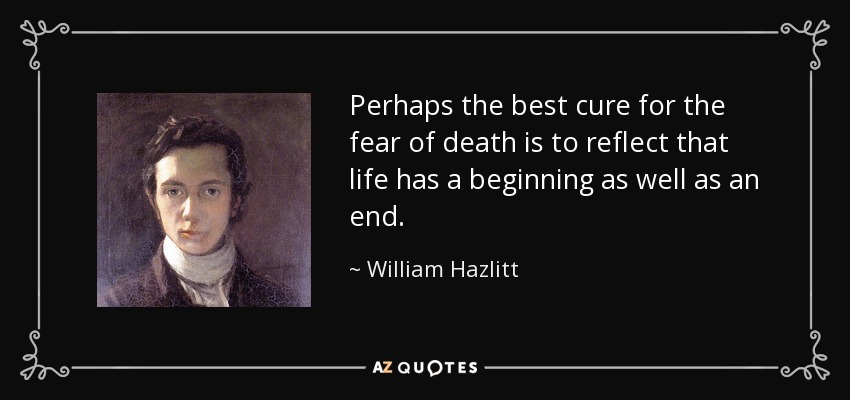



Perhaps the best cure for the fear of death is to reflect that life has a beginning as well as an end.
All is without form and void. Someone said of his landscapes that they were pictures of nothing and very like.
We cannot by a little verbal sophistry confound the qualities of different minds, nor force opposite excellences into a union by all the intolerance in the world. If we have a taste for some one precise style or manner, we may keep it to ourselves and let others have theirs. If we are more catholic in our notions, and want variety of excellence and beauty, it is spread abroad for us to profusion in the variety of books and in the several growth of men's minds, fettered by no capricious or arbitrary rules.
A man is a hypocrite only when he affects to take a delight in what he does not feel, not because he takes a perverse delight in opposite things.
Those who wish to forget painful thoughts do well to absent themselves for a while from, the ties and objects that recall them; but we can be said only to fulfill our destiny in the place that gave us birth.
Cant is the voluntary overcharging or prolongation of a real sentiment; hypocrisy is the setting up a pretension to a feeling you never had and have no wish for.
We do not like our friends the worse because they sometimes give us an opportunity to rail at them heartily. Their faults reconcile us to their virtues.
Silence is one great art of conversation. He is not a fool who knows when to hold his tongue; and a person may gain credit for sense, eloquence, wit, who merely says nothing to lessen the opinion which others have of these qualities in themselves.
Cowardice is not synonymous with prudence. It often happens that the better part of discretion is valor.
What passes in the world for talent or dexterity or enterprise is often only a want of moral principle. We may succeed where others fail, not from a greater share of invention, but from not being nice in the choice of expedients.
Man is a poetical animal, and delights in fiction.
A distinction has been made between acuteness and subtlety of understanding. This might be illustrated by saying that acuteness consists in taking up the points or solid atoms, subtlety in feeling the air of truth.
People do not persist in their vices because they are not weary of them, but because they cannot leave them off. It is the nature of vice to leave us no resource but in itself.
The vices are never so well employed as in combating one another.
There is some virtue in almost every vice, except hypocrisy; and even that, while it is a mockery of virtue, is at the same time a compliment to it.
I have known persons without a friend--never any one without some virtue. The virtues of the former conspired with their vices to make the whole world their enemies.
We prefer a person with vivacity and high spirits, though bordering upon insolence, to the timid and pusillanimous; we are fonder of wit joined to malice than of dullness without it.
A great chess-player is not a great man, for he leaves the world as he found it. No act terminating in itself constitutes greatness. This will apply to all displays of power or trials of skill, which are confined to the momentary, individual effort, and construct no permanent image or trophy of themselves without them
Charity, like nature, abhors a vacuum. Next to putting it in a bank, men like to squander their superfluous wealth on those to whom it is sure to be doing the least possible good.
Features alone do not run in the blood; vices and virtues, genius and folly, are transmitted through the same sure but unseen channel.
In some situations, if you say nothing, you are called dull; if you talk, you are thought impertinent and arrogant. It is hard to know what to do in this case. The question seems to be, whether your vanity or your prudence predominates.
The last pleasure in life is the sense of discharging our duty.
The great have private feelings of their own, to which the interests of humanity and justice must curtsy. Their interests are so far from being the same as those of the community, that they are in direct and necessary opposition to them; their power is at the expense of OUR weakness; their riches of OUR poverty; their pride of OUR degradation; their splendour of OUR wretchedness; their tyranny of OUR servitude.
It [will-making] is the latest opportunity we have of exercising the natural perversity of the disposition. This last act of our lives seldom belies the former tenor of them for stupidity, caprice, and unmeaning spite. All that we seem to think of is to manage matters so (in settling accounts with those who are so unmannerly as to survive us) as to do as little good, and to plague and disappoint as many people, as possible.
The admiration of power in others is as common to man as the love of it in himself; the one makes him a tyrant, the other a slave.
Follow AzQuotes on Facebook, Twitter and Google+. Every day we present the best quotes! Improve yourself, find your inspiration, share with friends
or simply: