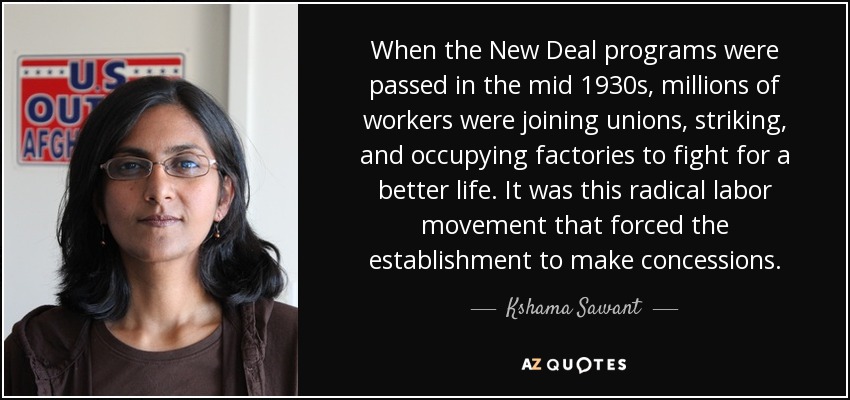
When the New Deal programs were passed in the mid 1930s, millions of workers were joining unions, striking, and occupying factories to fight for a better life. It was this radical labor movement that forced the establishment to make concessions.
The human species is now at a point where it has to make choices that are going to determine whether decent survival is even possible. Environmental catastrophe, including war, maybe pandemics, these are very serious issues and they can't be addressed within the current structure of institutions. That's almost given. There have to be real significant changes, and only really effective popular mass-based movements can introduce and carry forward such initiatives, as indeed did happen during the 1930s.
Labor has been severely undermined, but that's happened before. In the 1920s, the labor movement was virtually crushed, in large part by Wilson's Red Scare, but it dramatically revived in the 1930s. It spearheaded the social-democratic New-Deal style changes which were beneficial to the country - not sufficient, but beneficial. That could happen again.
I optioned a book called "Rare Objects" by Kathleen Tessaro and I'm adapting it . It takes place in the 1930s and it's about two women and that's what I'm working on to direct.
I was born in 1929, and in the 50 years from 1930 to 1980, I've been able to live an unbelievably varied century. Before, you could never have seen such intense change in a 50-year span.
All you have to do is read the business literature. In the 1930s they were very frightened and they were concerned about how the rising power of the masses was hazardous to industrialists.
They [unions] used straight Marxist rhetoric [in 1930s] - just the values were changed.
I think that Democrats have to think through answers we haven't in the past: How we are going to create those jobs? How should we restructure the entire tax code? Should we have things like a payroll tax, when jobs are so scarce? They weren't - basically the architecture of our employment law, tax law, all these things were from the 1930s - and I do think that one benefit of Donald Trump, which is not worth it, but one perverse thing is, he has widened the scope of things that we should discuss.
The rise of fascism in Europe sent most Americans home. Some black American communists who had emigrated to the Soviet Union perished in Stalin's purges of the late 1930s.
Definitely they [Adolf Hitler and Eva Braun] argued, especially in the period we've just been talking about, the middle 1930's. They were like any other couple.
The novelist now usurps the chair of the educator, the pulpit of the preacher, the columns of the journalist. Yet his original purpose of entertaining may have been his highest purpose. (introduction to Gladiator, Book League Monthly, 1930)
Economist Frederick Thayer has studied the history of our balanced-budget crusades and has come up with some depressing statistics. We have had six major depressions in our history (1819, 1837, 1857, 1873, 1893 and 1929); all six of them followed sustained periods of reducing the national debt. We have had almost chronic deficits since the 1930s, and there has been no depression since then - the longest crash-free period in our history.
I can't resist telling you that when the Vienna Economics Institute celebrated its centennial, many years ago, they invited, as their keynote speaker, my father [John Kenneth Galbraith]. The leading economists of the Austrian school- including von Hayek and von Haberler - returned for the occasion. And so my father took a moment to reflect on the economic triumphs of the Austrian Republic since the war, which, he said, "would not have been possible without the contribution of these men." They nodded - briefly - until it dawned on them what he meant. They'd all left the country in the 1930s.
It reminds me in some ways of the debate taking place in this country and around the world in the late 1930s. There were people, in this Congress, in the British Parliament saying, 'Don't worry! Hitler's not real! It'll disappear'.
The second assault on Fallujah was a monument to brutality and atrocity made in the United States of America. Like the Spanish city of Guernica during the 1930s, and Grozny in the 1990s Fallujah is our monument of excess and overkill.
The Holocaust would never have happened if black people lived in Germany in the 1930s and 40s … well, it wouldn't have happened to Jews.
The spring of 1930 marks the end of a period of grave concern...American business is steadily coming back to a normal level of prosperity.
Since the 1930s the technique of buying votes with the voters' own money has been expanded to an extent undreamed of by earlier politicians.
The relation of eugenics to British psychiatry bears examination. The primary controlling body for psychiatry in England is the British National Association for Mental Health (NAMH), formed in 1944, and initially run by the mentally unstable Montagu Norman, previously of the Bank of England. The group originally met at Norman's London home, where he and Nazi Economics Minister Hjalmar Schacht had met in the 1930s to arrange financing for Hitler.
Vaccination programs were instituted in the late 1930s, and the first handful of autistic babies were noted in the early 1940s. When vaccination programs were expanded after the war, the number of autistic children increased greatly.
The US and UK governments' relentless backing for the global spread of genetically modified seeds was in fact the implementation of a decades long policy of the Rockefeller Foundation since the 1930's, when it funded Nazi eugenics research - i.e. mass-scale population reduction, and control of darker-skinned races by an Anglo-Saxon white elite. As some of these circles saw it, war as a means of population reduction was costly and not that efficient.
In his 1930 book, Dirac took for granted that measurements could be made, but was very vague about what was actually involved.
Redistribution of wealth would require enormous amounts of investment. The only time an elite has accepted this has been during crises, such as in America in the 1930s under Roosevelt.
My ideal city is more like the city (New York and Paris come to mind, but it sort of applies to all) that existed up to and including the 1930s, when different classes lived all together in the same neighborhoods, and most businesses of any sort were mom-and-pop, and people and things had a local identity.
I think that when the education system started to be dismantled during the first Great Depression in the 1930s, we didn't recover from that.
Follow AzQuotes on Facebook, Twitter and Google+. Every day we present the best quotes! Improve yourself, find your inspiration, share with friends
or simply: