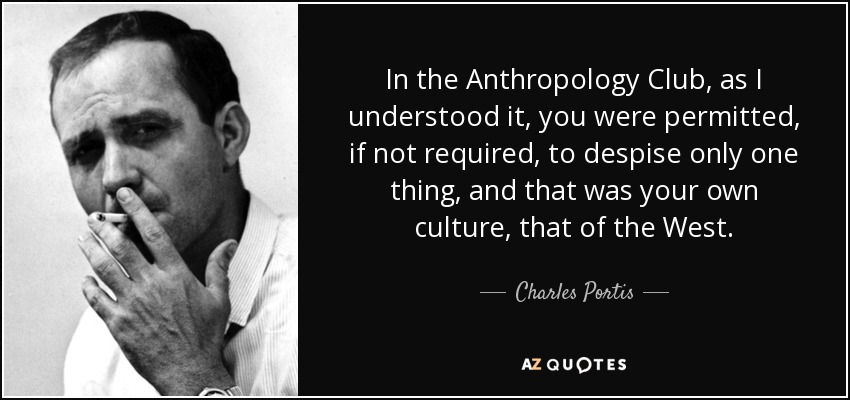
In the Anthropology Club, as I understood it, you were permitted, if not required, to despise only one thing, and that was your own culture, that of the West.
Ever since I was a kid, I've had an enormous interest in the sciences - everything from quantum physics to anthropology.
History is preoccupied with fundamental processes of change. If you are allergic to these processes, you abandon history and take cover in the social sciences. Today anthropology, sociology, etc, flourish. History is sick. But then our society too is sick
When I'm not governing my country any more, I'll go back to taking care of children. Or else I'll start studying anthropology - it's a science that's always interested me very much, also in relation to the problem of poverty. Or else I'll go back to studying history - at Oxford I took my degree in history. Or else...I don't know, I'm fascinated by the tribal communities. I might busy myself with them.
The Restless Anthropologist is a rich, powerful, and compulsively readable collection of essays by anthropologists who look back at the multiple relationships between their serial fieldwork experiences and their lives. Illustrating the dense interweaving of the personal and the professional that is the hallmark of anthropology as a vocation, these essays are at once affectively deep reflections, and clear-eyed assessments, of lives often lived 'between here and there.' Alma Gottlieb's idea to stimulate these articles and bring together this collection was inspired.
Depended on the soldier. To relax, most of them put on headphones or played video games. Later in the war some of the younger officers began to read a lot of anthropology because they realized that the basic problem was that they were trying to fight a war in a culture they didn't understand. They might have read someone like Margaret Mead.
Life became a science when interest shifted from the dissection of dead bodies to the study of action in living beings and the nature of the environment they live in.
I wanted to be a car mechanic and I wanted to race cars and the idea of trying to make something out of my life wasn't really a priority. But the accident allowed me to apply myself at school. I got great grades. Eventually I got very excited about anthropology and about social sciences and psychology, and I was able to push my photography even further and eventually discovered film and film schools.
In a world where concepts are so often deployed in an ad hoc fashion, half explored before being displaced by others, it is immensely refreshing to encounter such serious and sustained attention to the building blocks of inquiry—and to the responsibilities thereby incurred. Designs on the Contemporary is a work of profound importance to the philosophy of anthropology. In conjunction with Rabinow’s other works, it creates a nonpareil, a configuration of thought with no equal.
Because he did not have time to read every new book in his field, the great Polish anthropologist Bronislaw Malinowski used a simple and efficient method of deciding which ones were worth his attention: Upon receiving a new book, he immediately checked the index to see if his name was cited, and how often. The more "Malinowski" the more compelling the book. No "Malinowski", and he doubted the subject of the book was anthropology at all.
This is an extremely ambitious book. In addition to science and mathematics, Byers brings to bear insights from literature, philosophy, religion, history, anthropology, medicine, and psychology. The Blind Spot breaks new ground, and represents a major step forward in the philosophy of science. The book is also a page-turner, which is rare for this topic.
Margaret Mead was both a student of civilization and an exemplar of it. To a public of millions, she brought the central insight of cultural anthropology: that varying cultural patterns express an underlying human unity. She mastered her discipline, but she also transcended it. Intrepid, independent, plain spoken, fearless, she remains a model for the young and a teacher from whom all may learn.
I went to college to study drama where I discovered I had no talent and after a period of dropping out majored in cultural anthropology which of course meant more masks and dancing. I studied what interested me and so I had to become a writer because my education had left me unsuited for a decent well-paying job.
I wasn't reading it [the Bible] as literature. I was reading it as literature, and as history, and as a moral guide, and as anthropology and law and culture.
Missions is not applied anthropology, comparative religion or sociology. It is storming the gates of hell. It is a power confrontation-h and-to-hand combat with Satan and his demons.
I had a doctorate in biological anthropology. I got a post-doc at CWRU dental school in 1983 teaching gross anatomy.
As one recalls some of the monstrous situations under which human beings have lived and live their lives, one marvels at man's meekness and complacency. It can only be explained by the quality of flesh to become calloused to situations that if faced suddenly would provoke blisters and revolt.
Man is a free moral agent and can be magnanimous and deal disinterestedly, humanity is a definite goal, social justice is desirable and possible, individual lives may be gloriously diversified, uniquely individualized, and yet socially useful; or, these are mere phrases, snares to catch gulls, soothing syrup for our troubled souls.
The drive behind life has lost none of its power; proof that, impelled by that drive, man can build as well as destroy; that in his nature is more of Vishnu the Creator than of Siva the Destroyer.
I am perhaps more proud of having helped to redeem the character of the cave-man than of any other single achievement of mine in the field of anthropology.
I had just received my degree in Calcium Anthropology... the study of milkmen.
Among the various forms of science which are reaching and affecting the new popular tradition, we have reckoned Anthropology. Pleasantly enough, Anthropology has herself but recently emerged from that limbo of the unrecognised in which Psychical Research is pining.
I was a student in the Department of Anthropology. At that time, they were teaching that there was absolutely no difference between anybody. They may be teaching that still.
In 1989 I came to New York to go to the School of Visual Arts. Then, after two years, I switched over to the New School for Social Research and did cultural anthropology in the graduate school there.
My first job was actually as a social worker. And then later, I got my PhD in anthropology. And I've always been interested in humans as well as primates. We are all kind of have the same emotions, the same goals and lives really. But to me, when I first got to Madagascar I realized that the lemurs lives are very closely related to what the humans are doing; partially because they've got both looking for natural resources. And if we can make some way that both humans and lemurs can live together peaceably and happily, that would be my goal for Madagascar.
Follow AzQuotes on Facebook, Twitter and Google+. Every day we present the best quotes! Improve yourself, find your inspiration, share with friends
or simply: