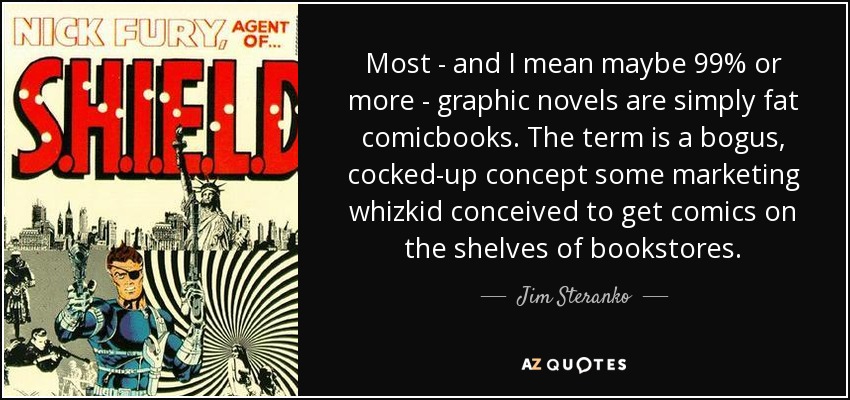
Most - and I mean maybe 99% or more - graphic novels are simply fat comicbooks. The term is a bogus, cocked-up concept some marketing whizkid conceived to get comics on the shelves of bookstores.
Nobody recognizes that a bookstore or library can also be a drowning polar bear. And in this country [US], magazines, newspapers, and bookstores are drowning polar bears. And if people can't see that or don't want to talk about it, I don't understand them at all.
I think it's easy to get a book in a bookstore. I think it's just damn near impossible to get a book out of a bookstore.
When I was a young comic in New York and I wasn't getting any work, I was wandering around the Lower East Side with my notebook. I would stop at the guitar place on St. Mark's and talk to that dude for a while, then I'd go to the bookstore and talk to that dude for a little while. I had a guy over at the record store, and I'd talk to him for a while. It kept me connected to life.
The best moment is when you walk into a bookstore and see a pile of your books - that is the oddest experience in the world!
I had some very, very fond memories of the people I worked with and the authors I worked with - and I won't mention any names - but as I have been traveling through rural Maine over the past few weeks, one of my favorite things to do is to go into bookstores on the side of rural routes and paw through the old copies of Tom Clancy and Trevanian books they have in there for weird old 1970s thrillers that I haven't read yet.
My first signing was at my hometown independent bookstore and everyone in the world came. It was so nice. My family was there, my parents, everybody I worked with, all my friends. So I had this great first reading with a like hundred people there.
The only bookstore I had was the paperback rack at the drugstore.
I just hate the whole idea of labeling anything as a comedy. If you tell me something's funny, I'll want to rebel against it. When I go to a bookstore and see books categorized as humor, I get furious. Don't tell me that a book is funny. Let me decide if it's funny. It's the same with sitcoms. You call something a sitcom and people expect it to be funny. And that ruins everything.
I was once almost forced off the stage at a large chain bookstore that shall remain nameless, because she introduced me as Lemony Snicket, and I immediately interrupted her and said, "Oh no, Lemony Snicket isn't here," and then she tried to cancel the event right then and there.
My main interest was finding boyfriends. I'd park myself in the bookstore and read with one eye on everyone coming in.
My father tried to get me to be around gay people a lot when I was young. He owned a gay bookstore and it had a lot of gay literature and art books and he wanted me to be taken care of by the young gays and lesbians who worked for him.
As far as Love Dare for Parents goes, you can download the book. You can buy it at bookstores...We're really excited about it and believe that it's going to make significant impact for parents.
There's an unwritten compact between you and the reader. If someone enters a bookstore and sets down hard earned money (energy) for your book, you owe that person some entertainment and as much more as you can give.
If you want to know who the oppressed minorities in America are, simply look at who gets their own shelf in the bookstore. A black shelf, a women's shelf, and a gay shelf.
Whatever art offered the men and women of previous eras, what it offers our own, it seems to me, is space - a certain breathing room for the spirit. The town I grew up in had many vacant lots; when I go back now, the vacant lots are gone. They were a luxury, just as tigers and rhinoceri, in the crowded world that is making, are luxuries. Museums and bookstores should feel, I think, like vacant lots - places where the demands on us are our own demands, where the spirit can find exercise in unsupervised play.
The fact that people go to Portland to visit a tiny feminist bookstore-no matter what the impetus is for them getting there-the fact that they go in there and look around and shop for books or stationery or whatever, is a major source of pride for me.
Excellence is THE trend of the '80s. Walk into any shopping mall bookstore, go to the rack where they keep the best-sellers such as Garfield Gets Spayed, and you'll see a half-dozen books telling you how to be excellent: In Search of Excellence, Finding Excellence, Grasping Hold of Excellence, Where to Hide Your Excellence at Night So the Cleaning Personnel Don't Steal It, etc.
It seems preposterous now, but Amazon began as a bookstore.
I always thought that television was the way to go in my goal to invade pop culture because it got to towns in which there were no bookstores. That's how I used to think of it: How do I reach kids who not only don't read but probably have no access to much in the way of books?
Some people, of course, say they're practicing tantra. There are a lot of books on tantric sexual practice in local bookstores. These are usually pretty silly books.
Age about 30, I stopped looking up my books in bookstores. Paying attention to the marketplace isn't a healthy thing for me.
I can understand the allure of a venerable Big Six imprint, of a shot at the New York Times list, of a publisher-sponsored book tour, of seeing your hardbacks in bookstores and your paperbacks in supermarkets.
Bookstores will not disappear but will exploit digital technologies to increase their virtual and physical inventories, and perhaps become publishers themselves.
An author is a person who can never take innocent pleasure in visiting a bookstore again.
Follow AzQuotes on Facebook, Twitter and Google+. Every day we present the best quotes! Improve yourself, find your inspiration, share with friends
or simply: