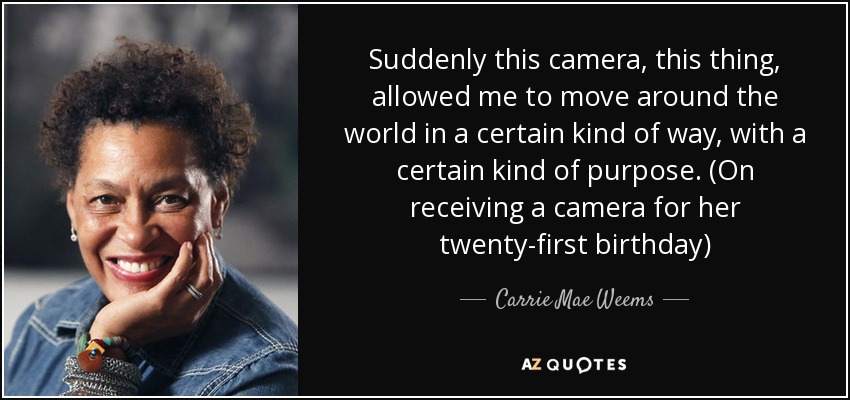
Suddenly this camera, this thing, allowed me to move around the world in a certain kind of way, with a certain kind of purpose. (On receiving a camera for her twenty-first birthday)
Considering that knowledge of the chemical as well as the optical principles of photography was fairly widespread following Schulze's experiment (in 1725)... the circumstance that photography was not invented earlier remains the greatest mystery in its history... It had apparently never occurred to any of the multitude of artists of the seventeenth and eighteenth centuries who were in the habit of using the camera obscura to try to fix its image permanently.
I could take a cow and implant a camera in it and let it amble around the city or in its own domain (I say a cow because a human being I would not trust). If the camera was programmed to go off at an indeterminate series of moments, the samplings would be fantastic.
I just picked up a camera without any kind of ambition to be good or bad. And especially without any ambition to make a living... My whole freedom working in photography comes because I say to myself, Let's see what is going on in this world. Let's find out. How do these people look?
The same camera that photographs a murder scene can photograph a beautiful society affair at a big hotel.
The dominant problem of pictorial art since the nineteen-fifties is photography, and, by extension, film and video. The basilisk eye of the camera has withered the pride of handworked mediums. Painting survives on a case-by-case basis, its successes amounting to special exemptions from a verdict of history.
We used the camera only as a means of expression and as a visual medium that offers possibilities found in no other artistic technique, possibilities that the eye cannot catch in their totality. We tried to establish a characteristic vision of photography.
I hope we'll be able to see that in our lifetime: the end of the camera! When I'm in Paris, I'll buy a big bottle of champagne and I'll save it for that day, for the day when they'll be no more camera.
Often what is nearest is hardest of all to see - try asking a fish to define water. Distance opens a door to revelation. When the first great distances of space were conquered by technology, a camera altered the human perspective on the Earth as radically as Galileo did when he proved the sun was the center of the universe. The ecology movement was born from a photographically altered consciousness.
Most screenplays, most motion pictures, owe much more to the screenplay. Ingmar Bergman has such an economy of language, so little language in his piece, it is so visual, his moods are introduced and buttressed by camera rather than by word or character. But again, that's unique.
Great claims are being made for the photograph as truth. We are showing you things, we show you the war. I say you can't actually. The camera can't.
There is a tradition of television which isn't dross and stands up. Betjeman's programmes, which were made for 2/6d with one man and a cine camera, were amazing to watch because he was such a great talker.
I expect that people are going to feel differently about that once they're aware that AI systems can watch through a camera and can, in some sense, understand what it's seeing.
In Slumdog Millionaire when you are immersed in the point of view of children in the slum and the bustle of the city, the handheld camerawork is amazing. A handheld camera is perfect for establishing point-of-view and for instilling the feeling that you are there.
I don't think there is any advantage to digital unless it's in a case like Slumdog Millionaire, where you have to get a shot and a big bulky film camera is out of the question.
I think Instagram at its best is where you feel like you're getting the most authentic version of the person on the other side of the camera.
Modeling's terrifying to a lot of people. Standing in front of a camera is terrifying. I like a challenge.
The biggest considerations I had were practical: how do you move such a large number of actors around a small space? So, for example, if I have to have the mother bring a pot of tea from the kitchen to the living room and serve it to the others, how do I, on a practical level, get everyone into the frame? Any decisions I made about the camera angles or movement came out of necessity, versus any sort of stylistic choice.
I found my father's Super8mm film camera when I was around eight years old and started shooting with it. I had no idea what I was doing at the time, but that's really where my filmmaking began.
Most of the people I've been fortunate enough to work with all share the same passion for creativity, for ingenuity, for playing make-believe and really just having fun. It doesn't matter if we're blowing up cars, or shooting an emotional scene in a police station, deep inside we all know our imaginations are at work, and our imaginations are manifesting into reality - at least momentarily for the cameras to capture.
I have produced all my music videos. Love to get behind the camera and get involved in the editing process.
I look at it scene-by-scene. Whether it's a historical character or not, whatever, on the page is one thing and delving into the history or somebody is one thing, but making something work for an audience in front of a camera is another exercise and you bring whatever authenticity you can to it.
Improv is not something I had a lot of experience with, because for a long time, my only experience in front of a camera was all television, which is pretty rigid script-wise, except for the occasional scene where you toss in an ad-lib just to elongate something.
You don't want to say somebody did a great job of acting. You want to say, "Where did he find that person? How did he get that factory worker to come out of the factory and be on camera?" You want to believe that person is real.
When you're directing you're kind of interested in the movie and the story and the characters. I just sort of prefer the really tough fighting and some of the other street fighting type moves. You know, where it's not just show. It's not dressing it up for the cameras too much. It's pretty down and dirty, the way it should be. That's something I like to do. I do that.
Follow AzQuotes on Facebook, Twitter and Google+. Every day we present the best quotes! Improve yourself, find your inspiration, share with friends
or simply: