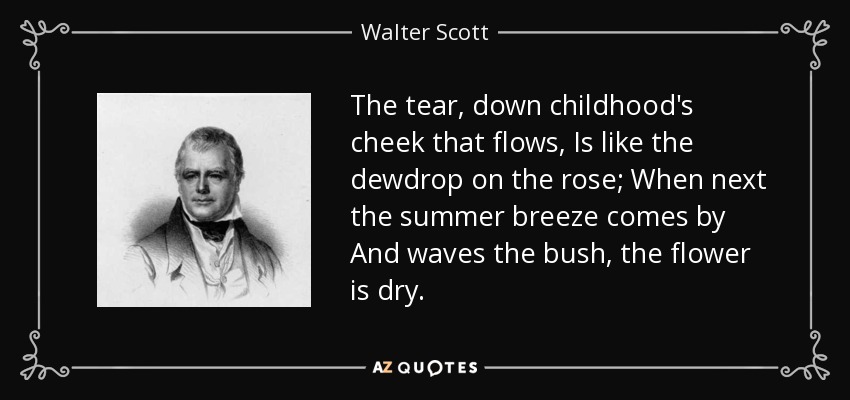
The tear, down childhood's cheek that flows, Is like the dewdrop on the rose; When next the summer breeze comes by And waves the bush, the flower is dry.
A Dream of Undying Fame is a probing, elegant and balanced book. Louis Breger shows how Freud’s traumatic childhood shaped his ambitious, detached and authoritarian personality, and led to the betrayal of his mentor, Josef Breuer. Breger’s analysis exposes a fascinating paradox: Freud both invented psychoanalysis and impoverished its development. A must-read for everyone interested in how ideas can change the world.
Poetry is one of the few nasty childhood habits I've managed to grow out of
My first record was about childhood. There were a lot of nursery rhyme and fairytale references; it was all about being naive.
O happy childhood! blessed youth! But once we know thy potent power; But once we live all careless free; No cross to mar our love-lit bower.
I spent my childhood alone, overweight and ugly, angry at everything, and knowing nothing of a life beyond this sadness.
I went one afternoon to the church of my childhood and had a vision of what I must have really meant with "Beat"... the vision of the word Beat as being to mean beatific... People began to call themselves beatniks, beats, jazzniks, bopniks, bugniks and finally I was called the "avatar" of all this.
You get the feeling that childhood does not last as long as it used to. Innocence gets harder to hold on to as the world gets older, as it accumulates more experience, more mileage and more blood on the tracks.
What is patriotism but love of the good things we ate in our childhood? I have said elsewhere that the loyalty to Uncle Sam is the loyalty to doughnuts and ham and sweet potatoes and the loyalty to the German Vaterland is the loyalty to Pfannkuchen and Christmas Stollen. As for international understanding, I feel that macaroni has done more for our appreciation of Italy than Mussolini... in food, as in death, we feel the essential brotherhood of mankind.
We wove a web in childhood, A web of sunny air; We dug a spring in infancy Of water pure and fair; We sowed in youth a mustard seed, We cut an almond rod; We are now grown up to riper age Are they withered in the sod?
This is a book that respects kids and their ideas. And in that regard, it places Chasing Vermeer in the tradition of classic favorites fondly recalled from our own childhoods.
My whole childhood was filled with classical music and going to concerts of the New York Philharmonic and other New York ensembles and organizations, but interestingly, I didn't become conscious of wanting to be a musician until I was about 11. I was a rather late starter.
The Gap has always been an iconic, go-to brand that reminds me of my childhood.
Anyone who has read Yeats's wonderful Autobiography will remember his Sligo shabby, shadowed, half country and half sea, full of confused romance, superstition, poverty, eccentricity, unrecognized anachronism, passion and ignorance and the little boy's misery. Yeats was treated well but was bitterly unhappy; he prayed that he would die, and used often to say to himself: "When you are grown up, never talk as grown-up people do of the happiness of childhood.
How few of us appreciate the fact that a very great deal of physical suffering in after life comes from bad mental training in childhood! I do not mean suffering of an imaginary kind; I mean disease which may entirely ruin a life which might have been of use to the world, and which surely would have been happier but for the lost health. Many a chronic invalid might have preserved his health had he been taught to use his brain properly when a child.
It seems like a cliche, but you do grow up a lot faster when you travel a lot, go through things like this interview, spend time away from home and hang around with other actors. It's inevitable that you're not going to have a so-called normal childhood.
The seen and seeing softly mutually strike Their glass barrier that arrests the sight. But the world's being hides in the volcanoes And the foul history pressed into its core; And to myself my being is my childhood And passion and entrails and the roots of senses; I'm pressed into the inside of a mask At the back of love, the back of air, the back of light.
I had been riding horses before my memory kicked in, so my life with horses had no beginning. It simply appeared from the fog of infancy. I survived a difficult childhood by traveling on the backs of horses, and in adulthood the pattern didn't change.
Old age is second childhood.
To me the early childhood story is an ecumenical one. You take poverty seriously. You take seriously maternal depression. You take seriously children under stress and you take seriously the effects of extended hours participation in poor quality care. Those are the facts I begin with.
For all its material advantages, the sedentary life has left us edgy, unfulfilled, even after 400 generations in villages and cities, we haven't forgotten: The open road still softly calls like a nearly forgotten song of childhood.
Whole great chunks of written history are of little value to the psychohistorian, while other vast areas which have been much neglected by historians - childhood history, content analysis of historical imagery, and so on - suddenly expand from the periphery to the center of the psychohistorian's conceptual world, simply because his or her own new questions require material nowhere to be found in history books.
Everyone has a bizarre childhood and unusual life experiences, whether they know it or not. There's no such thing as a normal childhood. What's useful in writing weird fiction is learning how to understand and articulate those moments of personal, particular strangeness.
You don't know the things in your childhood that influence you. You can't possibly know them. People today try to analyze the early environment and the reasons for something that happened, but if you look at children of the same family -- children who have identical parents, go to identical schools, have an almost identical upbringing, and yet who have totally different experiences and neuroses -- you realize that what influences the children is not so much the obvious externals as their emotional experiences. Of course any psychiatrist knows that.
We were so poor as kids. I didn't even see a bathtub, running water, hot water, commode - we didn't have any of that. We started with a humble log house, milk cow, garden-raised our own food, killed a hog every year in the fall, and had the meat hanging up in the smokehouse - that was our childhood, me and ol' Si.
Follow AzQuotes on Facebook, Twitter and Google+. Every day we present the best quotes! Improve yourself, find your inspiration, share with friends
or simply: