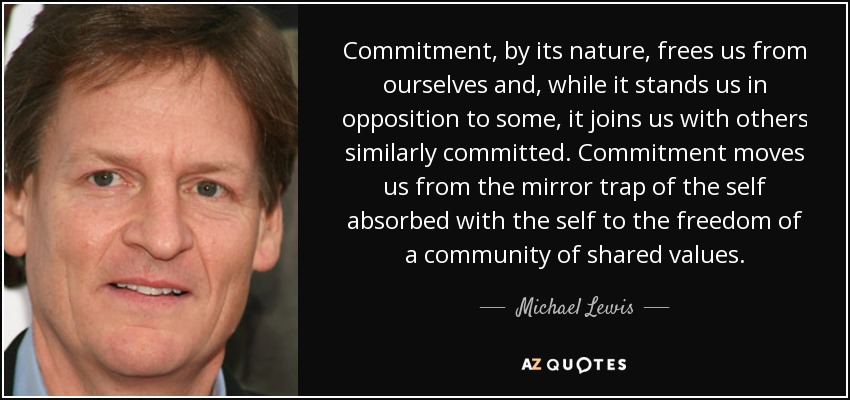
Commitment, by its nature, frees us from ourselves and, while it stands us in opposition to some, it joins us with others similarly committed. Commitment moves us from the mirror trap of the self absorbed with the self to the freedom of a community of shared values.
It's hard to propose a $100 laptop for a world community of kids and then not say in the same breath that you're going to depend on the community to make software for it.
I believe each individual is naturally entitled to do as he pleases with himself and the fruit of his labor, so far as it in no wise interferes with any other mans rightsthat each community, as a State, has a right to do exactly as it pleases with all the concerns within that State that interfere with the right of no other State, and that the general government, upon principle, has no right to interfere with anything other than that general class of things that does concern the whole.
It is my belief that whereas the twentieth century has been a century of war and untold suffering, the twenty-first century should be one of peace and dialogue. As the continued advances in information technology make our world a truly global village, I believe there will come a time when war and armed conflict will be considered an outdated and obsolete method of settling differences among nations and communities.
The intelligence community, for the most part, has no accountability at all; to the Congress, to us the American people, and so they feel that they above the law.
As I look back over my mountains of growth and compare them to the molehills where I stagnated, community often made the difference.
The overall picture, as the boys say, is of a degraded community whose idealism even is largely fake. The pretentiousness, the bogus enthusiasm, the constant drinking, the incessant squabbling over money, the all-pervasive agent, the strutting of the big shots (and their usually utter incompetence to achieve anything they start out to do), the constant fear of losing all this fairy gold and being the nothing they have never ceased to be, the snide tricks, the whole damn mess is out of this world.
There's a reason why every human society has fiction. It teaches us how to be 'good,' to behave in a way that is for the benefit of the whole community.
Science is a way of thinking much more than it is a body of knowledge. Its goal is to find out how the world works, to seek what regularities there may be, to penetrate to the connections of things-from subatomic particles, which may be the constituents of all matter, to living organisms, the human social community, and thence to the cosmos as a whole.
Acting a part is not always synonymous with lying; it is far often the best way of serving the truth. It is more truthful to act what we should feel if the community is to be well served rather than behave as we actually do feel in our selfish private feelings.
In a day of footloose movements of people and of mixed marriages in the ancestry of the most desirable elements of the community we preach unabashed the gospel of the pure race.
For decades, community colleges have been the backbone of American workforce training. Because they are nimble and closely attuned to local community needs, they are inherently positioned to be influential leaders of the movement for a sustainable economy.
The great virtue of free enterprise is that it forces existing businesses to meet the test of the market continuously, to produce products that meet consumer demands at lowest cost, or else be driven from the market. It is a profit-and-loss system. Naturally, existing businesses generally prefer to keep out competitors in other ways. That is why the business community, despite its rhetoric, has so often been a major enemy of truly free enterprise.
If the private sectors are about markets and the public sectors are about governments, then the plural sector is about communities.
People are not fundamentally bad. It only takes the smallest of correctives to take care of that tiny minority that wants to disrupt the community.
Franchises and chains have come to dominate small communities, but those same chains have eliminated a lot of the greasy spoons, places you didn't want to eat in the first place.
We have to deal with where we are. We have to create cooperatives, we have to create intentional communities, we have to work for local cooperation where we are.
In the city one clings to nostalgic and unreal signs of community, takes forced refuge in codes, badges and coteries; the city's life, of surfaces and locomotion, usually seems too dangerous and demanding to live through with any confidence.
A community receives light from its history, it becomes aware of itself by remembrance of its history.
No scientist knows the world merely by holding it at arm's length: if we ever managed to build the objectivist wall between the knower and the known, we could know nothing except the wall itself. Science requires an engagement with the world, a live encounter between the knower and the known. That encounter has moments of distance, but it would not be an encounter without moments of intimacy as well. Knowing of any sort is relational, animated by a desire to come into deeper community with what we know.
We want someone else to act. But miracles aren't what other people do. They're what each of us does. They're what happens when ordinary people take extraordinary action. To be a miracle doesn't mean you have to tackle problems across the globe. It means making a difference in your own living room, cubicle, neighborhood, community.
The Olympic movement simply cannot allow the Russians to become estranged, because Russia is a vital part of the world sports community, in the sense of having nuclear missiles.
Once the threshold is crossed when there is a self-sustaining level of life in space, then life's long-range future will be secure irrespective of any of the risks on Earth. Will this happen before our technological civilization disintegrates, leaving this as a might-have-been? Will the self-sustaining space communities be established before a catastrophe sets back the prospect of any such enterprise, perhaps foreclosing it forever? We live at what could be a defining moment for the cosmos.
The question to ask is whether the risk of traveling to space is worth the benefit. The answer is an unequivocal yes, but not only for the reasons that are usually touted by the space community: the need to explore, the scientific return, and the possibility of commercial profit. The most compelling reason, a very long-term one, is the necessity of using space to protect Earth and guarantee the survival of humanity.
Human communication, 'as the saying goes, is a clash of symbols' it covers a multitude of signs. But it is more than media and messages, information and persuasion; it also meets a deeper need and serves a higher purpose. Whether clear or garbled, tumultuous or silent, deliberate or fatally inadvertent, communication is the ground of meeting and the foundation of community. It is, in short, the essential human connection.
Follow AzQuotes on Facebook, Twitter and Google+. Every day we present the best quotes! Improve yourself, find your inspiration, share with friends
or simply: